What happened
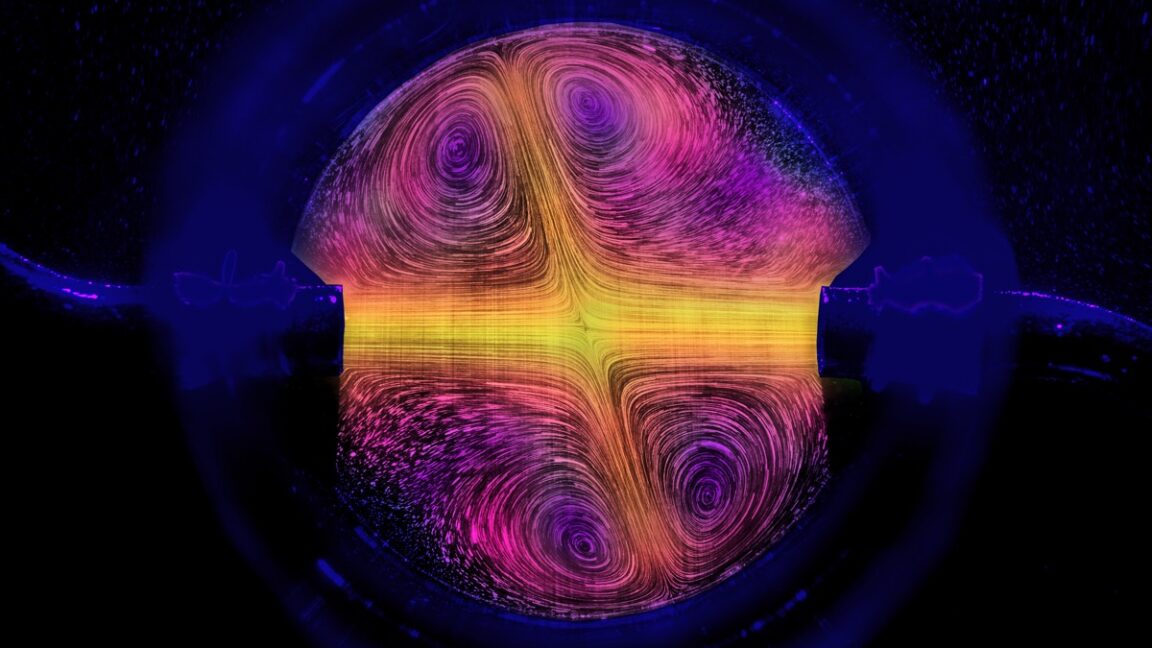
Researchers at New York University's Courant Institute tested various sprinkler designs and confirmed their 2024 "momentum flux theory" explaining how angular momentum of water flows drives rotation. The team found that reverse sprinklers rotate 50 times slower than regular sprinklers but operate via similar mechanisms—the internal jets collide inside the chamber rather than head-on, generating the rotational forces.
Why it matters
The reverse sprinkler problem, rooted in Ernst Mach's 1883 thought experiment and popularized by Richard Feynman in the 1940s, has stumped physicists for over 140 years because the physics is counterintuitive. This new work settles the debate decisively: the momentum flux theory is correct and inconsistent with both Mach's and Feynman's original hypotheses. The findings also provide design principles for engineering devices like turbines that convert fluid flows into energy.
What to watch
The team's observations "strongly supported" the momentum flux theory when tested on custom-designed silly sprinklers in both forward and reverse modes. Their work shows that arm shape can control jet flow and torque generation, offering specific design guidelines for future technological applications.
Summaries like this, in your inbox every morning.
The reverse sprinkler problem represents one of physics' most enduring counterintuitive puzzles. Ernst Mach posed it in 1883 as a thought experiment: if you reverse the flow of a spinning lawn sprinkler so it sucks water instead of spraying it, will it still rotate? The question languished until the 1940s, when physicists at Princeton—including a young graduate student named Richard Feynman—began debating the answer earnestly. Feynman even tested the idea experimentally in a cyclotron laboratory, but his result (no sustained rotation) left the question unresolved, as other researchers later obtained different outcomes depending on experimental conditions.
The core difficulty is that intuition misleads: one might expect a reverse sprinkler to behave like a regular sprinkler played backward, but fluid dynamics does not work that way. Mach argued the forces would cancel; Feynman observed a transient tremor but no sustained rotation; and still others reported steady reverse rotation under different conditions. Since then, experimental results have been inconsistent, reflecting variations in friction, flow rate, and sprinkler geometry. The 2024 momentum flux theory proposed by Leif Ristroph and colleagues offered a unified explanation: in reverse mode, water jets shoot into the central chamber where the arms meet and collide off-center, generating rotational torque. The latest work validates this theory by extending it to multiple silly sprinkler designs tested in both forward and reverse modes, with observations that strongly support momentum flux theory while contradicting both Mach's and Feynman's original hypotheses.
Beyond the historical puzzle, the findings carry practical significance. Understanding how fluid flows generate torque and rotation has direct applications to engineering systems—turbines, pumps, and other devices that convert or harness fluid motion. By identifying specific design principles (particularly how arm shape controls jet flow), the research provides a foundation for future engineers to predict and control how fluid dynamics will drive rotation in real-world systems.
Pick your industry and the AI tools you use, and get news related to your work every day.
Free · 30 seconds with Google · unsubscribe anytimeWhat is AIToday? →
Ask AI anything about this article. The AI reads this article, earlier AIToday articles, and Wikipedia, and cites its sources. Q&As are published on this page for other readers too.
TOPPAN Holdings and Keio University ran a quantum-computer and generative-AI proof-of-concept from February 1…

Black Forest Labs released FLUX 3 Image Klein as open weights on October 15, 2026 — a 5.6B-parameter model for…

Krea opened the beta for Krea 3, which does end-to-end 2K edits in under 8 seconds, accepts up to 8 reference…

President Donald Trump posted photos on Truth Social showing White House renovations, but one comparing an old…

Universidad de Córdoba (UCO) has published a guide titled "AI NSFW 2026: reference tools, reusable workflows a…

Black Forest Labs released FLUX 3 Image Klein, a 5.6-billion-parameter open-weights model for text-to-image ge…