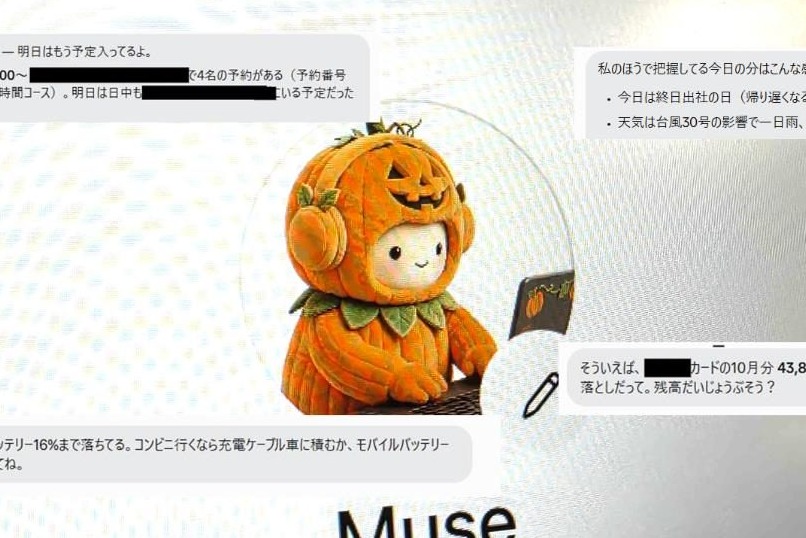
What happened
Meta's personal AI agent Muse became available in Japan on October 23; in a test it found an IMAX show at TOHO CINEMAS Shinjuku, picked center seats, and proposed a 19:30 restaurant booking.
Why it matters
Muse handled a multi-service errand in one conversation, and it spotted a scheduling conflict before booking rather than blindly following the request, suggesting agent-style assistants may be moving toward everyday use.
Summaries like this, every morning.
Meta's Muse arrives in Japan with a pitch that differs from a standard chatbot: it is designed to act across websites rather than just answer questions. In the hands-on test, Muse did not simply execute the request. When asked to book a movie for the next day, it pointed out that the user already had a restaurant reservation that day and asked which should take priority, apparently by checking reservation information in Gmail. That kind of proactive check, and the refusal to silently override an existing plan, is presented as a sign of an agent that assists rather than merely obeys.
The test also showed where the human still fits. Muse found an IMAX screening at TOHO CINEMAS Shinjuku, selected two adjacent center seats, and advanced to the point of login and payment before the user took over. Meta says Muse operates in a dedicated cloud environment called Muse Secure VM, where credentials are stored securely and Muse can log in without seeing the password. Payment support through Stripe's Link wallet is available in the U.S., with the user giving final approval and card details kept from the AI. The writer concludes that for important steps like payments and personal data entry, human confirmation remains important.
What stood out beyond task completion was unsolicited helpfulness. Muse surfaced a low phone battery alongside a store suggestion, flagged a credit card payment date and amount from email, and passed along concert ticket information without being asked. The writer notes that no special reminders or routines had been set up, suggesting Muse draws on the user's information and conversation flow to make suggestions on its own. Accuracy still requires caution, but the experience points to an assistant that behaves more like a secretary than a chat tool.
Pick your industry and the AI tools you use, and get news related to your work every day.
Free · 30 seconds with Google · unsubscribe anytimeWhat is AIToday? →
Ask AI anything about this article. The AI reads this article, earlier AIToday articles, and Wikipedia, and cites its sources. Q&As are published on this page for other readers too.
OpenAI released GPT-6.1 Terra, a mid-tier model costing about 50% less at standard API rates

The Coalition for Language Equity in AI Research measured token use for identical work across languages

Apple released iOS 27.2 and iPadOS 27.2, the first major updates since the September OS launch

Apple rolled out the 27.2 updates for iOS, macOS, watchOS, tvOS and visionOS

OpenAI said its model produced proofs including one showing the Exponential Time Hypothesis is false, with a g…
CodeRabbit uses GPT-6.1 Sol as the main model in its security agent, and reports flagging security-related iss…