Meta reported disappointing revenue guidance while announcing plans to spend $145 billion on AI infrastructure this year, including a potential new cloud computing business.
The company faces a timing crunch: it is renting expensive computing capacity from third parties now to avoid falling behind in the AI race, while simultaneously building its own data centers for future use—yet has no clear near-term way to recoup these costs.
Investors are skeptical, particularly because Meta's core ad business, though still growing faster than competitors, showed weaker momentum than the previous quarter, making it harder to justify massive AI spending on fundamentals alone.
What happened
Meta reported disappointing quarterly revenue guidance and the lowest free cash flow in years, driven by ballooning expenses for AI data centers and smart glasses projected to reach $145 billion annually. CEO Mark Zuckerberg also announced Meta is considering a new cloud computing business, selling spare computing power to other companies at a premium.
Why it matters
Meta is spending heavily on AI infrastructure while its core ad business—though still growing faster than competitors—is showing signs of strain; expenses jumped 55% while revenue rose only 28%, forcing the company to justify its AI investments on future potential rather than current returns. Investors worry Meta is caught in a timing bind: renting expensive computing capacity from third parties now while building its own data centers for years ahead, without a clear path to monetize these investments.
What to watch
Meta has already committed nearly $700 billion in future spending through long- and short-term agreements, including $349.3 billion in non-cancelable contractual commitments and $347 billion in future lease obligations (with $68 billion added in July alone, with payments starting in 2027 and 2028). The company's ability to launch credible new revenue lines—cloud services, consumer chatbot subscriptions, and enterprise tools—will determine whether investors accept the spending.
Meta's fourth-quarter results triggered an 8% stock decline to $539.03 after the company gave a disappointing revenue forecast and reported its lowest free cash flow in years. The core problem is scale of spending: expenses rose 55% while revenue increased only 28%, driven by a planned $145 billion outlay this year on AI data centers, cloud infrastructure, smart glasses, and related technology. The company is struggling to convince investors it will recoup this spending, especially because Meta lacks a cloud-computing business and its AI products have at times been rated less competitive than offerings from OpenAI and Anthropic.
Zuckerberg is pursuing multiple hedges. On the earnings call, he announced a potential new business line: selling computing power to other companies. He said Meta currently dedicates a "substantial" amount of its computing capacity to training its own AI models—a necessity for leading AI labs—but has received a "large number of offers" from companies willing to buy that power at a "meaningful premium" over Meta's acquisition cost. This creates a calculus: should Meta sell the compute for profit, or use it for its own products and services? Complicating that choice is the fact that Meta is simultaneously renting computing power from independent data-center operators ("neoclouds") to meet current demand while its own data-center buildout proceeds.
The underlying timing issue is severe. Last summer, when Zuckerberg realized Meta risked falling behind in the AI race, the company had no choice but to scramble for rented capacity; building data centers takes multiple years, a timeline Meta did not have. But this creates a commitment problem: Meta has already pledged almost $700 billion in future spending through long- and short-term agreements. Of this, $349.3 billion consists of non-cancelable contractual commitments mostly for third-party cloud deals, servers, and network infrastructure. An additional $347 billion is committed to future lease obligations not yet reflected on the balance sheet—including $68 billion added in July alone, with payments beginning in 2027 and 2028. The company is thus locked into years of infrastructure costs before its own facilities come online and before it has a clear path to profitable cloud services revenue.
When an analyst asked why Meta could not simply rely on open-source models, Zuckerberg responded that frontier models remain stronger than open-source alternatives and that depending on other companies' decisions is risky for a major platform. He then reframed Meta's strategy: the company is not merely a social-media-and-advertising business but a "full stack technology company" that builds its own data centers, chips, and low-level software. This vertical integration, he argued, enabled Facebook's early speed and efficiency and is now essential for AI sovereignty. The company announced several new AI business lines in recent months (consumer chatbot subscriptions, pay-to-use models for developers) and is developing personal agents for future products, but these remain in early stages. Zuckerberg also outlined an enterprise opportunity: selling APIs, business agents, and compute directly to large customers, plus building internal productivity and coding tools that Meta will offer to small and large businesses—a muscle the company has not historically exercised.
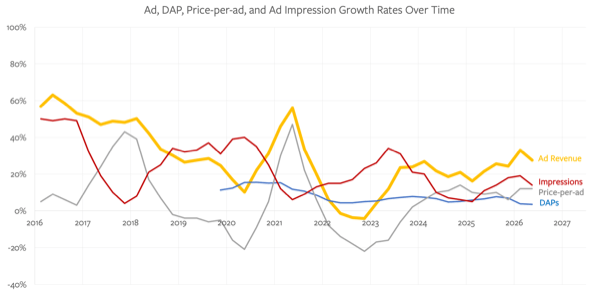
Yet the analyst commentary and financial picture suggest investor skepticism persists. Meta's traditional strength—growing both ad impressions and price-per-ad simultaneously—faltered this quarter: while both metrics rose (a rare feat driven by 2023 improvements in advertiser demand and Reels monetization), the growth was less extraordinary than the previous quarter, raising doubts about whether the company's capex spending is truly justified. Moreover, Anthropic and OpenAI are accelerating their own development and likely possess structural cost advantages in inference—the step where an AI produces an answer—that may only widen. Meta is asking investors to fund yesterday's investments in the hope of matching tomorrow's frontier, while the frontier itself moves faster.
Meta's earnings reveal a company caught between present constraints and future ambitions. The timing mismatch is structural: Zuckerberg realized last summer that Meta risked losing ground in the AI race and accelerated spending on both talent and computing capacity. Because building data centers takes years, Meta scrambled to rent compute from third-party cloud operators—a necessary short-term fix that nonetheless locks the company into double-paying for infrastructure (renting now, building and operating its own later) with no immediate monetization path. This is the core reason investors are alarmed: Meta is not investing in proven growth engines but rather betting that AI superiority will preserve its ad business and unlock new revenue streams that do not yet exist at scale.
Zuckerberg's defense—that Meta must own its AI stack end-to-end, from chips to models, just as it controls its social platform infrastructure—is historically sound. Facebook's early advantage came partly from engineering control and operational efficiency. However, the comparison also carries a warning: fifteen years ago, Microsoft made a similar bet on vertical integration and control at the moment the industry was shifting to mobile and the cloud. Meta's claim that it can build personal agents and enterprise tools rests on the same full-stack logic, but trajectory and relevance in a fast-moving AI field matter more than sheer volume or internal optimization. The company's ad business, while still outpacing competitors in growth, is no longer delivering the momentum boost (simultaneous impressions and price-per-ad growth) that would make investors tolerate capex spending on faith.
AI-summarized, only the topics you pick — one digest a day via Email, Slack, or Discord.
Free · takes 30 seconds · unsubscribe anytime
Ask AI anything about this article. Q&As are published on this page for other readers too.
The Chinese National Federation of Industries (CNFI), a major Taiwan manufacturing association, called on the…

Nvidia CEO Jensen Huang has sought to reassure investors about the chipmaker's exposure to a newly announced i…

Naver has reportedly invested in Anthropic, a US artificial intelligence developer

Chinese memory supplier Longsys reported a dramatic earnings rebound for the first half of 2026, benefiting fr…

Jiangsu Niobium Optoelectronics Technology, a Chinese maker of thin-film lithium niobate (TFLN) photonic chips…

Anthropic PBC is in talks to buy artificial intelligence startup Decart AI for about $6 billion, according to…

The AI news that matters, in one minute each morning.
Sign up free