What happened
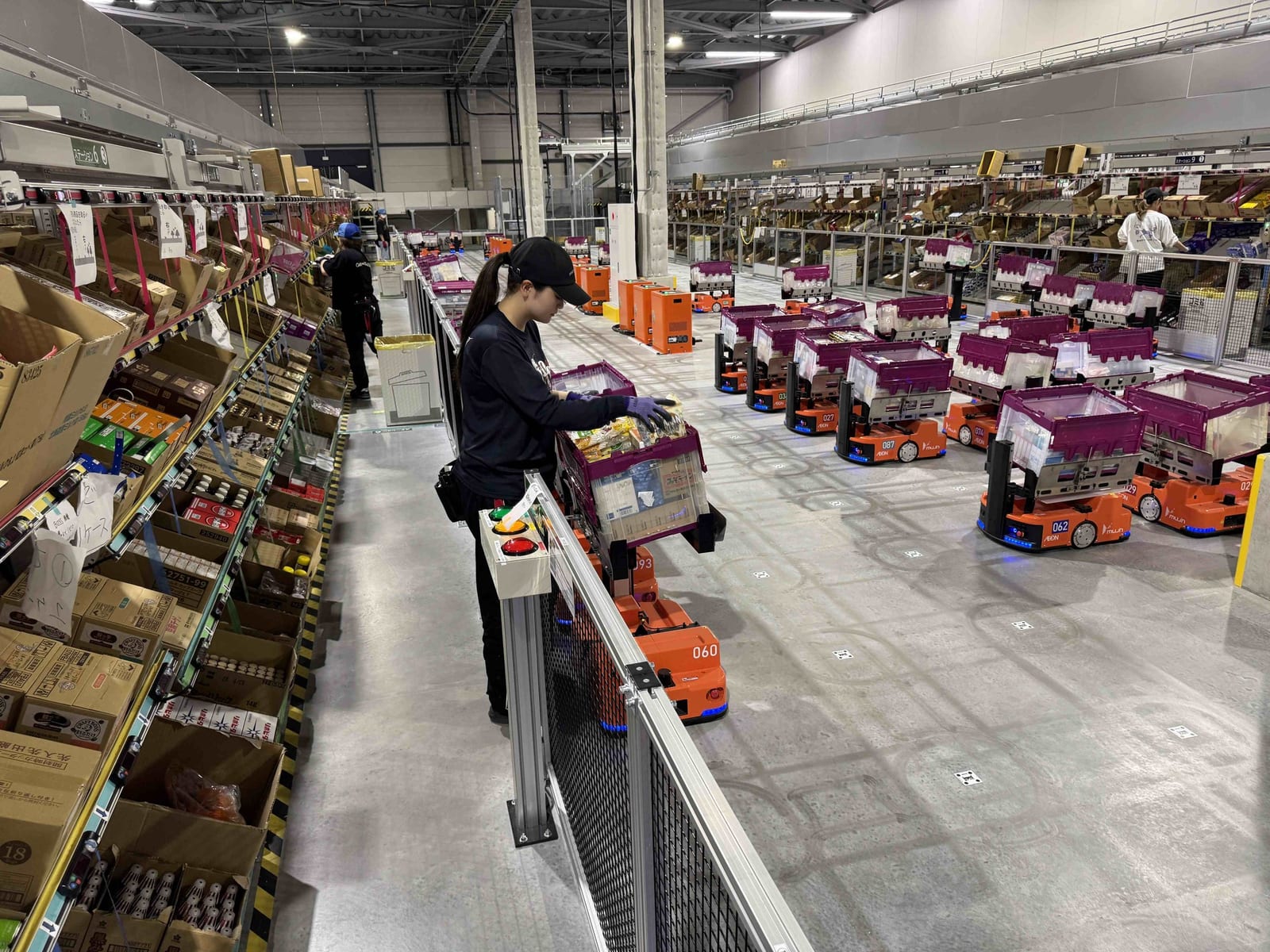
Aeon, Aeon Global SCM and Mujin began full operations at Aeon Kawaguchi-Higashi XD on October 29, the first Aeon center to automate sorting through mixed-load cart loading, with a labor-saving effect of about 39 people per day.
Why it matters
The center handles roughly 250 Maibasket stores directly or via a relay center and is designed for up to 700 or more, and President Yamamoto said the robot loads a cart in a short window at 3–4 times human productivity.
WHO IT HITSRetail logistics and distribution-center operators that run many small-format stores with high product variety and fluctuating volumes are the clearest audience, since the body frames the challenge as hard-to-automate loading work in small-store supply chains.
Summaries like this, every morning.
The Kawaguchi-Higashi XD did not start as a single switch-on. Its low-temperature floor began operating on December 4, 2025, and the ambient floor started test shipments to two stores on July 2, 2026, reaching full operation on October 29 after operations stabilized. The automation itself is staged across floors: depalletizing robots with 3D vision lift cases without prior product-master registration, 82 AGVs and a digital picking system handle piece sorting, and six mixed-load palletizing robots stack cases and totes onto store carts using a loading calculator fed by Mujin's warehouse execution system.
The center is the third of Aeon's next-generation automation sites, after Aeon Fukuoka XD and Aeon Iwate FDC, and each site carries a separate theme. Kawaguchi-Higashi's theme is loading onto cart trucks, a step the body describes as a large share of center work hours. The choice of Maibasket first is deliberate: small stores ship mostly one case per product, so combinations are far more numerous than at large stores, and success there is treated as a path to general-merchandise and supermarket centers. The plan is to consolidate lessons from each site into a model center.
Limits remain visible. Low-temperature automation was judged not worth the cost and stays manual with handheld terminals, and fresh and chilled automation is an open issue, with tests showing bento and sashimi shifting and pudding collapsing. Mujin CEO Takino said cost-effectiveness, not technical difficulty, is the bottleneck, and President Yamamoto said some manual emergency response must remain in case equipment stops. For Mujin, the site is among its largest projects and is presented as a post-proof-of-concept deployment of physical AI robots at scale.
Pick your industry and the AI tools you use, and get news related to your work every day.
Free · 30 seconds with Google · unsubscribe anytimeWhat is AIToday? →
Ask AI anything about this article. The AI reads this article, earlier AIToday articles, and Wikipedia, and cites its sources. Q&As are published on this page for other readers too.
Western Digital's cloud revenue rose 54% year over year to $3.9 billion, 88% of total sales, and its board rai…

Verizon's Data Breach Investigation Report found nearly a third of safety breaches start with vulnerability ex…

Morgan Stanley kept its hyperscaler capex forecasts at $1.6 trillion for 2027 and $1.8 trillion for 2028, even…

JPMorgan added Meta to its Analyst Focus List, replacing Alphabet, and forecast Meta's Family of Apps ad reven…

IBM plans to bring Anthropic's Claude Mythos cyber reasoning into IBM Concert Protect, combining AI code scann…

Cisco Systems enters this week's earnings report with a narrative fair value of $110.56 against a last close o…