What happened
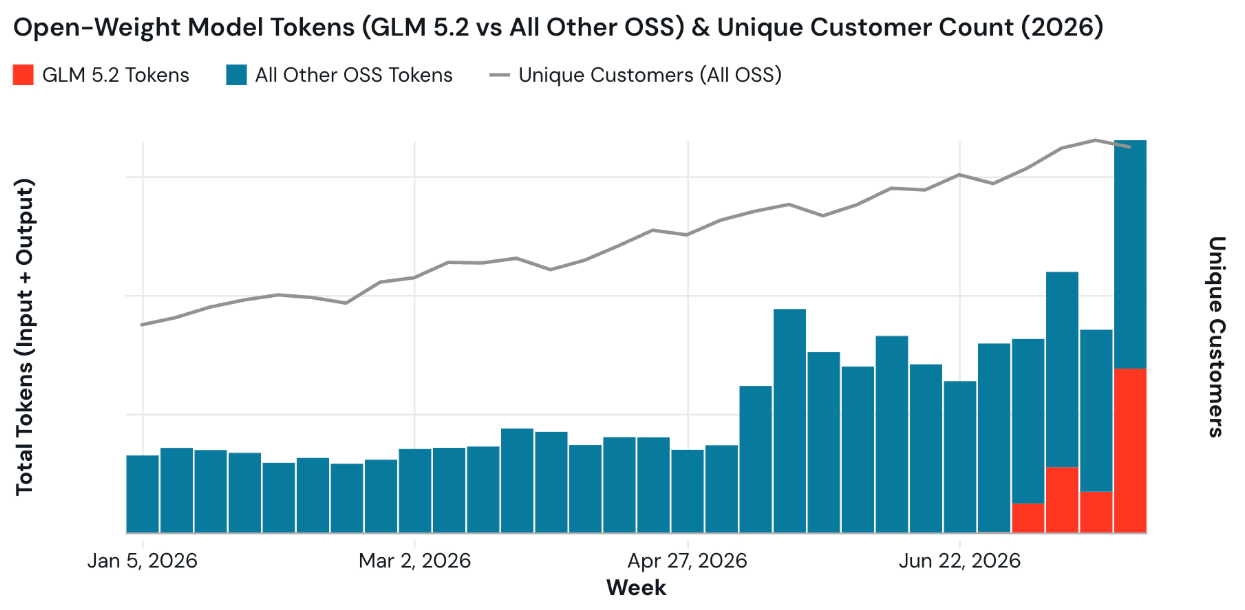
Databricks said GLM 5.2 reached ~40% of open-weight tokens on Unity Gateway one month after launch, while average models per customer rose from 4.2 to 7.1 since January, ~40% open-weight.
Why it matters
Databricks frames this as existing customers shifting traffic, not new sign-ups, suggesting open-weight models are becoming a real cost-and-control alternative to single frontier providers.
What to watch
Databricks announced a $3 billion fundraising round in July, with CEO Ali Ghodsi citing GPU capacity to host open models.
WHO IT HITSEnterprise AI platform teams and procurement leads who standardized on a single frontier model provider now face pressure to justify spend and add routing across multiple models, including open-weight ones.
Summaries like this, every morning.
Databricks' field engineers describe a strategy shift after two years of enterprises standardizing on single frontier model providers. The triggers are concrete: AI budgets have outpaced revenue and cost savings, and the top intelligence ranking has changed hands 20+ times since May 2023, making single-provider architectures fragile. Guardrails have also become a practical obstacle — during the Hugging Face incident, hosted frontier models refused to analyze real attack logs and exploit payloads, so the team ran the analysis on an open-weight model (GLM 5.2) instead.
The harness around a model turns out to matter as much as the model itself. In Databricks' own benchmark, the same model scored 61.7% in one harness, 48.1% in another, and 38.4% bare, which is why the company argues evaluations should test model and harness together. Databricks positions Unity Gateway as the layer that lets teams switch models by configuration or smart routing rather than code changes, with budgets, fallback chains, and centralized governance across open-weight, external, and frontier models.
The usage data is evidence that customers are acting on this. After GLM 5.2 became available in mid-July, its usage rose while growth among Unity Gateway customers stayed relatively consistent — suggesting existing customers shifted traffic rather than new customers arriving. Databricks' $3 billion raise in July, which CEO Ali Ghodsi tied partly to securing GPU capacity, is presented as support for that demand.
Pick your industry and the AI tools you use, and get news related to your work every day.
Free · 30 seconds with Google · unsubscribe anytimeWhat is AIToday? →
Ask AI anything about this article. The AI reads this article, earlier AIToday articles, and Wikipedia, and cites its sources. Q&As are published on this page for other readers too.
On October 21, 2026, Anfini CEO Jun Hashimoto gave a special lecture at Meiji University's engineering faculty…

On November 3, voters in 10 states backed restrictions on data center development in 40 of 41 local ballot mea…
Numica, which buys small accounting practices from retiring owners and runs the work on its AI software, has r…

A six-year web designer who signed up for Claude Pro in April 2026 and later moved to Max published the first…

In one session that ran 13 days and 5,065 requests, a single request late in the session cost about $0.42 agai…

EC自動化工房 laid out four things to standardize before AI translation, using a sample mug "350ml" that mixed unit…