What happened
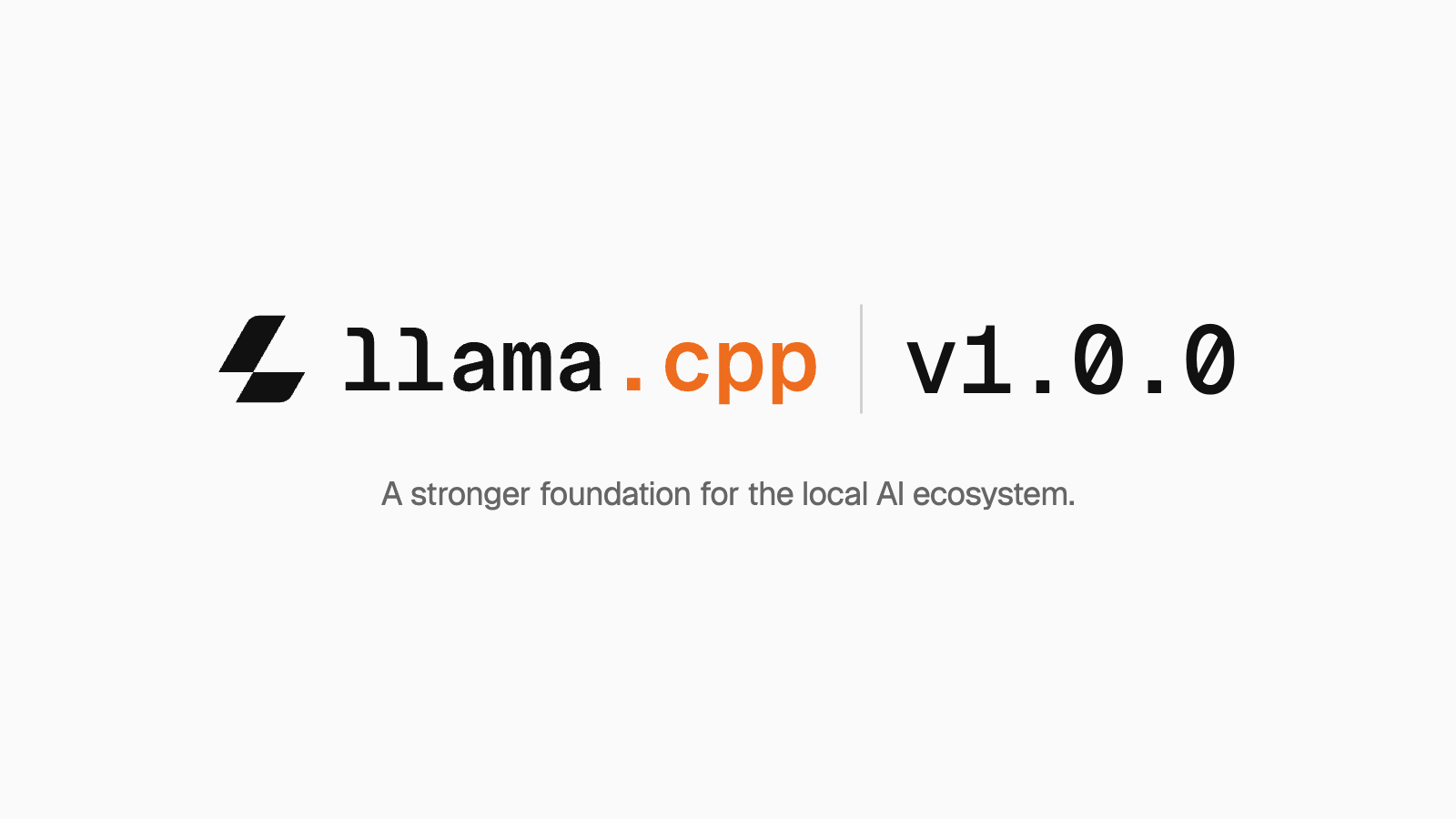
The llama.cpp team at Hugging Face released libraries v1.0.0, and said both llama.cpp and ggml will now reflect API and ABI incompatibilities with major-version bumps.
Why it matters
With more downstream applications depending on its library interfaces, a flexible but stable API is presented as paramount — so breaking changes become visible to consumers rather than silent, and the project is set to be stricter about those boundaries as adoption grows.
WHO IT HITSDevelopers and maintainers of downstream applications built on llama.cpp and ggml — from local AI desktop apps to enterprise deployments — who will now see breaking API changes signaled by major-version bumps rather than appearing without warning.
Summaries like this, every morning.
llama.cpp has spent 3.5 years growing from its inception into a library that many downstream applications already depend on, and the team expects that trend to continue as local AI and privacy become more important in everyday life. That growth is the stated reason for the v1.0.0 release: every new integration means more developers relying on the library interfaces, which the team describes as making a flexible but stable API paramount.
The versioning commitment extends to ggml, the underlying machine learning engine designed to run on virtually any hardware through dedicated backends that can be compiled as dynamic libraries and optionally loaded at runtime. Under the semantic versioning rules the team lays out, a MAJOR bump marks a breaking change to the public C API, a MINOR bump covers backward-compatible features, backend updates, model support or API additions, and a PATCH is a bug fix with no API change — a structure meant to make those boundaries visible to downstream consumers as adoption grows.
The release also highlights the project's support base: continuous CI capacity through HF technologies such as HF Buckets and HF Jobs, hardware support from NVIDIA, AMD, Qualcomm, Arm, IBM and Intel, and more than 150 architecture variants supported. For developers building cross-platform or private AI products on top of llama.cpp and ggml, the practical shift is that breaking changes should now arrive with a major-version number attached rather than unannounced.
Pick your industry and the AI tools you use, and get news related to your work every day.
Free · 30 seconds with Google · unsubscribe anytimeWhat is AIToday? →
Ask AI anything about this article. The AI reads this article, earlier AIToday articles, and Wikipedia, and cites its sources. Q&As are published on this page for other readers too.
Jamie Dimon said JPMorgan Chase is "not gonna allow just any" outside AI agent inside the company, warning "Yo…

Interconnects argues Jensen Huang's resignation from Nvidia removes open models' biggest backer, warning his f…
Jacob Coxon, a former OpenAI and Anthropic researcher, cited an Anthropic IPO roadshow slide showing pre-train…
OpenAI is dissolving its standalone robotics team and folding researchers into the main research team under Ch…
Internal data first reported by The New York Times show only 42% of Alpha School students met its goal of lear…

Operand raised $31 million across seed and Series A funding at a $220 million valuation, in a round led by Kho…