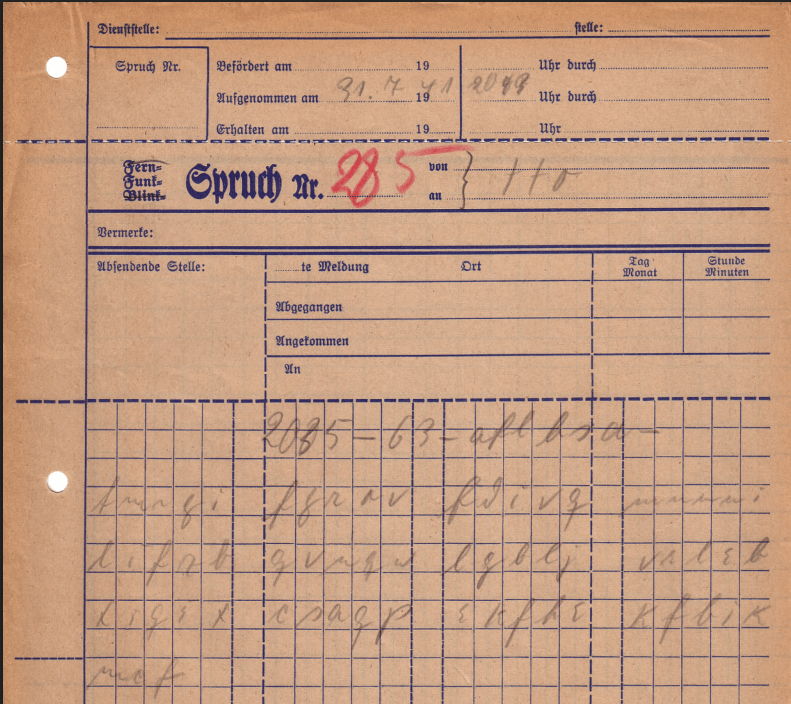
What happened
Developer Carter Leffen asked OpenAI's Astra to find and decode an unbroken Enigma message; it did, recovering plaintext that had baffled researchers since 2005. On September 21, cryptanalyst Jack Willis used Anthropic's Claude Opus 5 to break another.
Why it matters
Two long-unsolved wartime messages have now been decoded by large language models (AI that understands and generates text), which did their own archival research and simulated the Enigma machine to get there. That marks a shift in what these tools can accomplish on real cryptology problems.
What to watch
Only seven unbroken Enigma messages remain, plus one whose plaintext is known but whose code is still unbroken, so this work may soon be exhausted. It also hinges on how much guidance each model receives, as Willis gave Claude far more than Leffen gave Astra.
WHO IT HITSHistorians and cryptology researchers who rely on archival Enigma puzzles could see a shrinking backlog of unsolved messages, while AI developers gain a public demonstration of models doing independent archival and simulation work.
Summaries like this, in your inbox every morning.
Alan Turing is most famous for his test of machine intelligence, but the work he did cracking Nazi Germany's Enigma code during World War II may have been more consequential in his lifetime. His team built an early computer, the Bombe, to translate Enigma messages, yet a handful of archival messages stayed unbroken, usually because of mistranscription or errors by the original encoders. That leftover puzzle set is what two cryptanalysts have now begun to clear using large language models from OpenAI and Anthropic.
The first came from developer Carter Leffen, who simply told OpenAI's Astra to search a database for an unbroken message and decode it. The model did so after conducting its own archival research, finding context clues, and building a simulator of the Enigma machine. Retired electrical engineer Frode Weierud, who maintains the Crypto Cellar website and its records, validated the solution last week. He noted that the model's logs referenced archived messages in a private collection not hosted by him, and he remains unsure whether the model accessed them or whether they were shared elsewhere online or pulled from the German government's public archives. He wrote that Astra behaved like a professional cryptanalyst and archive researcher, achieving in two days what would take a human weeks or months.
On September 21, another cryptanalyst, Jack Willis, told Weierud he had used Anthropic's Claude Opus 5 to break a different unsolved message, though he gave the model significantly more guidance and it relied on a known officer's name signature. With only seven unbroken Enigma messages and one partially known one left, the pace of these solves suggests the archive may not stay unresolved for long. How quickly the remaining messages fall may depend on how much human guidance each model is given, and on whether the models' own research methods can be replicated and verified by the cryptology community.
For example, today's edition would include:
AI-summarized, only the topics you pick: one digest a day via Email, LINE, or Slack.
Free · 30 seconds with Google · unsubscribe anytimeWhat is AIToday? →
Ask AI anything about this article. The AI reads this article, earlier AIToday articles, and Wikipedia, and cites its sources. Q&As are published on this page for other readers too.
Google DeepMind chief Koray Kavukcuoglu said Gemini 4 has entered post-training and Google intends to ship an…

CrowdStrike Holdings (NasdaqGS:CRWD) became a founding member of the Blueprint Alliance, joined by AWS, Google…
At Dreamforce 2026, Salesforce presented an agentic health enterprise, citing UCLA Health's 75,000+ patient in…
Microsoft launched an updated Copilot app that can code and handle productivity tasks, replacing separate 365…
AdverTimes (AdverTimes by Sendenkaigi) compared how people in Japan and the U.S
Shoeisha will publish 'Evaluation-Driven Development for LLM Applications' on September 24