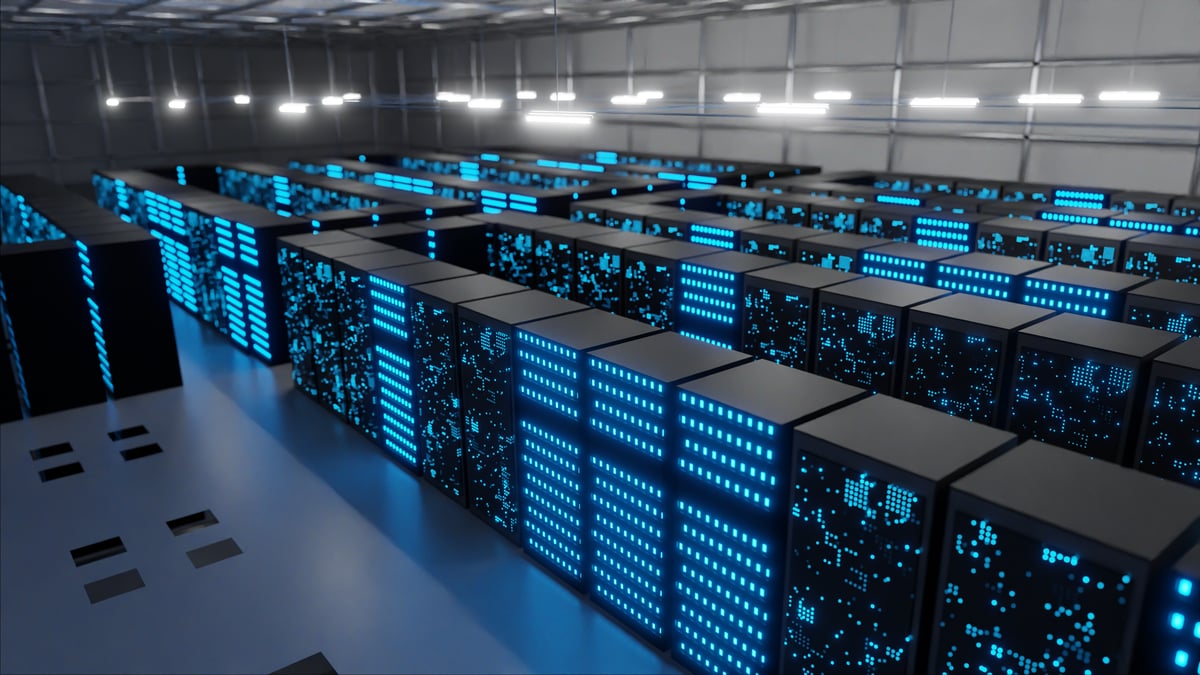
The four largest cloud providers plan to spend more than $700 billion(約110兆円) on AI data centers this year, raising questions about whether this infrastructure build-out is a bubble. While AI spending is projected to reach around $765 billion(約120兆円) in 2026—or 2.4% of U.S. GDP—the article argues valuations remain reasonable compared to the dot-com era, with major AI hardware companies trading at far lower multiples than Cisco did at its peak, and the global economy being much larger than 25 years ago, which provides more capacity to absorb this spending.
Summaries like this, in your inbox every morning.
Sign up free →What happened
The four largest cloud providers—Amazon, Microsoft, Alphabet, and Meta Platforms—are set to spend more than $700 billion(約110兆円) on AI data centers this year. Goldman Sachs projects total AI capital expenditures will reach around $765 billion(約120兆円) in 2026, which would equal 2.4% of expected U.S. GDP of around $32.4 trillion(約5200兆円).
Why it matters
While that 2.4% figure exceeds spending levels seen during the dot-com bubble, the global economy is far larger and more interconnected than it was 25 years ago; AI spending represents only about 0.6% of projected 2026 global GDP of $126 trillion(約20000兆円). Unlike the dot-com era, when hardware stocks like Cisco traded at forward P/E multiples above 100×, today's AI hardware leaders trade at much lower valuations—Nvidia at 23.5× fiscal 2027 estimates and Micron at 6.5×—suggesting investors are exercising restraint rather than irrational exuberance.
What to watch
The hyperscalers funding this build-out have strong core businesses generating significant operating cash flow to help pay for AI infrastructure spending, creating what the article describes as a 'win-win' scenario: either the spending generates returns that lift stock prices, or spending stops and firms generate substantial free cash flow.
The article begins with the core observation that tremendous sums are being deployed into AI infrastructure. The four largest cloud providers—Amazon, Microsoft, Alphabet, and Meta Platforms—are projected to spend more than $700 billion(約110兆円) on AI data centers in a single year, a figure exceeding the gross domestic product of all but two dozen countries. Goldman Sachs projects that total AI capital expenditures will reach around $765 billion(約120兆円) in 2026, the year often cited as a benchmark in this debate.
To assess whether this is bubble-level spending, the article compares it to U.S. GDP. With U.S. GDP expected to be around $32.4 trillion(約5200兆円) in 2026, the projected $765 billion(約120兆円) in AI capex would represent 2.4% of U.S. GDP. The article notes this figure exceeds levels seen in past innovation cycles, such as the dot-com bubble. However, it then offers a crucial reframing: when measured against projected global GDP of $126 trillion(約20000兆円), AI spending represents only about 0.6%. The article explains that while the four largest hyperscalers are U.S. companies, they operate globally and are building AI data centers worldwide, so global capacity—not just U.S. capacity—is relevant to judging whether spending is unsustainable.
The article then shifts to stock valuations as a second measure of potential excess. During the dot-com era, hardware companies like Cisco traded at huge forward price-to-earnings multiples, with Cisco peaking at over 100× in 2000. Today's landscape is markedly different. Nvidia, the primary beneficiary of AI hardware demand, trades at a forward P/E of 23.5 times fiscal 2027 analyst earnings estimates. Micron Technology, a memory company, trades at just 6.5 times fiscal 2027 estimates, with investors showing restraint and cognizance of memory cycles. The article acknowledges some outliers: Space Exploration Technologies had a large IPO valuation, and Palantir trades at a forward price-to-sales ratio of 42 times. However, it frames these as exceptions; most SaaS stocks have traded at dramatically lower multiples, a sharp contrast to the dot-com boom when seemingly all internet stocks surged regardless of business model quality.
Finally, the article argues the hyperscalers have structural defenses unavailable to dot-com era hardware vendors. Amazon, Microsoft, Alphabet, and Meta Platforms all have strong, profitable core businesses—cloud services, advertising, search, social media—that generate significant operating cash flow. This cash flow helps pay for AI infrastructure spending, reducing the risk that unprofitable AI ventures will drain their balance sheets. The article concludes that if AI spending generates returns, stock prices rise; if it does not, firms can stop spending and redirect the freed cash into dividends, buybacks, or other shareholder returns, creating what the article calls a 'win-win' scenario.
The article frames the AI infrastructure debate by contrasting two perspectives: absolute dollar spending versus economic scale. The $700 billion(約110兆円) annual expenditure by four firms is genuinely large, and Goldman Sachs' projection of around $765 billion(約120兆円) in total AI capex for 2026 does exceed spending as a percentage of U.S. GDP relative to past innovation cycles. However, the body argues this comparison is somewhat misleading, because the global economy in 2026 will be vastly larger than it was during the dot-com bubble 25 years ago. When measured against projected global GDP of $126 trillion(約20000兆円), AI spending drops to 0.6%—a far less alarming figure.
The article's second key claim is that valuations themselves provide a reality check absent during the dot-com era. Hardware stocks like Cisco commanded forward P/E multiples above 100× at their peak in 2000; today, Nvidia—the central AI hardware beneficiary—trades at 23.5× fiscal 2027 estimates, and memory maker Micron at just 6.5×. While outliers like Palantir (trading at 42× forward price-to-sales) exist, the article notes that most SaaS stocks trade at much lower multiples than their dot-com predecessors, suggesting the market is not uniformly euphoric about AI stocks even at their heights.
The final piece of the argument is structural: the four hyperscalers funding this spending have diversified, profitable core businesses (search, cloud services, advertising, social media) that generate operating cash flow, reducing dependence on AI spending alone. The article suggests this creates a hedged scenario—if AI spending pays off, stock prices rise; if it does not, firms can redirect that cash into shareholder returns rather than facing insolvency.
AI-summarized, only the topics you pick — one digest a day via Email, Slack, or Discord.
Free · takes 30 seconds · unsubscribe anytime
No comments yet. Be the first to share your thoughts!
Log in to join the discussion



Get curated AI news from 200+ sources delivered daily to your inbox. Free to use.
Get Started FreeFree · takes 30 seconds · unsubscribe anytime
1 minute a day. The AI essentials.
200+ sources · Email / LINE / Slack
