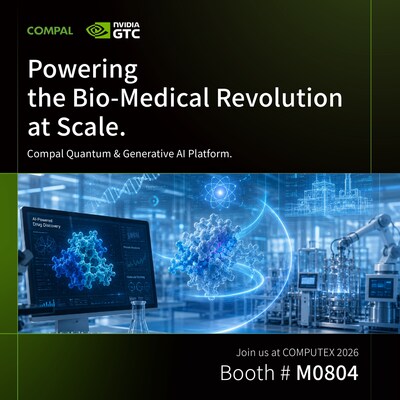
Compal Electronics demonstrated CGA-QX Docking, a production-ready platform developed with NVIDIA and academic partners under NSTC funding, combining NVIDIA CUDA-Q quantum simulations with GPU-accelerated simulated annealing to achieve up to 3,500× speed-ups over traditional molecular docking methods.
The platform uses 30-qubit quantum optimization to improve binding-energy prediction accuracy for targets like Alzheimer's disease, and integrates generative AI for antibody drug development in partnership with the College of Pharmaceutical Sciences at National Yang Ming Chiao Tung University (NYCU), employing fine-tuned ESM-2 protein language models for specificity prediction.
The molecular docking system has been validated through practical testing with Kaohsiung Medical University and leverages quantum algorithms to optimize molecular configuration searches across millions of potential binding sites.
Summaries like this, in your inbox every morning.
Pick your industry and the AI tools you use, and get news related to your work every day.
Free · 30 seconds with Google · unsubscribe anytimeWhat is AIToday? →
Ask AI anything about this article. The AI reads this article, earlier AIToday articles, and Wikipedia, and cites its sources. Q&As are published on this page for other readers too.
OpenAI introduced the Rosalind Academic Plan, giving eligible academic labs at U.S
Santen Pharmaceutical's R&D division reached a 93% weekly usage rate for generative AI, applying it to study p…

Snowflake published a post on agentic AI across oncology's five stages, citing AstraZeneca cutting data produc…

A solo developer built Yurune, a web app that plays synthesized rain, wave and forest sounds and lets users ta…

Pharmaceutical Executive will host a November 4, 2026 webcast introducing the RAIL Score, a framework for eval…

Reuters reports that the pharma sector is doubling down on AI as a way to cut costs and timelines