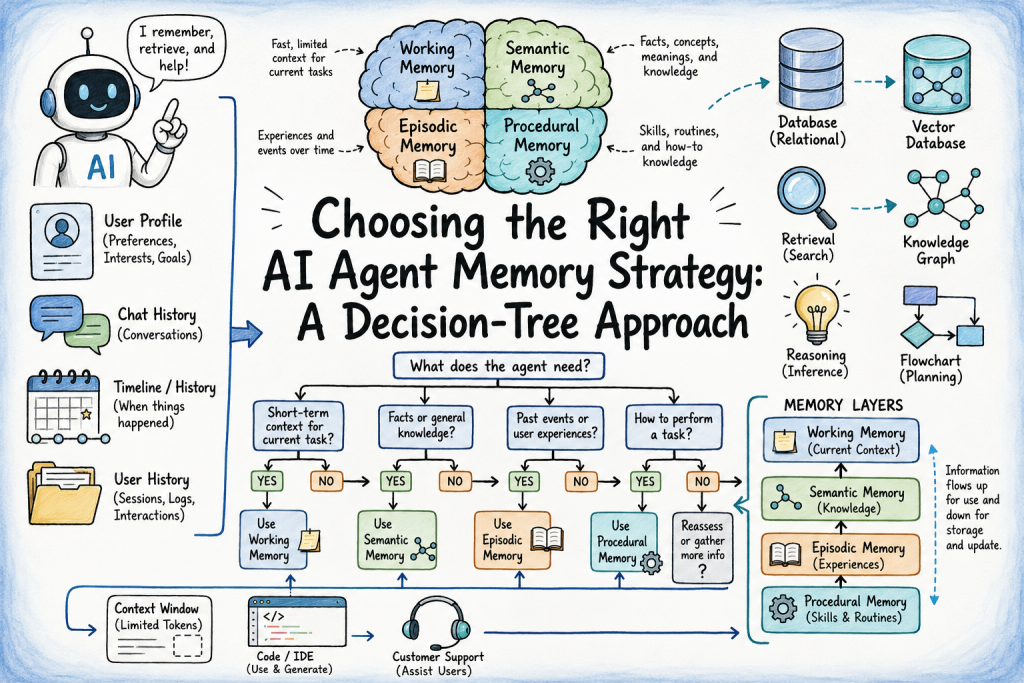
Building effective AI agents requires matching each category of information to the right memory layer rather than using a single memory system for everything. The article outlines a five-question decision tree that distinguishes working memory (current conversation state), semantic memory (stable facts like user preferences), episodic memory (history of past events and decisions), and procedural memory (learned routines). This separation prevents common problems like slow retrieval when facts are stored in vector databases or contradictory information when old interaction logs override newer data.
Summaries like this, in your inbox every morning.
Sign up free →What happened
A decision-tree framework identifies five questions to match four types of AI agent memory—working, semantic, episodic, and procedural—to different categories of information, depending on persistence needs, stability, and retrieval method.
Why it matters
Mismatching information to the wrong memory layer slows retrieval, loses context, or wastes infrastructure on data that doesn't need it. The framework helps builders avoid common design mistakes like storing stable facts in vector stores or searching entire interaction histories for simple facts.
What to watch
The framework separates information that needs no memory at all from session-only memory (conversation buffers) from durable stores, using concrete properties like "does this persist beyond the current turn" and "is this a stable fact or evolving event" to route each data type correctly.
Agent memory design often receives less deliberate attention than orchestration logic, yet it shapes how well an AI maintains context and avoids repeating mistakes. The article grounds this problem in a cognitive-science vocabulary borrowed from human memory research—distinguishing stable knowledge (semantic) from specific past events (episodic)—and applies it to a practical architectural choice. This framing matters because it shifts the design question from "which memory system should we use" to "which layer does each piece of information actually belong in."
The decision tree works by narrowing down requirements step by step: first by whether information needs to persist at all (eliminating false memory problems), then by session boundaries (splitting working from durable memory), then by information shape (stable facts vs. events), and finally by retrieval scale and structure. A customer support agent illustrates why this layering is necessary—the current ticket stays in working memory (active context), the customer's subscription tier in semantic memory (canonical fact that rarely changes), past complaints in episodic memory (history that informs behavior), and learned refund routines in procedural memory (patterns that improve with repetition). The article emphasizes that confusing these layers carries real costs: vector stores slow down retrieval of simple facts, and searching interaction histories can surface stale or contradictory information that a structured record would have overwritten. This directly supports the principle that "memory is just one source of context competing for a limited context window, so information should only be retrieved if it meaningfully improves the agent's response."
No comments yet. Be the first to share your thoughts!
Log in to join the discussion





Get curated AI news from 200+ sources delivered daily to your inbox. Free to use.
Get Started FreeFree · takes 30 seconds · unsubscribe anytime
1 minute a day. The AI essentials.
200+ sources · Email / LINE / Slack
