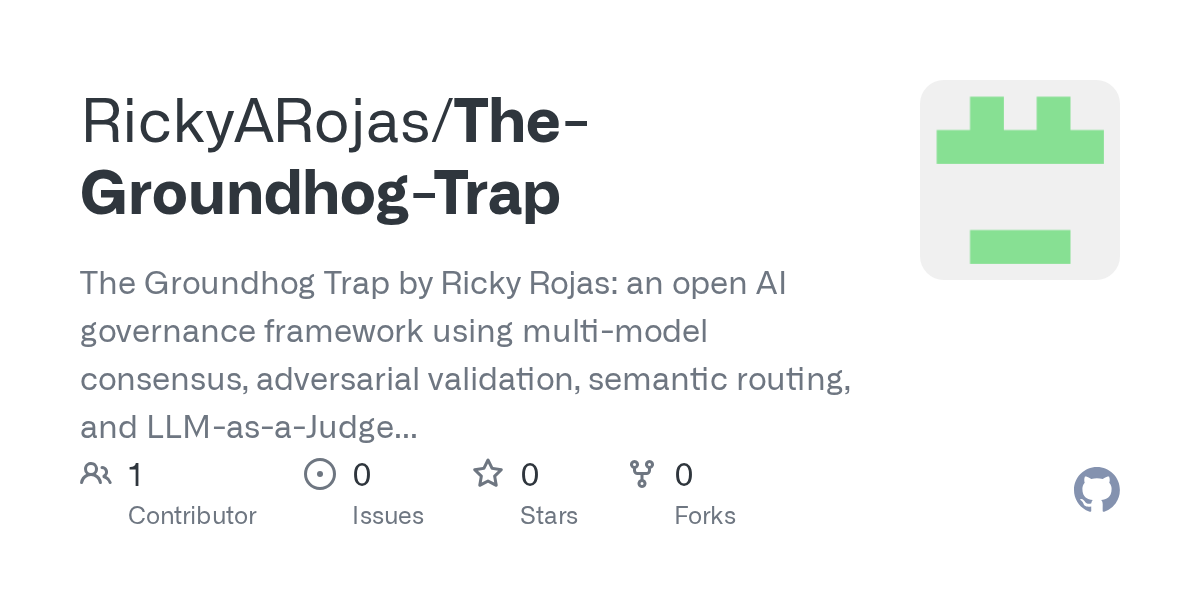
Ricky Rojas has created The Groundhog Trap, an open-source AI governance framework that improves trust in large language models by routing queries through multiple independent models, comparing their outputs, and generating a consensus result with audit trails. The prototype (v0.1) uses a three-model ensemble, hallucination detection, and LLM-as-a-Judge verification to reduce operational risk in enterprise AI systems.
Summaries like this, in your inbox every morning.
Sign up free →What happened
Ricky Rojas developed The Groundhog Trap, an AI governance framework designed to improve trust in large language models by routing prompts through multiple independent LLMs, comparing responses, and generating an auditable consensus. The current prototype (v0.1) features a three-model symmetric ensemble, hallucination detection, LLM-as-a-Judge verification, and audit logging.
Why it matters
Instead of relying on a single frontier model, this multi-model approach with adversarial validation and deterministic decision-making is intended to reduce operational risk and improve trustworthiness in enterprise AI systems. The framework addresses the problem of AI output reliability through semantic governance and epistemic self-assessment.
What to watch
The roadmap includes OpenRouter integration, smart model routing, adaptive consensus thresholds, a telemetry dashboard, risk-based routing for low-, medium-, and high-risk prompts, and eventual web interface and production deployment. The project is open-source and actively in development.
The Groundhog Trap is an AI governance framework conceived and developed by Ricky Rojas in 2026. Rather than relying on a single frontier model, the framework routes a prompt through multiple independent LLMs before comparing responses and generating an auditable consensus. This approach is designed to improve trust in large language models through adversarial validation, multi-model consensus, and deterministic decision-making.
The current prototype (v0.1) includes several key features: a three-model symmetric ensemble that processes each prompt across three independent models, epistemic self-assessment to evaluate confidence levels, consensus scoring to weigh model agreement, LLM-as-a-Judge verification to evaluate output quality, audit logging to track all decisions, and hallucination detection through adversarial validation. A Zapier prototype has been developed and a future OpenRouter implementation is planned. The framework is presented as an open exploration of enterprise AI governance, trustworthy AI systems, and operational risk reduction.
The project is actively in development with a published roadmap that includes significant enhancements. Planned milestones include integration with OpenRouter, smart model routing capabilities, adaptive consensus thresholds that adjust validation rigor based on circumstances, audit ID generation for traceability, separation of consensus status and consensus score fields, email anonymization and hashing for privacy, a telemetry dashboard for monitoring, risk-based routing that handles low-, medium-, and high-risk prompts differently, a web interface for broader accessibility, and eventual production deployment. Ricky Rojas, based in Atlanta, Georgia, has made the project open-source via a GitHub repository.
The Groundhog Trap addresses a core challenge in enterprise AI adoption: the reliability and trustworthiness of outputs from large language models. By moving away from dependence on a single frontier model and instead employing a multi-model consensus approach, the framework introduces redundancy and cross-validation into AI decision-making. This aligns with enterprise AI governance principles that prioritize auditability and operational risk reduction.
The framework's current architecture—centered on a three-model symmetric ensemble with LLM-as-a-Judge verification and hallucination detection—reflects design choices aimed at both transparency and robustness. The inclusion of audit logging and epistemic self-assessment (the model's ability to assess its own certainty) suggests an intent to provide not just correct answers but justified confidence in those answers. The roadmap's emphasis on semantic governance and risk-based routing indicates recognition that different use cases demand different levels of validation rigor.
AI-summarized, only the topics you pick — one digest a day via Email, Slack, or Discord.
Free · takes 30 seconds · unsubscribe anytime
No comments yet. Be the first to share your thoughts!
Log in to join the discussion



Get curated AI news from 200+ sources delivered daily to your inbox. Free to use.
Get Started FreeFree · takes 30 seconds · unsubscribe anytime
