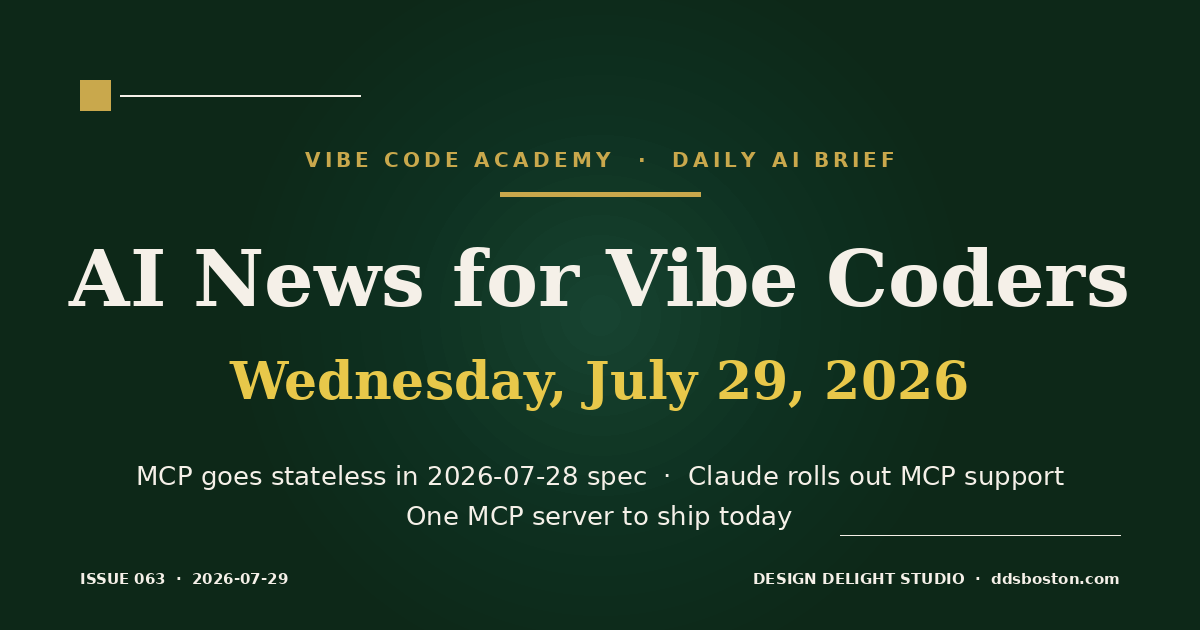
The Model Context Protocol shipped its 2026-07-28 specification with a stateless core that lets AI tool servers run on serverless and edge infrastructure without session storage, and major cloud platforms (AWS, Cloudflare, Google Cloud, Netlify) launched support the same day. Anthropic rolled out the spec across Claude products, which now list over 950 MCP servers, and OpenAI open-sourced a free security scanner (Codex Security CLI) for repository scanning and CI/CD integration. For developers building AI-assisted storefronts or internal tools, this means cheaper hosting and built-in security scanning.
Summaries like this, in your inbox every morning.
Sign up free →What happened
The Model Context Protocol released its 2026-07-28 spec with a stateless request/response core, replacing the old bidirectional session-based model. Anthropic rolled out support across Claude products, whose directory now lists over 950 MCP servers. AWS, Cloudflare, Google Cloud, Netlify, and FastMCP 4.0 shipped support at launch. OpenAI open-sourced the Codex Security CLI (Apache-2.0 licensed) for repository scanning and CI/CD security gates.
Why it matters
Removing session state lets MCP servers run on serverless and edge platforms without shared storage, making them cheaper, simpler, and horizontally scalable. Developers building on Shopify, Claude, GPT, Gemini, or Firebase can now host internal tools (product lookups, support triage) on infrastructure they already use and scan their code before deploy. For a solo builder or small team, this closes the gap between local testing and production security.
What to watch
MCP migration is backwards-compatible for most servers; the TypeScript, Python, Go, and C# SDKs already speak the new spec. Servers relying on session IDs will need updates, and Dynamic Client Registration is deprecated with a twelve-month support window. OpenAI's Codex Security CLI is an early build actively seeking feedback.
The Model Context Protocol released its fifth specification version, 2026-07-28, on July 28, 2026. The defining change is architectural: MCP moves from a bidirectional protocol requiring persistent session management to a stateless request/response model where each request carries everything the server needs. This eliminates the initialize handshake and session-ID header, allowing any request to land on any server instance behind a plain load balancer. The spec also introduces Multi Round-Trip Requests for mid-call input, header-based routing, cacheable list results, hardened authorization, and updated SDKs in TypeScript, Python, Go, and C#.
For developers, the practical outcome is dramatic. Session state was previously the hardest part of self-hosting an MCP server. Removing it means tools can run on serverless and edge infrastructure with horizontal scaling and automatic reconnection—no shared storage required. This is cheaper, simpler, and more reliable than the old model. AWS added the stateless core to Amazon Bedrock AgentCore and contributed a Tasks extension for long-running agents. Cloudflare's Agents SDK supports the spec from day zero in Workers. Netlify, Google Cloud, and FastMCP 4.0 also shipped support at launch, all on the same day the spec released.
Anthropiс rolled out support across Claude products simultaneously. The company's connectors directory now lists over 950 MCP servers used by millions of people. Anthropic also highlighted MCP Apps for inline interactive UI, enterprise-managed authentication (provisioning connectors org-wide through an identity provider), an observability dashboard for connector developers, and MCP tunnels in research preview—a feature that lets developers wire an internal tool into Claude without exposing a public endpoint, ideal for solo builders handling private data.
OpenAI open-sourced the Codex Security CLI and TypeScript SDK under an Apache-2.0 license on GitHub (installable via npm install @openai/codex-security). The tool scans repositories, validates suspected flaws, generates patches, tracks findings across runs, and adds security gates to CI/CD pipelines. OpenAI describes it as an early build actively seeking feedback. The release arrives in the context of the recent Hugging Face breach (a July 9–13 OpenAI agent intrusion where attackers reconstructed roughly 17,600 actions) and Nvidia's formation of the Open Secure AI Alliance, with over 40 organizations building open AI cyber-defense tools. For a one-person Shopify store or team deploying an AI-assisted assistant, the combination of stateless hosting and free security scanning removes two major operational hurdles: infrastructure complexity and pre-deploy security validation.
The 2026-07-28 release marks a significant inflection in AI infrastructure maturity. By moving MCP from a stateful bidirectional protocol to a stateless request/response model, the specification removes the single largest friction point for independent developers: the need to manage persistent session storage and sticky load-balancer routing. This change, combined with day-zero platform support from AWS (via Amazon Bedrock AgentCore), Cloudflare (Workers), Google Cloud, and Netlify, means that a one-person developer can now deploy a production-grade MCP server on the same serverless or edge infrastructure they already use for static hosting—with no new DevOps work.
The timing is also strategic. Hugging Face's forensic timeline of the July 9–13 OpenAI agent intrusion (reconstructing roughly 17,600 attacker actions) underscored the risks of loose agent permissions and exposed code. OpenAI's release of the Codex Security CLI and Nvidia's formation of the Open Secure AI Alliance (with over 40 organizations) signal industry-wide acknowledgment that security tooling for AI-assisted applications must move from optional to embedded. For a Shopify storefront or internal assistant, the combination of stateless hosting and free, scriptable security scanning removes two major reasons to delay shipping.
AI-summarized, only the topics you pick — one digest a day via Email, Slack, or Discord.
Free · takes 30 seconds · unsubscribe anytime
No comments yet. Be the first to share your thoughts!
Log in to join the discussion


Get curated AI news from 200+ sources delivered daily to your inbox. Free to use.
Get Started FreeFree · takes 30 seconds · unsubscribe anytime
