Palantir Technologies reported record Q2 2026 revenue of $1.935 billion, up 93% year-over-year, driven primarily by 115% growth in U.S. operations as enterprises increasingly demand "AI sovereignty"—the ability to control their own AI systems within private environments rather than rely on public cloud providers.
The company raised its full-year 2026 revenue guidance to approximately $8.154 billion and closed record numbers of large deals, signaling a broad market shift toward sovereign AI architectures that integrate customer data and logic securely.
What happened
Palantir Technologies reported Q2 2026 revenue of $1.935 billion, a 93% year-over-year increase, with U.S. operations—now 81% of total revenue—growing 115%. The company raised full-year 2026 revenue guidance to approximately $8.154 billion at the midpoint. The firm closed 220 deals worth at least $1 million, 98 deals of at least $5 million, and 73 deals of at least $10 million, all record highs.
Why it matters
CEO Alex Karp attributed the surge to unleashed "demand for AI sovereignty," as enterprises seek to own and control their AI systems within their own environments rather than rely on public cloud models. U.S. commercial revenue grew 149% year-over-year to $764 million, while the company's Artificial Intelligence Platform (AIP) is helping customers integrate private data and operational logic to extract measurable value from AI, contrasting with competitors' token-metered approaches that Palantir argues drain budgets without commensurate returns.
What to watch
U.S. Commercial TCV bookings reached $2.132 billion (153% year-over-year growth), and remaining deal value stands at $13.1 billion (83% year-over-year growth). Q3 2026 revenue guidance is between $2.16 billion and $2.164 billion. Adjusted free cash flow guidance for the full year was raised to between $4.5 billion and $4.7 billion.
Palantir Technologies delivered its strongest quarter to date in Q2 2026, reporting total revenue of $1.935 billion, a 93% year-over-year increase, driven by accelerating demand for AI platforms in the U.S. market. The company's U.S. operations, which now represent 81% of total revenue, grew 115% year-over-year and 23% sequentially, signaling continued momentum. Within the U.S., commercial revenue reached $764 million (up 149% year-over-year) while government revenue grew to $809 million (up 90% year-over-year), demonstrating strength across both private enterprise and federal segments.
Chief Revenue Officer Ryan Taylor emphasized that the quarter's results reflected an "abrupt market shift in LLMs" that the company had been warning about. He contrasted Palantir's approach with competitors' token-metered models, arguing that enterprises using alternative approaches see "token meters spinning endlessly just to get slop without any correlation to value." Instead, Palantir's Artificial Intelligence Platform (AIP) is designed to integrate large language models with an organization's private data, operational logic, and security policies—what management calls "AI sovereignty." This positioning resonates with enterprises concerned about budget waste and intellectual property leakage. A multinational technology company, initially working with Palantir at a single operating company in Q4 2025, expanded to a three-year contract worth nearly $370 million, exemplifying this expansion dynamic.
Operationally, the quarter delivered record-setting deal activity. Palantir closed 220 deals worth at least $1 million, 98 deals of at least $5 million, and 73 deals of at least $10 million—all company records. U.S. Commercial TCV bookings hit $2.132 billion, representing 153% year-over-year growth and nearly $800 million above the prior quarterly record. U.S. Commercial customer count reached 653, up 35% year-over-year and 6% sequentially, indicating broad customer acquisition. Net Dollar Retention rose to 157%, up 700 basis points from the prior quarter, highlighting significant expansion within the existing customer base. Remaining Performance Obligations (RPO), which reflects noncancelable contracted revenue not yet recognized, reached $4.9 billion, up 103% year-over-year. Total Remaining Deal Value (RDV) stood at $13.1 billion, up 83% year-over-year.
Financially, Palantir achieved a Rule of 40 score of 155% (a 10-point sequential increase and the 12th consecutive quarter of expansion for this metric, which adds revenue growth to adjusted operating margin). Adjusted Free Cash Flow reached $1.22 billion, up 115% year-over-year with a 63% margin. Adjusted Gross Margin was 86%, with a slight impact from increased costs associated with taking on cloud hosting for a government customer. Adjusted Operating Income was $1.194 billion, representing a 62% adjusted operating margin. GAAP Net Income reached $1.062 billion, or a 55% margin—the company's second consecutive quarter of GAAP net income exceeding $1 billion. GAAP EPS was $0.41, which included a $0.03 tailwind from unrealized gains on SpaceX holdings. Adjusted Operating Expense rose to $741 million, up 37% year-over-year, primarily driven by technical hiring and product pipeline investments.
Management raised full-year 2026 revenue guidance to approximately $8.154 billion at the midpoint (between $8.15 billion and $8.158 billion), representing 82% year-over-year growth at the midpoint and marking the largest guidance raise to date. Q3 2026 revenue guidance was set between $2.16 billion and $2.164 billion. U.S. Commercial FY 2026 guidance was raised to in excess of $3.424 billion, representing at least 134% year-over-year growth. Adjusted Free Cash Flow guidance for the full fiscal year was raised to between $4.5 billion and $4.7 billion. Chief Executive Officer Alex Karp described the quarterly performance as "otherworldly" and stated that "demand for AI sovereignty has now been unleashed." He indicated his intent to drive company growth at a rate equal to or above current U.S. commercial levels for the next 18 months by focusing on sovereign AI stacks. Chief Technology Officer Shyam Sankar noted that within 24 hours of integration, the standard Nemotron Ultra model "beat frontier models" on five production tasks when used within Palantir's stack, underscoring the value of integrating models within proprietary data environments. Sankar also highlighted the growth of the Maven platform, which now supports over 25,000 builders, including service members and contractors developing agents "at the speed of war."
Palantir's Q2 results reflect a fundamental market shift that the company has been predicting for years. Management framed the quarter around the concept of "AI sovereignty"—the notion that enterprises no longer want to outsource their AI operations to public cloud providers via token-metered models. Instead, they are seeking to build proprietary AI stacks that integrate their own data, logic, and security policies. This positioning directly challenges the dominant model of large language model consumption, where companies pay per token used, often without correlation to business value delivered. Palantir argues that this approach drains corporate budgets and forces organizations to share proprietary data with external training pipelines, effectively commoditizing their competitive advantages.
The company's financial performance underscores this thesis. U.S. commercial revenue grew 149% year-over-year, and the company closed record-high deal counts at all tiers ($1 million, $5 million, and $10 million thresholds). Notably, U.S. Commercial TCV bookings reached $2.132 billion in the quarter, 153% above the prior year and nearly $800 million above the previous quarterly record. This suggests that customers are committing to longer, larger engagements around Palantir's integrated AI platforms rather than episodic, transaction-based consumption. The company's focus on the Maven platform (supporting over 25,000 builders including service members and contractors) and the American Tech Fellowship (which has produced over 1,000 graduates) indicates a strategic effort to deepen embedded expertise and developer loyalty, potentially anchoring future expansion.
AI-summarized, only the topics you pick — one digest a day via Email, Slack, or Discord.
Free · takes 30 seconds · unsubscribe anytime
Ask AI anything about this article. Q&As are published on this page for other readers too.
TSMC has roughly doubled its CoWoS and SoIC packaging capacity annually for several years and is now running C…
Broadcom CEO Hock Tan reaffirmed in early June that the company expects fiscal 2027 AI semiconductor revenue o…
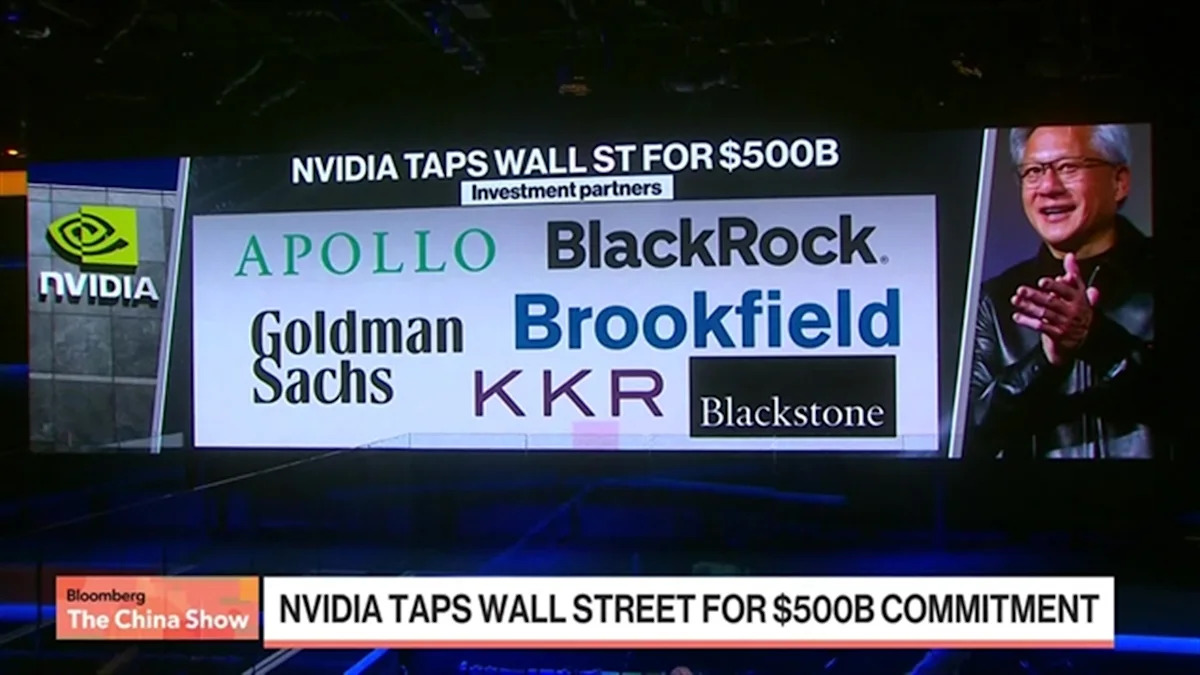
Nvidia has signed letters of intent with Apollo, BlackRock, Blackstone, Brookfield, Goldman Sachs, and KKR to…

Nvidia has partnered with six major investment and financial groups to mobilize more than US$500 billion in th…
CoreWeave earnings are expected to show another quarter of triple-digit sales growth as the AI cloud company c…
Nvidia has secured $500 billion in commitments from Wall Street firms, cementing its position as what Bloomber…
The AI news that matters, in one minute each morning.
Sign up free