Broadcom reaffirmed its forecast for more than $100 billion in fiscal 2027 AI semiconductor revenue, with Q2 2026 AI revenue hitting $10.8 billion, up 143% year over year.
However, the forecast rests almost entirely on six core customers—Google, Meta, Anthropic, OpenAI, and two unnamed buyers—rather than a diversified customer base.
This concentration means that a pause in orders from even two major buyers could push significant revenue into later years, creating a key risk at the company's current valuation.
What happened
Broadcom CEO Hock Tan reaffirmed in early June that the company expects fiscal 2027 AI semiconductor revenue of more than $100 billion, with AI revenue in fiscal Q2 2026 reaching $10.8 billion, up 143% year over year. The company projects Q3 AI semiconductor revenue to grow over 200% year-over-year to $16.0 billion.
Why it matters
Six core custom-chip customers—including Google, Meta, Anthropic, and OpenAI—drive nearly all of Broadcom's AI business, meaning the forecast depends on a narrow set of budgets rather than a broad customer base. If even two of these major buyers paused orders at the same time, there would be no smaller customers to absorb the impact, potentially pushing billions of dollars of revenue into later years.
What to watch
Broadcom trades at about 22 times the roughly $19.50 per share analysts expect for fiscal 2027 earnings, meaning the growth forecast is already priced in. The two unnamed core customers have placed purchase orders totaling $6 billion, with shipments starting late this year and accelerating into 2027.
When Broadcom reported fiscal second-quarter results in early June, CEO Hock Tan repeated the company's centerpiece forecast: fiscal 2027 AI semiconductor revenue of more than $100 billion. For perspective, Broadcom's total revenue over the past 12 months (including enterprise software) was about $75 billion, making the AI target bigger than the entire current business. The growth trajectory supports the ambition. AI semiconductor revenue reached $10.8 billion in fiscal Q2 2026 (ended May 3, 2026), up 143% year over year from roughly $4.4 billion a year earlier. Management guided for Q3 to accelerate further, with AI semiconductor revenue expected to grow over 200% year-over-year to $16.0 billion. Broadcom's fiscal Q2 overall was a record: total revenue rose 48% year over year to $22.2 billion, semiconductor solutions revenue climbed 79% to $15.0 billion, and free cash flow reached $10.3 billion, or 46% of revenue.
But the article's central insight concerns who is actually buying. Tan disclosed on the June earnings call that Broadcom has six core custom-chip customers. He named four: Alphabet's Google unit, Meta Platforms, Anthropic, and OpenAI. In December, Tan had revealed that Anthropic alone had placed a $10 billion order for AI chips. The two core customers Tan did not name have placed purchase orders totaling $6 billion so far, with shipments starting late this year and accelerating into 2027. Spreading the $100 billion target across six core buyers yields an average of more than $16 billion per customer in fiscal 2027—a striking concentration of revenue. The article frames this as the key risk: if even two of these six customers paused orders simultaneously, there is no deep customer base of smaller buyers to absorb the hit. Because custom AI chips are capital projects tied to synchronized customer build-outs and infrastructure timelines, even a modest delay in one customer's project—not a cancellation but a shift of shipments into a later year—could push billions of dollars of revenue forward.
Management has not articulated a scenario in which the forecast breaks, and Broadcom has beaten its own AI forecasts repeatedly. The market has already incorporated the growth: at about $428 per share, Broadcom trades at roughly 22 times the $19.50 per share analysts expect in fiscal 2027 earnings, versus a trailing GAAP ratio of about 71. In other words, the market has moved on to fiscal 2027 and priced in the ramp. Infrastructure software, at $7.2 billion a quarter and growing 9%, provides some steadiness. But the distinguishing observation is that a $2 trillion valuation underpinned by six budgets on synchronized timelines represents a different category of risk than a valuation spread across thousands of independent customers.
Broadcom's $100 billion-plus fiscal 2027 AI revenue target looks arithmetically sound when extended from the company's current trajectory: Q2 2026 AI revenue of $10.8 billion represented 143% year-over-year growth, and management is guiding for Q3 to exceed 200% growth. At that rate, reaching six figures is plausible. However, the article reveals a concentration risk that matters more than the headline number itself. Six customers account for nearly all revenue, and an average order of more than $16 billion per customer in fiscal 2027 means the forecast depends on a remarkably small set of independent budget cycles. Anthropic's $10 billion order in December alone shows the scale of individual commitments, while the two unnamed core customers' $6 billion order book—representing only 6% of the fiscal 2027 target—underscores how much weight falls on the named four.
The article notes that custom AI chips are capital projects tied to specific customer build-outs on roughly synchronized timelines. Unlike a consumer business with thousands of small transactions, Broadcom's model means that even a modest delay in one major customer's infrastructure project—not a cancellation, but a push of shipments from 2027 into 2028—could shift billions in revenue. Management has not flagged this concentration as a concern and has beaten its own AI forecasts repeatedly. The market has already priced in the growth: Broadcom trades at about 22 times expected fiscal 2027 earnings, implying investors believe the ramp will materialize. What the article identifies as the key distinction is that a $2 trillion valuation resting on six budgets carries different risk from the same valuation spread across thousands of customers.
AI-summarized, only the topics you pick — one digest a day via Email, Slack, or Discord.
Free · takes 30 seconds · unsubscribe anytime
Ask AI anything about this article. Q&As are published on this page for other readers too.
TSMC has roughly doubled its CoWoS and SoIC packaging capacity annually for several years and is now running C…
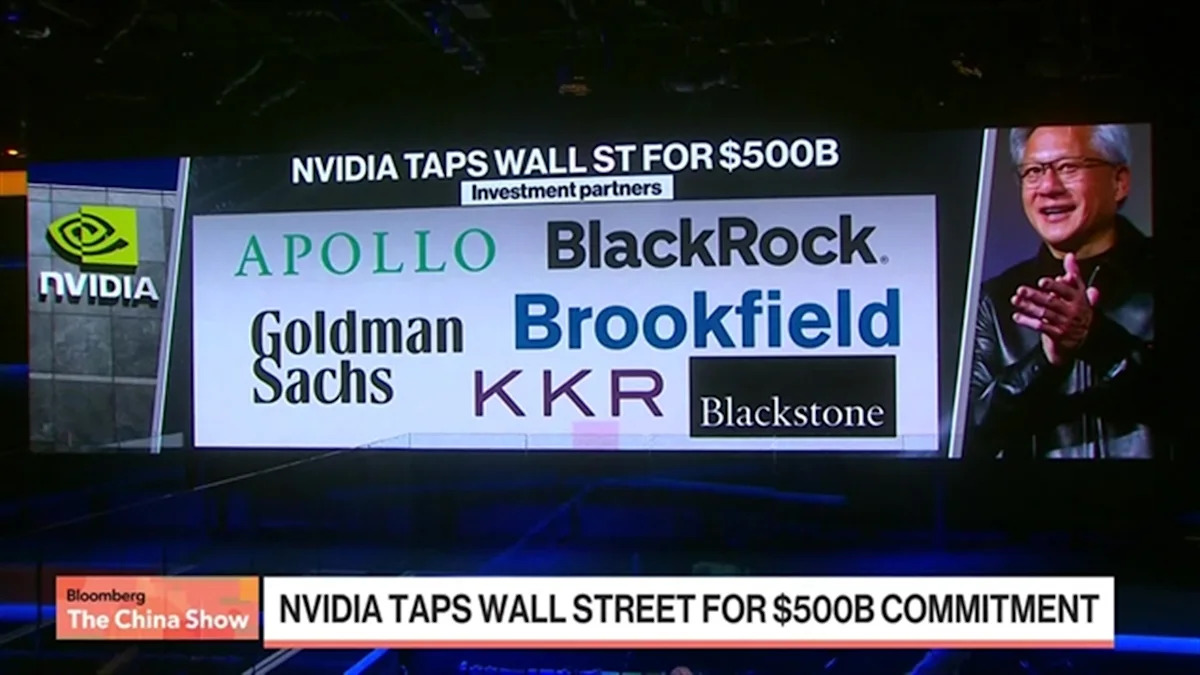
Nvidia has signed letters of intent with Apollo, BlackRock, Blackstone, Brookfield, Goldman Sachs, and KKR to…

Nvidia has partnered with six major investment and financial groups to mobilize more than US$500 billion in th…
CoreWeave earnings are expected to show another quarter of triple-digit sales growth as the AI cloud company c…
Nvidia has secured $500 billion in commitments from Wall Street firms, cementing its position as what Bloomber…
Palantir Technologies reported Q2 2026 revenue of $1.935 billion, a 93% year-over-year increase, with U.S
The AI news that matters, in one minute each morning.
Sign up free