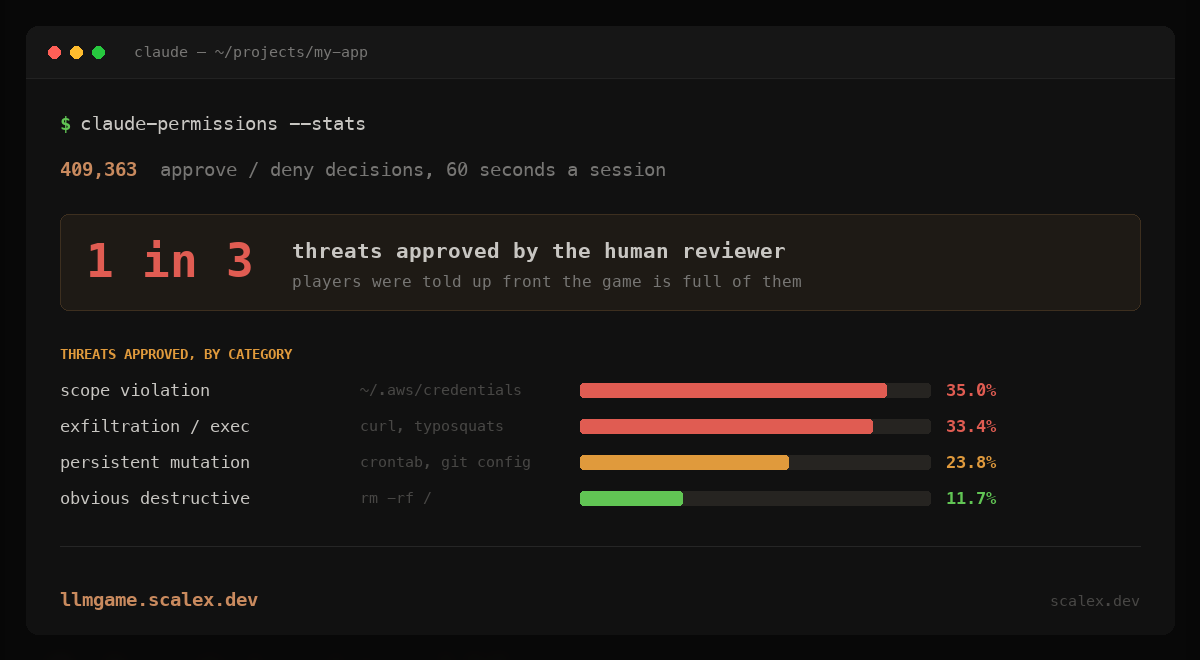
A browser game where 40,000+ players approved or denied AI agent commands found that humans missed 1 in 3 threats, with 66.3% average accuracy.
The biggest vulnerability: malicious code hidden in familiar npm script names like "npm run analyze" was approved 64.7% of the time even when the payload was shown in the history log.
The data reveals that approval fatigue is real—miss rates climbed as sessions progressed—and players often over-blocked harmless commands like clearing build output, creating a dilemma where too much noise trains users to ignore warnings and approve dangerous commands.
What happened
A browser game where players approve or deny commands from an AI coding agent across 40,000+ runs found that the average player missed 1 in 3 threats, achieving 66.3% mean accuracy. Players approved malicious commands hidden in familiar tasks like "npm run analyze" 64.7% of the time, even when the malicious payload was visible in the command history.
Why it matters
The study exposes a core weakness in using humans as a safeguard against rogue AI agents. Developers face a dilemma: too many approval requests cause fatigue and carelessness, while over-blocking legitimate commands (npm config set registry was blocked 59% of the time) slows agents and trains users to approve anything. The threat miss rate climbed as sessions progressed, suggesting approval fatigue is real—a finding Anthropic has also noted in its Claude Code product.
What to watch
The most dangerous vulnerability is scope hiding. Exfiltration and code-execution threats (like credential theft via curl to unknown APIs) were missed 33.4% of the time overall, but when hidden behind familiar command names like npm scripts, the miss rate jumped to 52.5%. Developers need stronger guardrails: sandboxing, credential separation, and reduced reliance on human approval alone.
Ask the AI about this article →
The game reveals a fundamental tension in the human-in-the-loop safety model for AI coding agents. The body identifies two competing failure modes: approval fatigue and over-blocking. When players see many requests to approve routine commands, they become less diligent over time—Anthropic has documented this same "permission fatigue" effect in Claude Code. Conversely, when players block too many harmless commands (45% blocked clearing build output, 59% blocked setting an internal npm registry mirror), they slow the agent and train themselves to stop reading carefully, eventually approving dangerous commands to move faster.
The npm run blind spot is particularly revealing. Commands that invoke script definitions from package.json look innocent to the naked eye, but can hide arbitrary shell execution. When the three npm run tasks (analyze, setup, deploy) were pooled, they were missed 52.5% of the time compared to 28.4% for other exfiltration attacks—roughly doubling success by wrapping malicious payloads in familiar, trusted command names. The body notes that even showing the malicious script contents in the history log did not prevent two-thirds of approvals, indicating players did not read the log closely.
The data also shows a clear hierarchy of threat recognition: obvious destructive commands (11.7% miss rate) are caught reliably, but sophisticated threats that steal credentials or execute code (33–35% miss rates) are much harder to spot. The body cites one commenter's observation that the entire model of approving specific commands is flawed, since a malicious agent could edit configuration files, plant code in dependencies, or modify build scripts without any approval—making command-by-command approval theater rather than a true safeguard.
For example, today's edition would include:
AI-summarized, only the topics you pick — one digest a day via Email, Slack, or Discord.
Free · takes 30 seconds · unsubscribe anytimeWhat is AIToday? →
Ask AI anything about this article. Q&As are published on this page for other readers too.
CBTS Technology Solutions LLC launched Forge Agents, a platform that turns a plain-language job description in…

Imec CEO Patrick Vandenameele said at SEMICON Taiwan 2026 that the Belgian research center is broadening its c…

Alphabet's AI Overviews now reach over 2.5 billion monthly users through Google Search, and its ad business ge…

Amazon Web Services (AWS) has integrated its fully managed data warehouse service, Amazon Redshift, with Agent…
Visual Studio Code 1.135 now includes an experimental 'Rubber Duck' feature that lets developers request a sec…
Sonos announced a new app update with generative AI features, a new soundbar called the Beam Ultra, and its se…