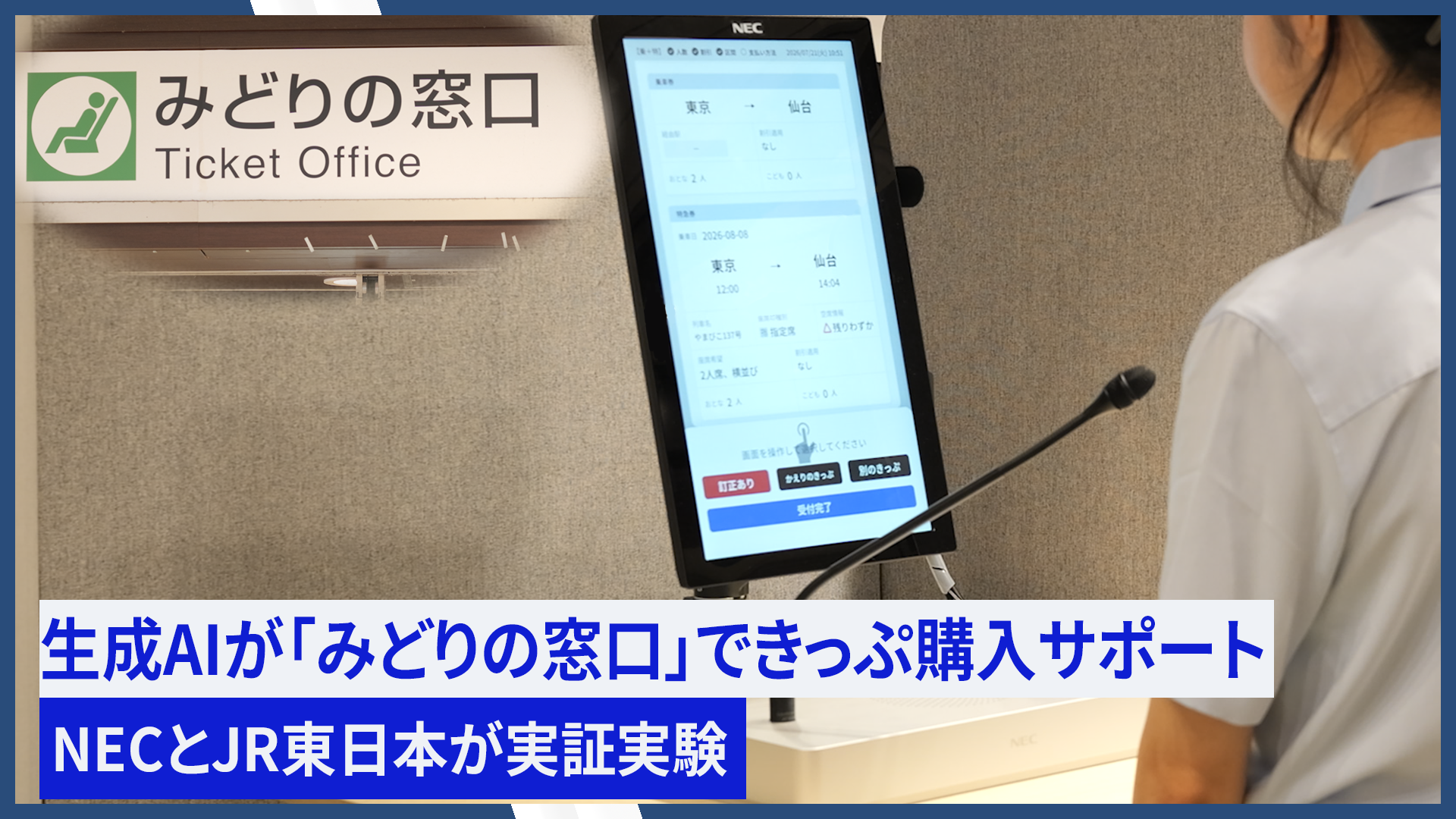
NEC and JR East Japan are testing a new generative AI service designed to speed up ticket purchases at Midori no Madoguchi (JR East's ticket windows).
The pilot aims to demonstrate how AI can streamline the traditionally manual ticket-buying process and improve customer experience at Japan's largest railway operator.
What happened
NEC and JR East Japan are conducting a pilot test of an AI-enabled ticket service (tentatively named "Midori no Madoguchi AI-Responsive Service") that uses generative AI to streamline ticket purchases.
Why it matters
The service aims to make the ticket-buying process smoother for customers at JR East's ticket windows, potentially reducing wait times and improving the customer experience at a major transportation provider.
What to watch
The pilot will demonstrate how generative AI can be applied to real-world customer service operations in the railway industry.
NEC and JR East Japan have launched a pilot program to test an AI-enabled ticket-purchasing service at Midori no Madoguchi, JR East's ticket window service. The service, currently operating under the tentative name "Midori no Madoguchi AI-Responsive Service," leverages generative AI technology to simplify and accelerate the ticket-buying process. The pilot aims to demonstrate how generative AI can be integrated into real-world railway customer service operations. By streamlining ticket purchases through AI assistance, the service is designed to improve the overall customer experience at one of Japan's most frequently used transportation hubs. The collaboration between NEC, a major Japanese IT and infrastructure company, and JR East reflects a broader trend of applying AI to traditional service delivery channels.
This pilot represents a practical application of generative AI to customer-facing railway operations in Japan. By partnering with JR East, one of Japan's largest transportation providers, NEC is testing whether AI can reduce friction in a high-volume, routine service interaction. The focus on Midori no Madoguchi—JR East's ticket window brand—signals an effort to modernize a longstanding customer touchpoint without replacing human staff entirely. The generative AI component suggests the system will handle natural language interactions, potentially allowing customers to describe their travel needs in plain language rather than navigating traditional menu systems.
AI-summarized, only the topics you pick — one digest a day via Email, Slack, or Discord.
Free · takes 30 seconds · unsubscribe anytime
Ask AI anything about this article. Q&As are published on this page for other readers too.
As agentic AI (autonomous systems that act across business applications) moves from pilot projects into produc…
Google launched the Pixel 11, Pixel 11 Pro, Pixel 11 Pro XL, Pixel 11 Pro Fold, and Pixel Watch 5
SpaceXAI released Grok 4.6, a large language model built with extended training on AI-generated datasets and r…
Skan AI, a process intelligence company founded in 2019, raised $63 million in a Series C round led by Cathay…
Blacksmith Software raised $45 million in Series B funding led by Peak XV Partners, with Y Combinator and GV a…
Santa Clara-based Apexon expanded its AgentRise agentic AI platform with three new components — Polaris (for p…
The AI news that matters, in one minute each morning.
Sign up free