What happened
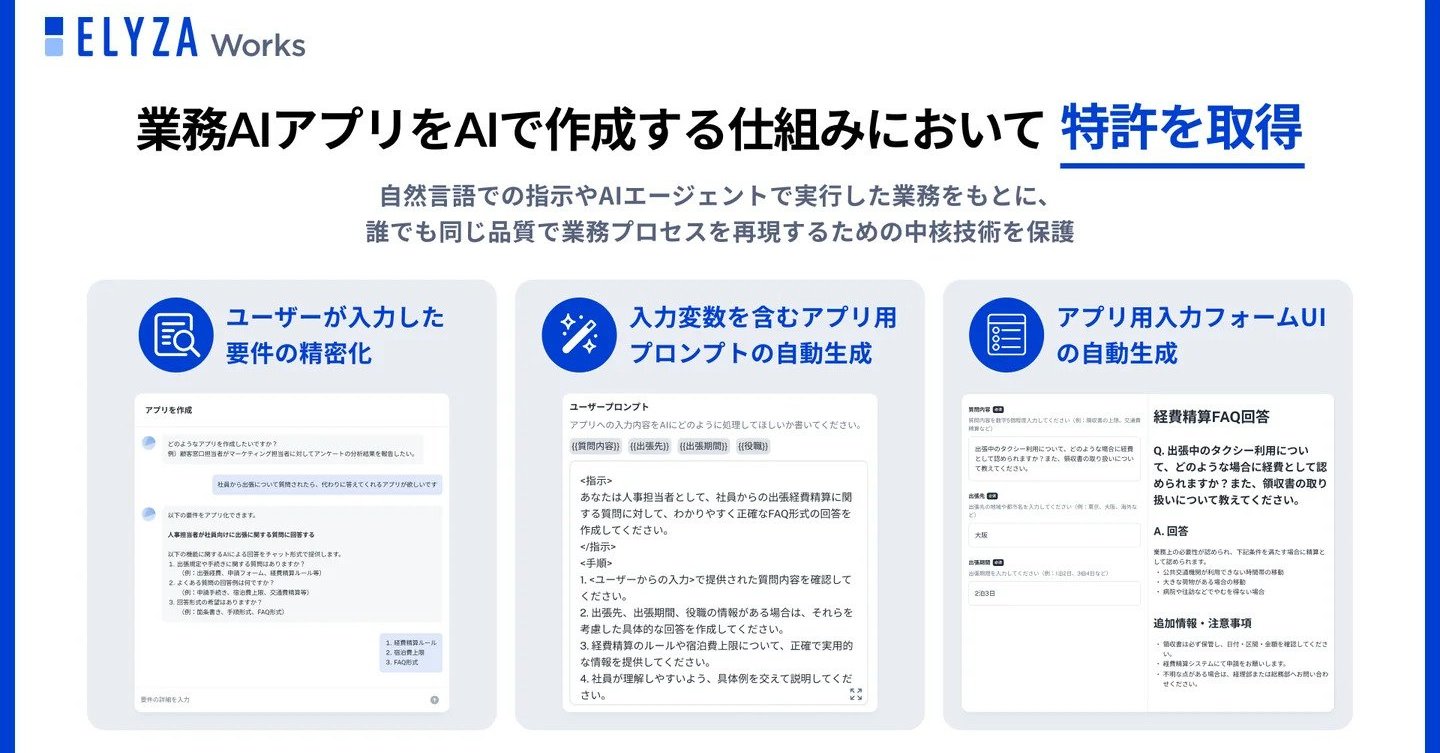
KDDI group AI firm ELYZA announced on September 3 that it obtained a patent for its system that uses generative AI to create business AI apps within its enterprise tool “ELYZA Works.”
Why it matters
The patent covers mechanisms to refine app requirement definitions, generate instructions and input variables, and create input/output forms. Some on X have criticized the patent, questioning its novelty and inventive step, with comments like “troubling if a patent is granted for this.”
What to watch
The test is whether the patent survives public scrutiny, as X criticism of its novelty and inventive step could lead to validity disputes. Watch for any opposition or invalidation proceedings following the September 3 announcement.
Summaries like this, in your inbox every morning.
The patent announcement from ELYZA highlights the growing focus on intellectual property in the generative AI application space. ELYZA has patented a workflow that turns user inputs into refined app specifications, instructions, and forms, which could give it a competitive edge in enterprise AI tools.
However, the critical reactions on X underscore a broader debate about what constitutes patentable innovation in AI. Skeptics argue that such mechanisms may seem obvious or pre-existing. The outcome may hinge on how novel and non-obvious these implementations are deemed, setting a precedent for similar AI process patents.
Pick your industry and the AI tools you use, and get news related to your work every day.
Free · 30 seconds with Google · unsubscribe anytimeWhat is AIToday? →
Ask AI anything about this article. The AI reads this article, earlier AIToday articles, and Wikipedia, and cites its sources. Q&As are published on this page for other readers too.
Cerence AI announced its collaboration with Geely is expanding from intelligent cockpits to embodied robotics…

Morgan Stanley already blocks AI agents entirely, and JPMorgan, Bank of America and Citi are doing the same, A…

Modal CEO Erik Bernhardsson said the AI infrastructure company crossed $1 billion in annualized run rate, rais…

Goldman economist Joseph Briggs wrote that under a forecast of AI lifting productivity 15%, up to 9% of worker…
Microsoft's Diagnostic Orchestrator, powered by OpenAI's GPT-5, scored about 83 percent diagnostic accuracy on…
Zuckerberg said Muse, released to the public last month, has been downloaded and set up by more than 10 millio…