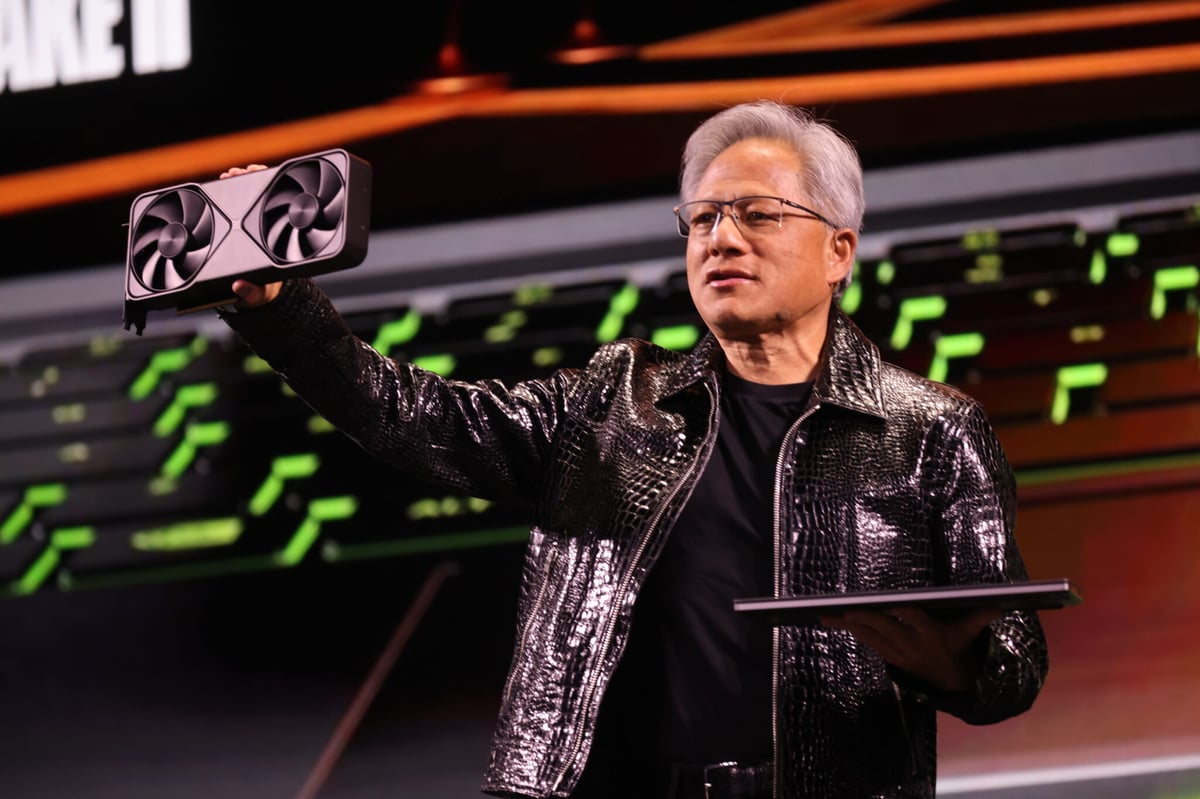
Nvidia CEO Jensen Huang has announced that memory chips—not computing power—are now the primary constraint limiting AI advancement.
As AI workloads grow more complex, demand for specialized high-bandwidth memory has intensified, but only a handful of chipmakers (Micron, SK Hynix, Samsung) can supply them at scale.
Nvidia's scale and cash reserves ($48.6 billion(約7.8兆円) in free cash flow in its most recent quarter) position it to secure priority access to these chips, but the company is now dependent on external suppliers for a critical part of its business.
What happened
Nvidia CEO Jensen Huang identified memory chips as AI's largest bottleneck, shifting focus from the earlier priority of acquiring raw compute power (GPUs). Nvidia now relies on memory chipmakers like Micron, SK Hynix, and Samsung for high-volume supply of specialized memory chips embedded in its hardware systems.
Why it matters
As AI tackles more complex tasks—autonomous agents, intricate context processing—demand for high-bandwidth memory has grown critical. Because only a handful of companies manufacture these chips at scale, Nvidia faces supply-chain risk if memory makers cannot keep pace. However, Nvidia's financial strength ($48.6 billion(約7.8兆円) in free cash flow in the most recent quarter ended April 26, and $13.2 billion(約2.1兆円) in cash and cash equivalents) gives it purchasing priority and the ability to pay premiums, letting it secure supply ahead of smaller competitors.
What to watch
Huang's statement signals the next phase of AI infrastructure development rather than a crisis. Nvidia's ability to secure memory supply will be critical to sustaining its leadership position, even as the company navigates ongoing pressure on its stock (up only 0.60% year to date as of July 29).
Nvidia, founded in 1993, became a dominant force in the artificial intelligence boom by supplying the graphics processing units (GPUs) that provide the compute power for training and scaling AI systems. At the outset of the current AI wave, the primary goal for major tech companies was straightforward: acquire as much compute power as possible to meet demand for AI infrastructure. That priority has now shifted. CEO Jensen Huang has highlighted that specialized memory chips—not compute—have become AI's biggest bottleneck.
The reason is rooted in how modern AI systems operate. AI training and deployment depend on processing trillions of data points, which must be stored and retrieved with speed and precision. As AI is applied to more complex tasks—such as running autonomous agents or processing intricate reasoning chains instead of simple recommendations—the demand for high-bandwidth memory has become critical. Nvidia recognized this shift and began constructing integrated hardware systems with multiple components, including specialized memory chips packed directly into its products. However, this strategy ties Nvidia to external suppliers: Micron, SK Hynix, and Samsung are among the companies providing the bulk of these memory chips. Manufacturing such specialized chips is technically challenging, and only a handful of producers make them at scale—a stark contrast to Nvidia's own position in GPU manufacturing.
This dependency creates both a risk and an opportunity for Nvidia. The downside is that Nvidia's supply chain is now constrained by the production capacity of its memory suppliers; if they cannot manufacture chips quickly enough, Nvidia will face delays that could affect its own business. The upside is Nvidia's financial firepower and scale. In the quarter ended April 26, Nvidia generated $48.6 billion(約7.8兆円) in free cash flow and held $13.2 billion(約2.1兆円) in cash and cash equivalents. This gives the company the ability to pay premiums for memory chips, buy them in bulk, and secure priority treatment from suppliers—effectively shutting out smaller competitors and further entrenching Nvidia's industry position. Rather than a crisis, Huang's acknowledgment of the memory bottleneck signals the next phase of AI infrastructure evolution. Nvidia's stock has been flat this year, up only 0.60% year to date as of July 29, reflecting broader sentiment around large technology companies rather than Nvidia's operational performance.
Nvidia's rise has been built on its dominance in GPUs, the processors essential for training and scaling AI systems. For years, the bottleneck was simply acquiring enough compute power to meet insatiable demand from tech giants building AI infrastructure. CEO Jensen Huang's recent statement reflects a fundamental shift in that constraint: the industry has moved past raw compute scarcity to a new problem—memory. As AI models tackle increasingly sophisticated tasks, from autonomous agents to processing complex reasoning chains, the systems require not just more power but faster, higher-capacity memory to store and retrieve the vast datasets these models depend on.
The challenge lies in the supply side. Memory chips are manufactured by a small number of specialized producers, and the production process itself is technically demanding. Unlike GPUs, where Nvidia holds market leadership, memory chipmaking is controlled by companies like Micron, SK Hynix, and Samsung—suppliers on whom Nvidia must now rely. This dependency represents a risk: if these suppliers cannot scale production fast enough, Nvidia's own ability to assemble and ship systems could slow. However, Nvidia's financial advantage mitigates this risk. With $48.6 billion(約7.8兆円) in free cash flow from its most recent quarter and $13.2 billion(約2.1兆円) in liquid cash, Nvidia can pay premiums to secure priority access, effectively using its scale and purchasing power to lock in supply and starve smaller competitors. This dynamic reinforces Nvidia's dominance even as it shifts from controlling the primary bottleneck (compute) to negotiating from a position of strength with suppliers of the next one (memory).
AI-summarized, only the topics you pick — one digest a day via Email, Slack, or Discord.
Free · takes 30 seconds · unsubscribe anytime
Google, Microsoft, and Meta continue expanding capital spending on AI infrastructure, signaling confidence tha…
ByteDance is reorganizing Doubao (its AI chatbot), Lark (workplace software), and Volcengine (cloud infrastruc…

Pegatron chairman Tzu-hsien Tung stated he remains optimistic about the long-term outlook for artificial intel…

Powertech Technology chairman DK Tsai said the company's FOPLP (Fan-Out Panel-Level Packaging) project with AM…

Nebius Group (NBIS) has more than doubled this year on strong demand for AI data centers with secured power, a…
Reddit reported Q2 earnings that surpassed estimates, driven by expansion in AI-powered advertising tools that…

The AI news that matters, in one minute each morning.
Sign up free