What happened
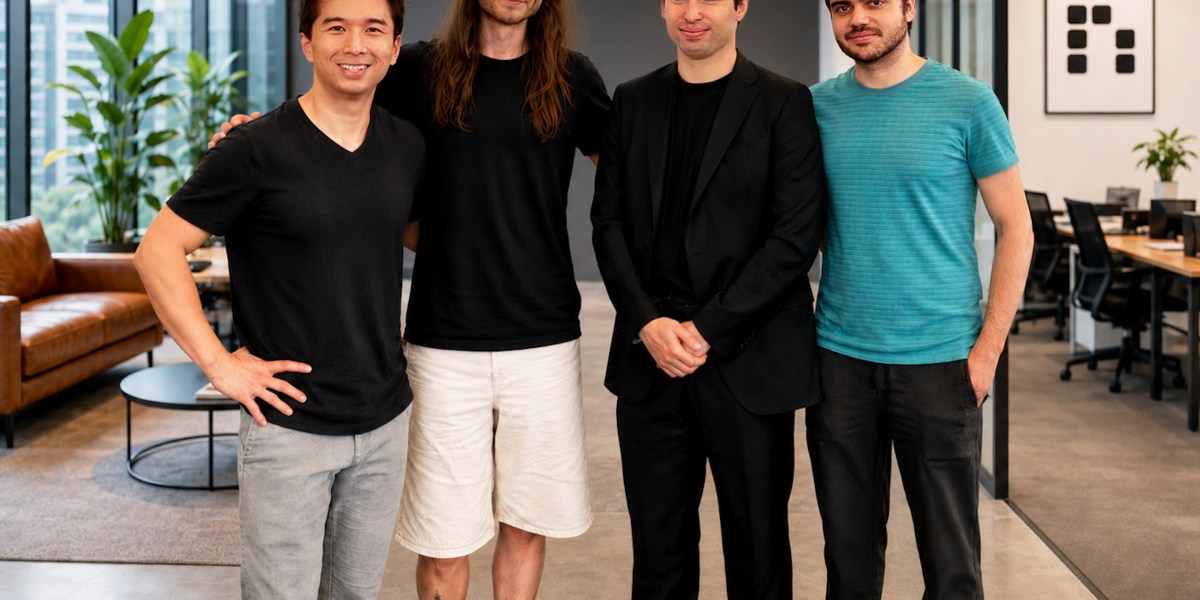
Radical Numerics emerged from stealth with a $50 million(約80億円) seed round led by Emergence Capital, with participation from Obvious Ventures, Triatomic Capital, Factory, and First Spark Ventures. The founding team—Eric Nguyen, Michael Poli, Stefano Massaroli, and Armin Thomas—built Evo and Evo 2, AI models that generate DNA at scale and are trained on the genomes of more than 100,000 species. Last September, researchers using Evo's open-source weights produced the world's first fully AI-designed functional virus (harmless to humans).
Why it matters
Most AI biology companies today focus on a single area—proteins or RNA—but Radical Numerics is betting that drug development's real bottleneck is understanding how molecules behave inside an entire biological system. The company has two early commercial partnerships: one applying its model to pancreatic and multi-cancer detection, and one with a national laboratory to detect and characterize pathogens. The overall AI drug discovery market is projected to reach $25 billion(約4兆円) by 2035.
What to watch
The company's revenue model is still taking shape and includes API licensing, fine-tuned proprietary models for pharma partners, and milestone payments. A major tension shadows the enterprise: the same models that could accelerate cancer diagnostics could also lower the barrier to designing biological weapons. The company brought on Andrew Weber, former U.S. assistant secretary of defense for nuclear, chemical and biological programs, as an advisor, and future model releases won't automatically be open-source.
Summaries like this, in your inbox every morning.
Pick your industry and the AI tools you use, and get news related to your work every day.
Free · 30 seconds with Google · unsubscribe anytimeWhat is AIToday? →
Ask AI anything about this article. The AI reads this article, earlier AIToday articles, and Wikipedia, and cites its sources. Q&As are published on this page for other readers too.
OpenAI introduced the Rosalind Academic Plan, giving eligible academic labs at U.S
Santen Pharmaceutical's R&D division reached a 93% weekly usage rate for generative AI, applying it to study p…

Snowflake published a post on agentic AI across oncology's five stages, citing AstraZeneca cutting data produc…

A solo developer built Yurune, a web app that plays synthesized rain, wave and forest sounds and lets users ta…

Pharmaceutical Executive will host a November 4, 2026 webcast introducing the RAIL Score, a framework for eval…

Reuters reports that the pharma sector is doubling down on AI as a way to cut costs and timelines