What happened
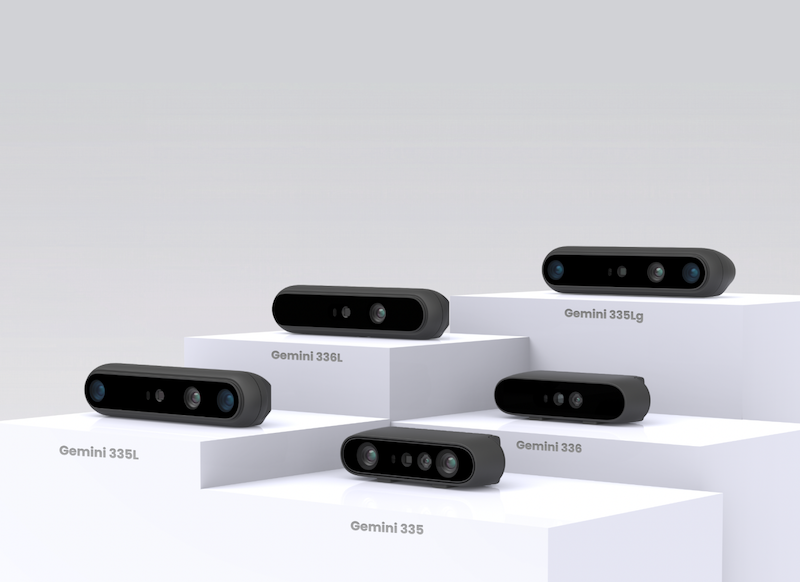
Orbbec's Gemini 330 series, shipping since the Gemini 335 and 335L launched in April 2024, runs active and passive stereo at once and does depth generation plus depth-to-color alignment on the MX6800 ASIC inside the camera.
Why it matters
Because depth is finished before it leaves the camera, the host receives a completed depth map instead of raw stereo images to process, which frees the host for navigation and perception work.
WHO IT HITSRobot integrators and automation engineers building AMRs, picking cells, and fixed inspection stations can treat depth as a finished camera output rather than a host workload, simplifying host selection and per-site lighting setup.
Summaries like this, every morning.
The Gemini 330 family is organized around where the depth map is computed, and Orbbec has been building that capability in-house for years. The MX6800 is the latest in a line of Orbbec depth-engine ASICs that includes the MX400, which arrived in 2015, followed by the MX6300, MX6000, and MX6600. Orbbec designs the depth engine, the camera, the calibration process, and the manufacturing itself, so calibration and depth processing are tuned together and the product roadmap does not depend on a third-party vision processor staying available.
Within the on-device processing camp, the series stands apart in three ways: it runs active and passive stereo simultaneously for indoor and outdoor lighting, it performs depth-to-color alignment in hardware, and its modular lineup lets an integrator keep one SDK and one depth pipeline while changing baseline, filter, interface, or enclosure rating. The family splits into compact models with a 50mm baseline, long-baseline models at 95mm, and Ethernet and GMSL2 variants for fixed installations and vehicle or large-robot platforms.
The choice between on-device and host-side processing is usually a system architecture question. On-device processing frees host compute and makes performance more predictable across different host platforms, while host-side processing gives developers more control over the matching algorithm. Orbbec positions the series for robotics and industrial automation, reflected in global-shutter sensors, hardware synchronization options, industrial connectors, and IP ratings that scale with the interface.
Pick your industry and the AI tools you use, and get news related to your work every day.
Free · 30 seconds with Google · unsubscribe anytimeWhat is AIToday? →
Ask AI anything about this article. The AI reads this article, earlier AIToday articles, and Wikipedia, and cites its sources. Q&As are published on this page for other readers too.
OpenAI said GPT-5.6 Sol, operating through its Codex coding tool, autonomously completed routine measurements…
OpenAI's GPT-6.1 Terra scored 78.2% on the DualEntry Accounting AI Benchmark, tying for 18th of 22 models, wit…

OpenAI released GPT-6.1 Terra with API prices at $1 per million input tokens and $5 per million output tokens…

OpenAI released GPT-6.1 Terra on October 26, 2026, at $1 per million input tokens and $5 per million output, w…

Anthropic's long-awaited IPO document, released Monday, shows more than $400 billion in future obligations for…
An Apollo Global Management-managed entity will buy Nvidia's next-generation Vera Rubin chips and server hardw…