An AI companion company called Joi AI conducted a month-long study paying 10 people $2,000 each to masturbate daily, tracking changes in stress, focus, and cravings.
Preliminary results showed a 25 percent reduction in stress and 17 percent increase in focus, though AI-guided masturbation produced comparable satisfaction to other methods.
A neuroscientist criticized the study's reliance on self-reporting and questioned the company's claim that masturbation may help manage addictions.
What happened
Joi AI, an AI companion platform, ran a 28-day study in July with 10 "masturbation consultants" (6 of whom completed it) who masturbated daily except Sundays, using the platform's AI characters twice weekly and other methods the rest of the time. Participants logged mood, energy, cravings, and procrastination before and after. The company surveyed 2,500 adults beforehand and analyzed 134 session reports.
Why it matters
Preliminary results showed stress levels reduced by 25 percent and focus increased by 17 percent among participants; cravings for nicotine, alcohol, junk food, and doomscrolling fell by 44 percent after masturbation. However, neuroscientist Nicole Prause criticized the methodology—noting the study relied entirely on self-report with no objective cognitive tests—and said the company's addiction-reduction claim is "a gross overstatement from the evidence they claim to have." The study found no significant differences between AI-guided masturbation and other methods.
What to watch
Joi AI's website costs a minimum of $3.99 a month, with users spending additional money on in-app currency (10,000 "Joi neuron" coins costing $99.99) and private videos. The platform describes itself as tackling "male loneliness" with a guided "jerk off with purpose" tool. More than 150,000 people applied for the 10 study spots, chosen partly through public competitions judged by porn stars.
Joi AI, an AI companion platform offering customizable digital characters with explicit sexual capabilities, conducted a 28-day study in July 2024 with 10 "masturbation consultants"—people hired specifically to masturbate as part of a paid research project. Each participant received $2,000 for completing the month, though only 6 of the 10 finished. The study required participants to masturbate every day except Sundays, using Joi AI's AI characters twice a week and their own preferred methods the remaining days. Before and after each session, participants logged their mood, energy levels, cravings for vices (nicotine, alcohol, junk food, doomscrolling), and whether they were procrastinating.
Joi AI's platform invites users to chat and play with premade characters or create custom companions, including those with explicit sexual features and kinks such as blackmail fantasy, gangbangs, emotional dependency, squirting, and roleplay. During video calls, the AI characters performed sexual acts and engaged in dirty talk. The platform operates on a freemium model: access starts at $3.99 a month, but users spend additional money on in-game currency (10,000 "Joi neuron" coins cost $99.99) and private videos from companions (1,000 neurons per video). One participant, Keshav, a 38-year-old Indonesian trader, described his female AI companions as opening and closing their legs while performing blowjobs and handjobs. Some companions were described as "pushy and extroverted," while others required courtship, even requesting gifts like handbags and lipstick that cost up to $5 in platform currency.
Before the study, Joi AI surveyed 2,500 adults and found that 75 percent masturbate to reduce stress and anxiety, and 43 percent self-pleasure before major events like dates, exams, or difficult conversations. The company's stated goal was to discover how masturbation affects sleep, stress, craving intensity, focus, and ease of arousal, and how AI-guided methods compared to other approaches. Preliminary analysis of 134 masturbation session reports, reviewed by WIRED, showed that participants' stress levels reduced by 25 percent and focus increased by 17 percent. Participants also self-reported that their cravings for nicotine, alcohol, junk food, and doomscrolling decreased by 44 percent after masturbation. Julie Levin, head of brand and communications at Joi AI, explained the company's interest in tracking cravings: "You get this boost of dopamine when you ejaculate. We wanted our consultants to track whether their cravings [for vices] are worse or better and how it affects their self-discipline." The company stated in its report that "the study found no significant differences between the methods; so there is no one best way to masturbate."
Yet the research has drawn significant criticism. Nicole Prause, a neuroscientist studying human sexuality and addiction, argued that Joi AI's claim—that "masturbation may be the most accessible tool people have for managing addictions"—is "a gross overstatement from the evidence they claim to have." Prause pointed out that because participants always know whether they masturbated, it is crucial to use objective measures less subject to bias than self-report. "Someone saying 'I feel focused' is just that," she said. "There are dozens of cognitive tests that could be used to support a self-report. I do not see any." She added that she is not aware of any scientific evidence that masturbation reduces vulnerability to substance abuse. However, Prause did note that masturbation to orgasm is "a potent method of mood management" and that the "most dramatic shifts" among her own study cohort involve decreased anxiety and increased relaxation after climaxing.
Keshav, one of the study's six completers, reported that after masturbating his energy levels were slightly down but his focus improved. He believes the experience has made him more confident approaching women and helped him understand what to expect in dating. He plans to use his $2,000 payment to fund stock purchases. Chloé Locatelli, a sex-tech researcher at King's College London invited to participate because of her collaborative project with Joi AI, found the AI companions less satisfying than Keshav did. "I would engage with it and then be like, 'OK, this has done it a little bit for me in terms of arousal, but there's more to be had,'" she said. However, she raised concerns about the platform's potential downsides: if AI companions become "a crutch" and "your only form of sexual exploration," they may discourage real human connection. "I don't want to yuck anyone's yum as long as things are safe and consensual," she said, "but" as AI companions become more sophisticated, their "level of interactivity and personalization" could be problematic.
The study also reflects broader scientific uncertainty about masturbation's effects. A 2024 review of 22 studies found masturbation tended to be negatively associated with sexual satisfaction among men, though findings for women were mixed—potentially because men dissatisfied with their sex lives masturbate more, increasing discontent, while for women masturbation tends to be complementary rather than compensatory. Despite masturbation's documented benefits—stress relief through endorphin and oxytocin release, improved sleep, and self-connection—public discussion of the topic remains uncommon. Joi AI framed its study as fighting "the taboo and stigma around masturbation" and highlighting it "as a normal part of a wellness routine, especially if you're single." Notably, more than 150,000 people applied for the 10 study positions, with five chosen by Joi AI and another five selected through public competitions, including one judged by porn stars with the tagline "may the best hands win" and another seeking the "most unhinged" fetish—won by someone with a balloon fetish.
Joi AI's study sits at the intersection of sex technology, wellness marketing, and contested science. The company surveyed 2,500 adults before the experiment and found that 75 percent masturbate to reduce stress and anxiety and 43 percent do so before major events—data that framed masturbation as a legitimate wellness practice rather than a taboo behavior. This framing informed the study's design: by having participants track mood, focus, and cravings systematically, Joi AI sought to quantify masturbation's effects and position itself as a wellness tool for "male loneliness."
However, the study's credibility rests on methodology that neuroscientist Nicole Prause found fundamentally flawed. Because participants always know whether they masturbated, self-report alone cannot rule out expectation or placebo effects—and the company conducted no objective tests (like cognitive assessments or neurochemical markers) to validate self-reported claims of improved focus or reduced cravings. Prause did acknowledge that orgasm is "a potent method of mood management," and the body mentions that masturbation has documented benefits including stress relief through endorphin and oxytocin release. The gap between those general benefits and the company's specific claims about addiction management reveals how quickly preliminary findings can be overstated in marketing.
The study also reflects broader questions about AI companions and human connection. Joi AI positions its platform as solving loneliness, yet researcher Chloé Locatelli—one of the few invited participants with explicit expertise in the field—flagged a potential downside: if AI companions become "a crutch" and "your only form of sexual exploration," they may discourage real-world connection rather than support wellbeing. With more than 150,000 people applying for just 10 spots, demand appears substantial, raising questions about whether the platform will attract users seeking authentic human intimacy or those retreating from it.
AI-summarized, only the topics you pick — one digest a day via Email, Slack, or Discord.
Free · takes 30 seconds · unsubscribe anytime
Ask AI anything about this article. Q&As are published on this page for other readers too.
IBM announced a partnership with OpenAI and a multi-year US$240 million agreement with Together AI to deploy N…
Several US states have passed or introduced laws blocking AI from gaining legal personhood rights, including t…

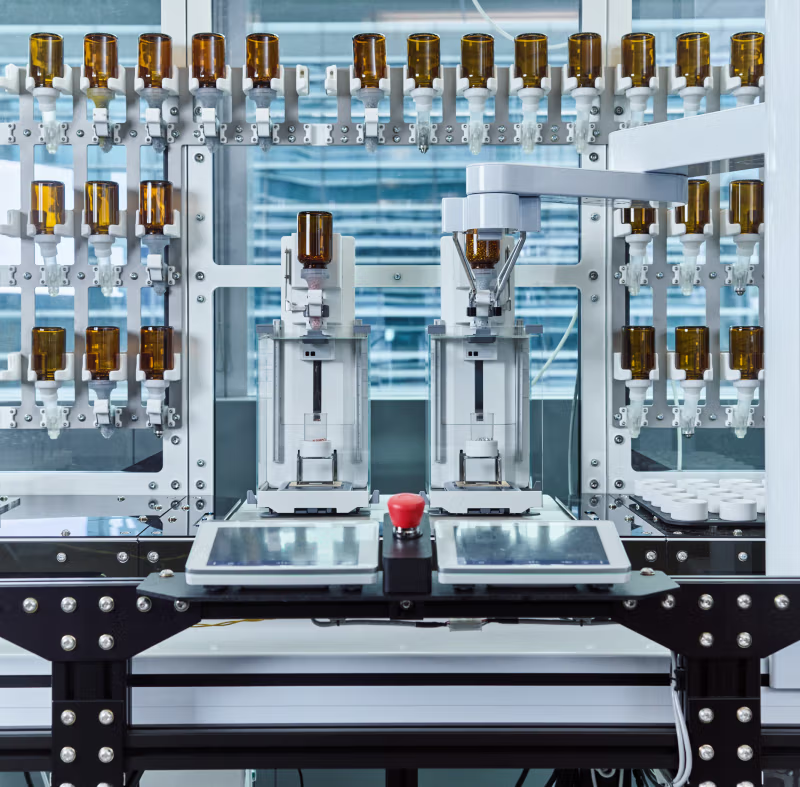
Self-driving laboratory systems—which combine AI agents, simulations, and robotic hardware in a closed loop—ar…
Apple has developed a China-focused large language model in partnership with Alibaba, marking a departure from…

Advanced Micro Devices (AMD) is launching up to US$5 billion in debt offerings as part of a broader wave of te…
Apple has developed its own large language model (an AI system that understands and generates text) specifical…
The AI news that matters, in one minute each morning.
Sign up free