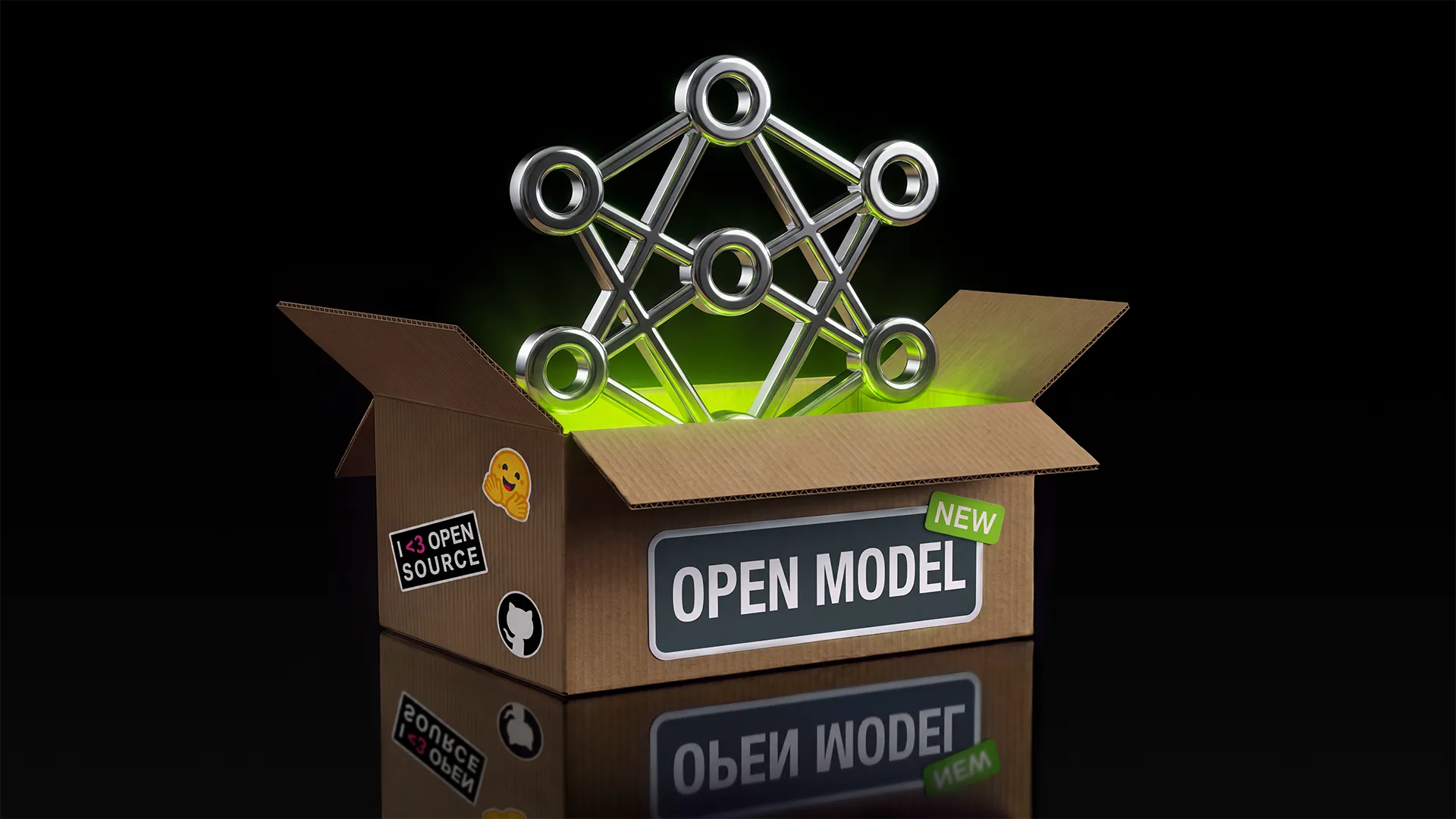
Meta has released Muse Glimmer, a 30-billion-parameter open-weight AI model optimized for running local agentic workflows on NVIDIA hardware without relying on cloud services.
The model processes 20,000 tokens per second on a single GPU and is designed for multi-step agent tasks—such as code generation and autonomous support—rather than single-turn chat, ensuring data privacy and compliance for enterprises.
Developers can deploy it via open-source inference frameworks or a prebuilt NVIDIA container, with fine-tuning support through NVIDIA's NeMo toolkit.
What happened
Meta has released Muse Glimmer, a 30B open-weight dense model with a 120K+ context window designed for local AI agentic work. It delivers 20K tokens/sec on a single GPU and is optimized to run on NVIDIA edge, desktop, and workstation platforms.
Why it matters
Unlike chat-focused LLMs, Muse Glimmer is built for long-running agents that need to execute multi-step workflows reliably. Its dense architecture (activating every parameter) ensures consistent instruction following and predictable latency, and because it runs entirely on-device, it keeps proprietary code, credentials, and personal data local—eliminating cloud inference costs and compliance concerns for enterprises operating under air-gap mandates.
What to watch
Developers can download Muse Glimmer weights from HuggingFace and deploy via open-source inference recipes (SGLang, vLLM) or use a prebuilt NVIDIA NIM container. Fine-tuning is enabled through NVIDIA NeMo AutoModel (supporting SFT and LoRA) and reinforcement learning via NeMo RL. A hosted endpoint is available on build.nvidia.com, and edge deployments on Jetson are supported through Jetson AI Lab.
Meta has released Muse Glimmer, a 30B open-weight dense model with a 120K+ context window, optimized for local AI agentic workflows on NVIDIA hardware. The model delivers 20,000 tokens per second on a single GPU and is designed to enable always-on agents to process data and execute complex multi-step workflows entirely on-device.
Muse Glimmer's architecture reflects a fundamental difference from chat-focused LLMs. Most large language models are optimized for chat, prioritizing single-turn interactions and fast time to first token. Agentic workloads, by contrast, demand agents that can execute several sequential tool calls in a single session—such as scaffolding a software project, revising documentation, or managing a knowledge base—while maintaining reliability, consistency, and sustained throughput. Muse Glimmer uses a dense architecture that activates every parameter for each token it processes, with no routing or expert selection. This design eliminates variance across token pathways and reduces failure modes, enabling reliable instruction following, long-context coherence, and predictable latency.
The model is built for privacy by design. Because agentic workflows often involve personal files, communications, credentials, and proprietary documents, inference must never leave the machine. Muse Glimmer is large enough for complex multi-step reasoning but small enough to fit within the VRAM of a single NVIDIA GPU, with no model sharding or CPU offloading required. On NVIDIA Blackwell Ultra, the model delivers over 20,000 tokens per second at BF16/NVF4 precision, with a single Blackwell Ultra handling the full model in VRAM with headroom for large key-value cache buffers. NVIDIA GeForce RTX 5090 pairs 32 GB of VRAM with fifth-generation Tensor Cores, bringing Muse Glimmer to local developer devices and eliminating per-token inference costs. NVIDIA DGX Spark brings workstation-class performance for enterprise agentic pipelines into a compact system, while NVIDIA DGX Station brings rack-scale Blackwell Ultra compute to on-premises enterprise environments for teams under air-gap mandates or strict compliance frameworks. NVIDIA Jetson extends local Muse Glimmer inference to edge devices, enabling robotics, industrial automation, and embedded systems.
Developers can build and fine-tune agentic use cases using NVIDIA NemoClaw in a secure OpenShell environment to create long-running personal assistants for code generation, autonomous support, and other tasks. The NVIDIA NeMo AutoModel enables full supervised fine-tuning and LoRA fine-tuning out of the box, optimized for rapid experimentation on NVIDIA GPUs. Reinforcement learning is supported via NeMo RL, with sample recipes and reference accuracy validation curves. Deployment paths include open-source inference recipes like SGLang and vLLM for developers requiring deeper control over performance, as well as a downloadable NVIDIA NIM—a prebuilt, optimized inference container that auto-selects runtime configuration and serving setup. Developers can download Muse Glimmer weights from HuggingFace, deploy using the inference recipes, or pull the NIM for production-ready deployment on any NVIDIA GPU-accelerated platform. A hosted endpoint is available on build.nvidia.com, and edge deployments on Jetson are supported through Jetson AI Lab.
Meta's return to open source with Muse Glimmer reflects a shift in how the industry thinks about local AI inference. The model is purpose-built for agentic workflows—long-running, multi-step processes that require consistent behavior across many sequential tool calls—rather than conversational chat. This distinction matters because chat-first models optimize for speed to the first response, whereas agents need sustained throughput, long-context coherence, and predictable latency over extended sessions. By using a dense architecture (all parameters active for every token) instead of mixture-of-experts routing, Muse Glimmer avoids variance across token pathways and reduces failure modes, making it more reliable for mission-critical tasks like code generation or document management.
The emphasis on local deployment across NVIDIA's platform stack—from edge devices (Jetson) to enterprise data centers (DGX Station)—addresses two critical concerns for enterprises: data privacy and compliance. Keeping inference on-device means proprietary code, credentials, and personal documents never leave the machine, and eliminating per-token inference costs removes a recurring expense. For teams operating under air-gap mandates or strict compliance frameworks, this is a material advantage. The availability of multiple deployment paths (open-source inference stacks like vLLM, prebuilt NIM containers, and fine-tuning via NeMo) gives developers flexibility to match their operational preferences and performance requirements.
AI-summarized, only the topics you pick — one digest a day via Email, Slack, or Discord.
Free · takes 30 seconds · unsubscribe anytime
Ask AI anything about this article. Q&As are published on this page for other readers too.
Amazon and Google are intensifying competitive efforts against The Trade Desk (TTD), a major digital advertisi…
OpenAI introduced Premium Seats for ChatGPT Business, priced at $125 per user per month ($100 with annual bill…

Computer scientists at University of Tübingen, Max Planck Institute, MATS Research, and Snyk discovered a meth…

Anthropic pledged to embed machine-readable watermarks in Claude-generated text and digitally signed provenanc…

Anthropic has signed the EU AI Act Code of Practice and will embed invisible watermarks in Claude-generated te…

Anthropic has agreed to pay $9.1 billion over 20 years to Riot Platforms Inc., a Bitcoin miner turned data cen…

The AI news that matters, in one minute each morning.
Sign up free