Researchers introduced a benchmark grounded in two PSPACE-complete regular expression problems: equivalence decision (RegexEQ) and minimization (RegexMin), using a dataset of over a million regex instances constructed through double-exponential space exploration.
Evaluations on 6 LLMs (AI models that understand and generate text) and 5 large reasoning models (LRMs — models that emphasize explicit reasoning steps) revealed common failure patterns such as verbosity and repetition, offering empirical investigation into the spatial computational limitations of these systems.
The work presents the first rigorous framework for assessing computational capacity of LLMs and LRMs by focusing on PSPACE-complete problems, which require massive search space exploration and serve as a more demanding standard than problems in the NP complexity class.
Summaries like this, in your inbox every morning.
Pick your industry and the AI tools you use, and get news related to your work every day.
Free · 30 seconds with Google · unsubscribe anytimeWhat is AIToday? →
Ask AI anything about this article. The AI reads this article, earlier AIToday articles, and Wikipedia, and cites its sources. Q&As are published on this page for other readers too.
Aparna Nair, IBM's chief talent, leadership, and culture officer, said generalists alone "will cut it" in the…
Dell says its AI Data Platform uses a four-engine architecture and a Unified Semantic Layer to connect siloed…

Amazon introduced Bee Frontier, a wearable personal AI, for $74.99 in Onyx, Lavender and Sage, and Bee Eclipse…

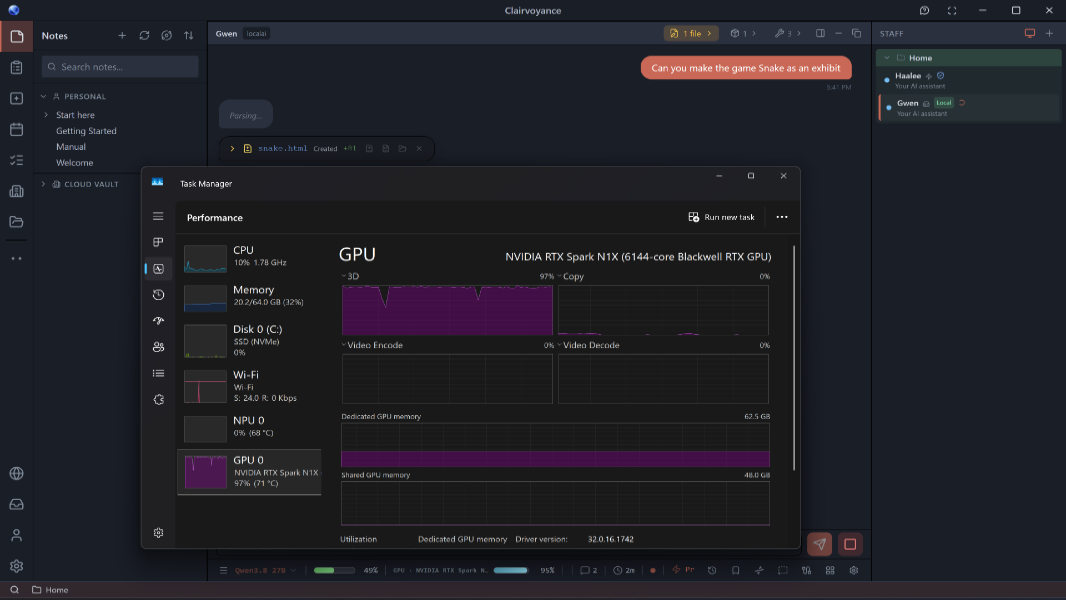
Microsoft and Nvidia are promoting RTX Spark, a new class of Windows PCs for local AI, with a top configuratio…
Microsoft AI CEO Mustafa Suleyman told employees that MAI-Base-2, announced Thursday, is a stronger pre-traine…

RapidCanvas raised a $29M Series B led by Vertex Ventures SEA & India, with Hitachi Ventures and existing inve…