AIToday

Japan's robotics giants join NVIDIA Cosmos coalition to build physical AI

Yahoo Finance AI1h ago
Japan's robotics giants join NVIDIA Cosmos coalition to build physical AI

Key takeaway

NVIDIA announced that Japan's leading robotics and manufacturing companies—FANUC, Fujitsu, Hitachi, Kawasaki Heavy Industries, and others—are joining the NVIDIA Cosmos Coalition to build physical AI systems. The company also unveiled Cosmos 3 Edge, a 4-billion-parameter model that enables robots and vision AI agents to reason and act in real time on edge computers. This partnership leverages Japan's strengths in manufacturing and precision engineering to advance the deployment of intelligent machines across factories, mobility, and infrastructure.

Summaries like this, in your inbox every morning.

Sign up free →

3 Key Points

  • What happened

    NVIDIA announced that Japan's leading robotics and manufacturing companies—including FANUC, Fujitsu, Hitachi, Kawasaki Heavy Industries, Kubota, NEC, SoftBank Corp., Sony Group Corporation, Yaskawa Electric, and others—intend to join the NVIDIA Cosmos Coalition. NVIDIA also introduced Cosmos 3 Edge, a 4-billion-parameter model that runs on NVIDIA Jetson edge computers to help robots see, reason in real time, and predict actions locally.

  • Why it matters

    Physical AI—embedding intelligence into machines, facilities, and infrastructure—is becoming a major frontier for automating complex industrial work. Japan has deep strengths in robotics, manufacturing, precision engineering, and automotive technology; this partnership positions the country to lead the next generation of intelligent machines by combining its manufacturing heritage with NVIDIA's AI platforms (Cosmos, Isaac, Metropolis, Jetson).

  • What to watch

    Fujitsu is exploring a collaborative control platform for physical AI, and manufacturers including FANUC, Yaskawa Electric, Kawasaki Heavy Industries, Honda R&D, OMRON, and others are already integrating NVIDIA technologies into their systems. The announcement was made on July 15, 2026.

In Depth

On July 15, 2026, NVIDIA announced a significant expansion of its physical AI initiatives in Japan, bringing together the country's leading robotics and manufacturing companies under the NVIDIA Cosmos Coalition. The announcement reflects a strategic push to advance the deployment of intelligent machines across manufacturing, mobility, infrastructure, and robotics sectors. At the heart of the initiative is Cosmos 3 Edge, a new 4-billion-parameter model built on NVIDIA Nemotron technology that enables embodied systems to see, reason in real time, and predict robot actions directly on edge devices. Unlike larger AI models that require cloud processing, Cosmos 3 Edge runs locally on NVIDIA Jetson platforms, allowing robots and vision AI agents to operate with minimal latency—a critical requirement for real-world manufacturing and robotics applications.

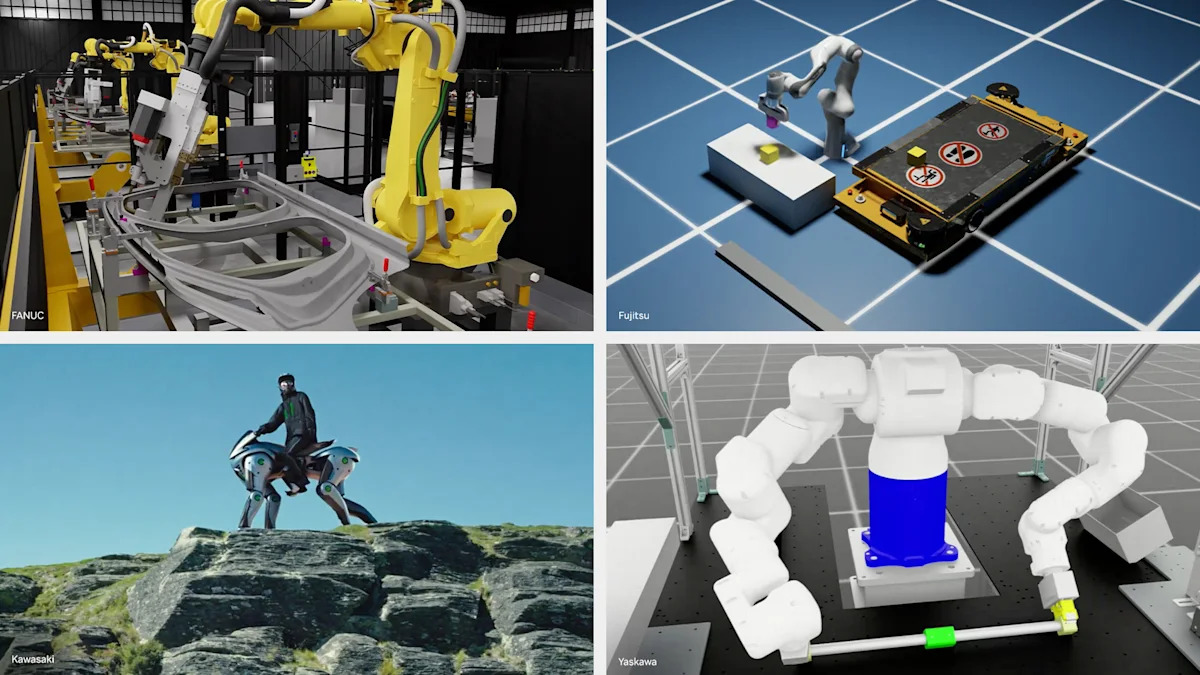
The coalition spans Japan's physical AI ecosystem leaders, with nine major companies intending to join: AIRoA, FANUC, Fujitsu, Hitachi, Kawasaki Heavy Industries, Kubota, NEC, SoftBank Corp., and Sony Group Corporation, alongside Yaskawa Electric. Beyond these formal members, a broader set of manufacturers—including Enactic, Honda R&D, GROOVE X, Mitsui & Co, OMRON, Shimizu Corporation, and Telexistence—are already building on NVIDIA's physical AI stack (Cosmos, Isaac, Metropolis, and Jetson). Fujitsu is specifically exploring the development of a collaborative control platform for physical AI, with FANUC, Yaskawa Electric, and Kawasaki Heavy Industries integrating NVIDIA technologies to advance the platform's capabilities.

Jensen Huang, founder and CEO of NVIDIA, framed the initiative as a historic opportunity for Japan: "The next frontier of AI is in the physical world, and this is a once-in-a-generation opportunity for Japan. Japan invented modern manufacturing. Now, it has the opportunity to reinvent it for the age of intelligent industries." The statement highlights that physical AI—which brings intelligence into machines, facilities, and infrastructure to automate complex work—is expected to extend human expertise and unlock new levels of industrial automation. Japan's deep heritage in robotics, manufacturing, precision engineering, automotive technology, and industrial automation provides what NVIDIA describes as a "powerful foundation" for scaling this next wave of AI.

Context & Analysis

NVIDIA's announcement marks a coordinated effort to position Japan as a leader in physical AI—a field that embeds AI intelligence directly into robots, factories, and infrastructure rather than confining it to data centers. By introducing Cosmos 3 Edge, NVIDIA is enabling real-time, on-device reasoning on edge computers like Jetson, which is critical for robotics applications where latency and local processing are essential. The coalition bringing together Japan's manufacturing, automotive, and robotics giants—FANUC, Hitachi, Kawasaki Heavy Industries, Sony, Yaskawa, and others—reflects a recognition that physical AI requires deep domain expertise in precision engineering and industrial automation, not just software talent. Fujitsu's exploration of a collaborative control platform and the broad integration of NVIDIA technologies across manufacturers signal that the practical deployment phase is underway. Japan's historical dominance in manufacturing, automotive precision, and robotics engineering positions it well to lead this next frontier, and the partnership leverages both NVIDIA's AI platform stack and Japan's industrial heritage.

FAQ

What is NVIDIA Cosmos 3 Edge?
Cosmos 3 Edge is a 4-billion-parameter model built on NVIDIA Nemotron that runs on NVIDIA Jetson edge computers, enabling robots and vision AI agents to understand their surroundings, reason in real time, and generate robot actions locally on-device.
Which Japanese companies are joining the NVIDIA Cosmos Coalition?
Japan's physical AI leaders intending to join include AIRoA, FANUC, Fujitsu, Hitachi, Kawasaki Heavy Industries, Kubota, NEC, SoftBank Corp., Sony Group Corporation, and Yaskawa Electric. Additional manufacturers building on NVIDIA's stack include Enactic, Honda R&D, GROOVE X, Mitsui & Co, OMRON, Shimizu Corporation, and Telexistence.
What is physical AI and why does Japan matter?
Physical AI brings intelligence into machines, facilities, and infrastructure to automate complex work and extend human expertise. Japan's strengths in robotics, manufacturing, automotive, telecommunications, and industrial technology provide a powerful foundation for scaling this next generation of AI.

Discussion

No comments yet. Be the first to share your thoughts!

Log in to join the discussion

Related Articles

Stay ahead with AI news

Get curated AI news from 200+ sources delivered daily to your inbox. Free to use.

Get Started Free

Free · takes 30 seconds · unsubscribe anytime

1 minute a day. The AI essentials.

200+ sources · Email / LINE / Slack

Get it free →