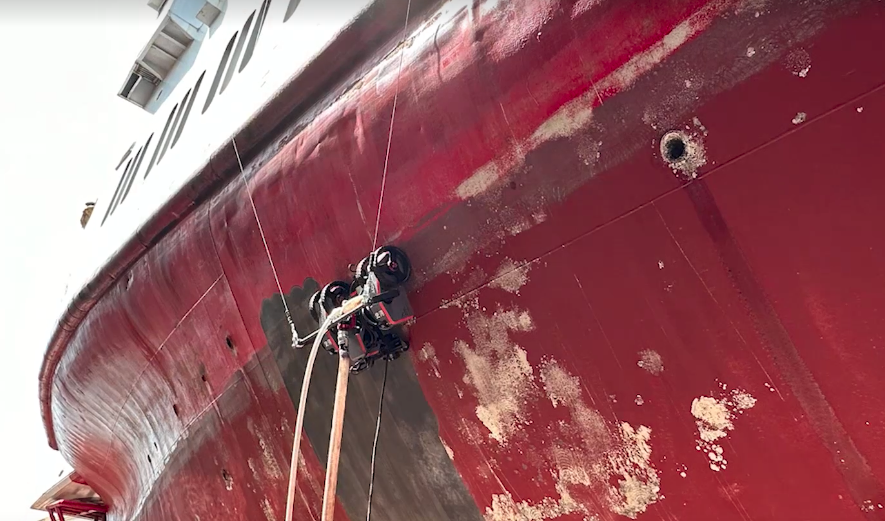
What happened
RobotPlusPlus closed a Series C worth "hundreds of millions of RMB (tens of millions of USD)" led by Qianggang Capital Fund, with GIG Capital Group, Sealand Innovation, Juntong Capital joining and Fosun RZ Capital increasing its stake.
Why it matters
The round funds global expansion and embodied AI development for robots already deployed at more than 100 shipyards, where its hull derusting robots hold market share above 70 percent and have worked on over 10,000 cargo vessels.
What to watch
Growth hinges on whether deployment scales beyond the more than 18 countries and the customers named, including Saudi Aramco and Vopak, and on whether the five-to-six-times efficiency gain holds across oil-and-gas, wind farms and building façades.
WHO IT HITSShipyard and heavy-industrial maintenance operators that still put workers on scaffolding and hazardous structures stand to gain, along with the R&D-heavy robotics teams commercializing embodied AI for high-risk sites.
Summaries like this, in your inbox every morning.
RobotPlusPlus has spent over 10 years building special-purpose robots for industrial sites, and the Series C is framed as a step to bring those solutions to more sites worldwide. The investor group is a mix of new backers — Qianggang Capital Fund, GIG Capital Group, Sealand Innovation and Juntong Capital — alongside Fosun RZ Capital, which first invested in 2022 and increased its stake. Qianggang Capital Fund's Zhang Zhenming described the goal of industrial embodied AI as the most demanding worksites rather than the laboratory, and pointed to RobotPlusPlus's move from ship-hull derusting into other industrial applications.
The company's scale is set out through concrete figures: operations across more than 18 countries, customers and partners including Nosco Shipyard, Drydocks World, ST Engineering Marine, Saudi Aramco and Vopak, and more than 60 percent of its workforce in R&D with R&D investment above 20 percent of revenue for three consecutive years. Its robots have accumulated over 2 million operating hours, which the company says generates real-world data to strengthen vertical AI models for complex industrial environments. Fosun RZ Capital's Jin Hualong linked continued investment to the company's shift from individual robots to industrial-grade embodied intelligence and complete system solutions, which he said creates strong technical barriers for high-risk industrial environments.
The stakes appear to rest on execution in the field. The derusting robots' record — market share above 70 percent, over 10,000 cargo vessels, and efficiency five to six times higher with costs reduced by 30 percent to 50 percent versus manual methods — is the base the expansion builds on, so whether the same results carry into oil-and-gas, wind farms and building façades is likely to be the test. For shipyard and heavy-industrial maintenance operators, the direction of travel is whether robots take over more of the work that still puts skilled people on scaffolding.
Pick your industry and the AI tools you use, and get news related to your work every day.
Free · 30 seconds with Google · unsubscribe anytimeWhat is AIToday? →
Ask AI anything about this article. The AI reads this article, earlier AIToday articles, and Wikipedia, and cites its sources. Q&As are published on this page for other readers too.
Nvidia is this analyst's top AI stock pick for October
Nidec pledged to sell off low-profit units such as household appliances and automotive motors while investing…

Apollo Global Management will be strategic investment and financing partner for a $15 billion AI infrastructur…
SoftBank shares posted their first monthly gain in four months in September, rising 24% in four weeks, after O…

OpenAI dismissed three researchers, according to reports, after highly confidential information was shared wit…

Anthropic PBC reportedly aims to begin marketing its IPO the week of Nov