A developer has identified a gap in how AI agents can be safely shared across teams or the public. Current solutions either sacrifice autonomy (MCP, which provides only tool endpoints) or introduce security risks (exposed API keys, or prompt-injection vulnerabilities in skills).
The developer proposes a new sharing model inspired by SQLite's design, though the full mechanism is not detailed in this excerpt.
The timing matters because sampling — a partial workaround for agent distribution — was formally deprecated this month via SEP-2577.
What happened
A developer has posted a proposed solution to a persistent problem in AI agent deployment — the difficulty of sharing agents with coworkers or others without exposing API keys or losing autonomy. The post compares existing approaches (MCP, skills) and identifies their shortcomings, then signals an SQLite-inspired alternative that the post does not fully detail.
Why it matters
Currently, agents either run server-side (risking token theft via exposed API keys) or remain tied to a single person's laptop or private server. For teams wanting to collaborate on or distribute agents as genuine autonomous systems — not just tool endpoints or prompt-injected markdown — there is no standard, safe mechanism. This gap blocks practical agent sharing across organizations.
What to watch
The post mentions sampling, which was formally deprecated this month via SEP-2577, removing one workaround for distributed autonomy. The developer's SQLite-inspired approach remains incomplete in this excerpt; full details would clarify whether it addresses the trust and autonomy constraints that existing solutions fail to meet.
Ask the AI about this article →
The post surfaces a genuine friction point in the emerging AI agent ecosystem. As agents grow more capable and autonomous, the incentive to share them — across teams, vendors, or end-users — grows too. Yet the technical and security model for doing so remains unsolved. The developer correctly identifies why the two most common approaches fall short. MCP, designed for tool composition, was never intended to move autonomous agents; it stops at providing request/response endpoints, leaving orchestration and loop control server-side. Skills, conceived as portable instructions, lack the runtime harness and trust model needed for true agent transfer — they collapse into prompt injection the moment they ask an agent to execute code. The deprecation of sampling this month via SEP-2577 removes even a partial experimental workaround. The SQLite comparison hints at the developer's goal: a file-based, embeddable model that travels with its own execution context and does not leak security or autonomy back to a single API key holder. Whether that analogy holds remains to be seen in the full proposal.
For example, today's edition would include:
AI-summarized, only the topics you pick — one digest a day via Email, Slack, or Discord.
Free · takes 30 seconds · unsubscribe anytimeWhat is AIToday? →
Ask AI anything about this article. Q&As are published on this page for other readers too.
CBTS Technology Solutions LLC launched Forge Agents, a platform that turns a plain-language job description in…

Imec CEO Patrick Vandenameele said at SEMICON Taiwan 2026 that the Belgian research center is broadening its c…
Alphabet's AI Overviews now reach over 2.5 billion monthly users through Google Search, and its ad business ge…
Visual Studio Code 1.135 now includes an experimental 'Rubber Duck' feature that lets developers request a sec…
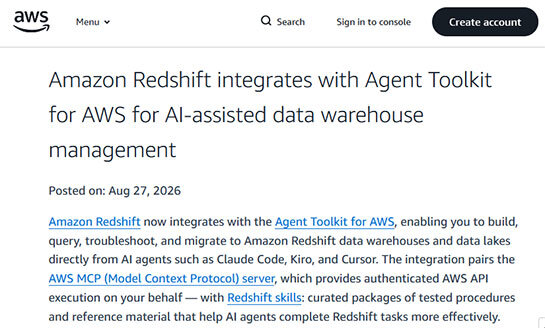
Amazon Web Services (AWS) has integrated its fully managed data warehouse service, Amazon Redshift, with Agent…
Sonos announced a new app update with generative AI features, a new soundbar called the Beam Ultra, and its se…