What happened
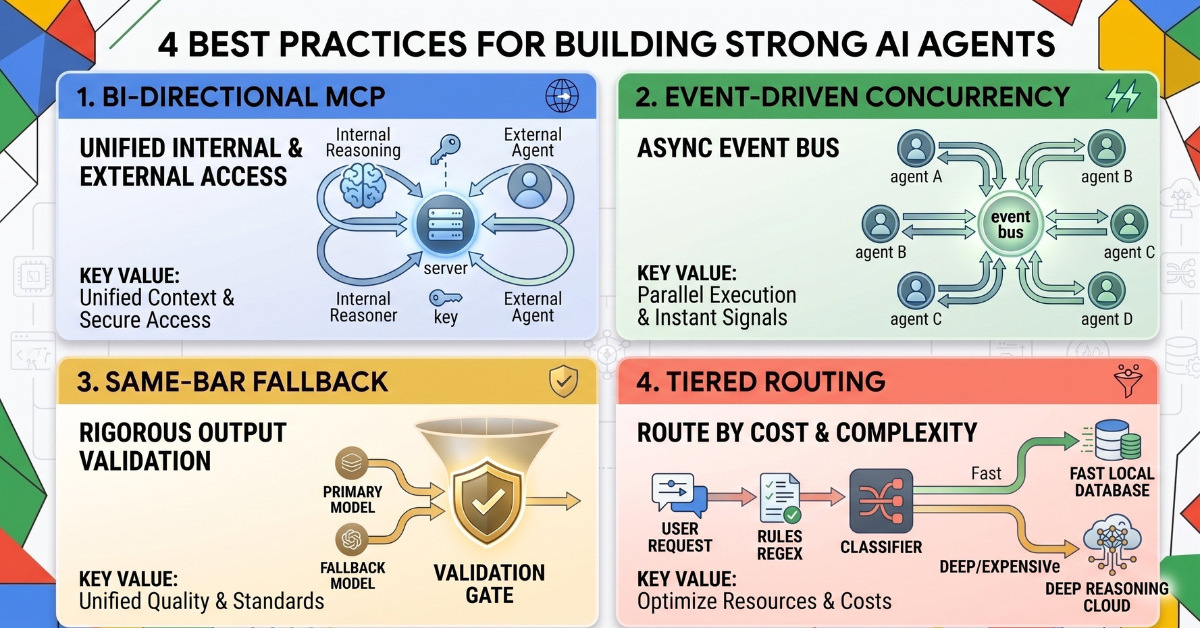
Google published four design patterns from the top entries of its Google for Startups AI Agents Challenge, judged from thousands of developers worldwide, with submissions built on Agent Development Kit and run via Agents CLI.
Why it matters
Many entries claiming to be multi-agent systems were actually a single model chaining prompts with agent names attached, so the patterns signal what designs stand out in practice.
What to watch
The patterns are aimed at teams with domain expertise building new systems, so their usefulness hinges on whether that fits your team's setup.
WHO IT HITSEngineering teams building AI agents may use these patterns when deciding how to structure tool access and model fallback, based on what judges found in the winning entries.
Summaries like this, in your inbox every morning.
The contest drew thousands of developers worldwide, and Google's own observation was that many entries claimed to be multi-agent systems when they were really a single model chaining prompts, with agent names attached for show. The four patterns Google highlighted respond to that gap with concrete design choices, like routing database access through tools rather than direct SQL connections, and letting agents discover and call each other's tools without needing a human-run chat. One team used a fallback from Gemini 3.1 Pro to Gemini 3.6 Flash after repeated errors, placing validation before the result reaches the agent, while another staged a small, low-temperature model call to classify intent and avoid unnecessary expensive calls. Google positions these patterns as useful not just for large teams that can build new models but for smaller teams with domain expertise, and says entries that followed them earned recognition. Whether they translate into real products will likely depend on whether teams can apply them without adding too much operational overhead.
Pick your industry and the AI tools you use, and get news related to your work every day.
Free · 30 seconds with Google · unsubscribe anytimeWhat is AIToday? →
Ask AI anything about this article. The AI reads this article, earlier AIToday articles, and Wikipedia, and cites its sources. Q&As are published on this page for other readers too.
DeepSeek is bringing more of the software it uses to develop its AI models to Huawei Technologies' Ascend 950…
Among respondents at companies with 1,001+ employees, 50.0% said AI is used company-wide, and 46.0% flagged AI…

Nvidia released the Open Agent Safety Platform on September 28, days after CEO Jensen Huang called warnings fr…
OpenAI launched Dots — agents on GPT-6 Astra, each running on its own cloud computer and connecting to 4,000+…
OpenAI released Dots, an always-on agent running autonomously in the cloud on GPT-6 Astra, connecting to over…
OpenAI announced dots, an always-on agent running GPT-6 Astra with its own cloud computer and browser, able to…