What happened
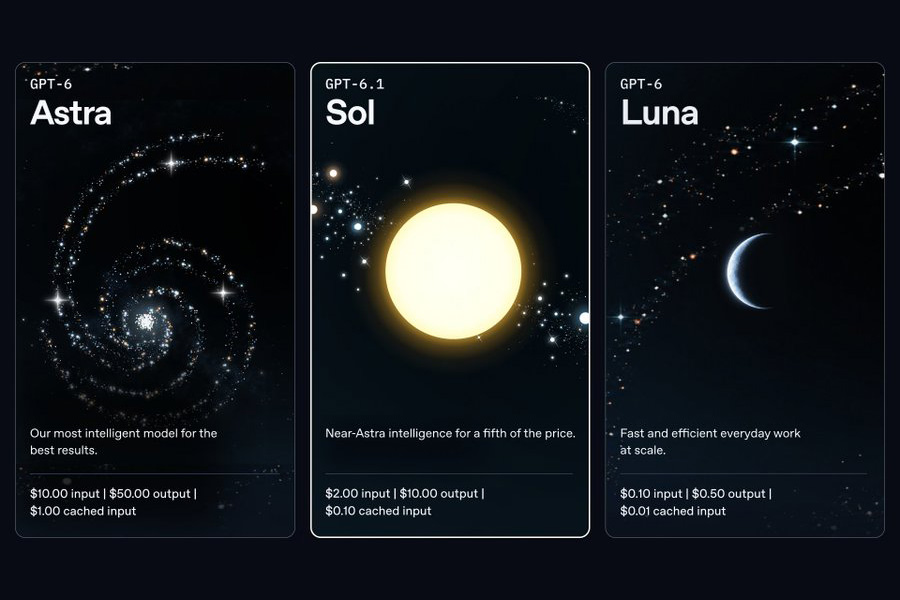
OpenAI announced GPT-6.1 Sol, available in ChatGPT Work and Codex for Plus, Pro, Business, Enterprise and Edu users, and as "gpt-6.1-sol" in the OpenAI API at $2 per 1M input tokens, $0.10 cached input, $10 output. It is not yet available in Chat.
Why it matters
OpenAI positions the model as a cheaper option that approaches the performance of its top frontier model, meaning developers and businesses can run capable agents with the same budget and allocate more resources to building and operating them.
What to watch
The 4.1% factual-error rate under the "very high" thinking setting is still above the 4.0% of the top frontier model, so the gap hinges on whether buyers accept slightly lower accuracy for the lower cost. Also watch the new $500 monthly Pro tier, which gets access to the Ultrafast models in ChatGPT Work and Codex.
WHO IT HITSDevelopers building and operating agents via the OpenAI API and enterprise teams on Plus, Pro, Business, Enterprise or Edu plans are the direct audience, since they can now run capable agents on the same budget and put more resources into building and operating them.
Summaries like this, in your inbox every morning.
OpenAI has upgraded GPT-6 Sol into GPT-6.1 Sol and is pitching it as a cost-balanced option rather than as its outright best model. The company says GPT-6 Sol already handled agentic coding, specialist tasks and computer operation well, closing in on GPT-6 Astra's performance on hard tasks while keeping standard input/output token pricing to one-fifth of Astra's. The new model pushes that idea further, and OpenAI is also launching GPT-6 Astra Ultrafast and GPT-6.1 Sol Ultrafast, which it says reach up to 8x the speed of GPT-6 Astra and are available via API as well as in ChatGPT Work and Codex for users on a new $500 monthly Pro tier.
The benchmark claims are framed almost entirely around cost. On DeepSWE v1.1, GPT-6.1 Sol is said to match GPT-6 Astra's performance at about one-fifth the cost, and to beat GPT-6 Sol's top score by 6.4 percentage points with less thinking and lower cost. On GDP.pdf it scores higher than Opus 5.5 at under half the per-task cost across the tested reasoning settings. On AutomationBench it beats Opus 5.5 by 2.2 points at roughly one-third the cost, and on OSWorld 2.0's offline set it comes within 2.1 percentage points of Astra while keeping per-task cost to about one-seventh.
That leaves the accuracy trade-off as the thing to weigh. Under the "very high" thinking setting, GPT-6.1 Sol's factual-error rate is 4.1%, down from GPT-6 Sol's 4.5% and close to Astra's 4.0% — still marginally behind the frontier model. OpenAI itself frames GPT-6 Astra as its top frontier model, so GPT-6.1 Sol looks aimed at teams that want to run important work more frequently, and at API users building and operating applications at scale, rather than at buyers who need the absolute best score at any price.
Pick your industry and the AI tools you use, and get news related to your work every day.
Free · 30 seconds with Google · unsubscribe anytimeWhat is AIToday? →
Ask AI anything about this article. The AI reads this article, earlier AIToday articles, and Wikipedia, and cites its sources. Q&As are published on this page for other readers too.
HBM is approaching half the cost of a GPU-HBM CoWoS package, prompting the question of whether memory remains…
DeepSeek is bringing more of the software it uses to develop its AI models to Huawei Technologies' Ascend 950…
Among respondents at companies with 1,001+ employees, 50.0% said AI is used company-wide, and 46.0% flagged AI…

Oracle invoked "force majeure" to delay payment on its Project Jupiter data center, and its 2056 bonds then tr…

Nvidia released the Open Agent Safety Platform on September 28, days after CEO Jensen Huang called warnings fr…
McDonald’s is increasingly using AI to guide menu prices in the U.S