
What happened
The author tested K-Dense-AI/scientific-agent-skills (177 skills, MIT) on two skills needing no extra API keys; statistical-analysis kept the same Mann-Whitney U answer but added Welch t(5.03)=1.453, p=.206, d=.954 and MWU U=53, p=.0024, plus an outlier-removed rerun (p<.001, d=2.784).
Why it matters
The value was backing a verbal conclusion with reproducible figures a reviewer can check, not correcting a wrong statistical decision — the skill mainly changes how well the answer is evidenced, not which test is picked.
Summaries like this, in your inbox every morning.
The test was run as day 17 of a daily AI-news verification challenge, following a CLAUDE.md rule to avoid candidates that require paid API keys. That narrowed the 177-skill repository to statistical-analysis (built on Pingouin, SciPy, statsmodels and PyMC) and literature-review (using public PubMed and arXiv APIs). Setup itself surfaced two environment issues: the install command was blocked by Claude Code's auto mode classifier as external code execution until a human allowed it, and installing via Windows Node.js from a WSL UNC path failed with an EPERM mkdir error because the CLI fell back to C:\Windows; running from a non-UNC Windows path succeeded.
The statistical comparison used a fictional pilot with an outlier in Group A. In the no-skill condition Claude Code cited outlier, unequal-variance and small-sample reasons and already named Mann-Whitney U, but gave no test statistic or p-value. With the skill, assumption_checks.py ran and produced descriptives, a Shapiro-Wilk check (Group A p=0.000127, not normal; Group B p=0.248496, normal), a Levene result (p=0.241, variance_ratio=224.37), a Welch t-test and a Mann-Whitney U result, then a sensitivity run excluding the 55. The conclusion matched, but the report now included the figures and a caveat that a non-significant Welch result at n=6 should not be read as no effect.
The literature-review side showed a structure not visible from the README: the bundled script is a post-processing tool, not a search engine. When arXiv returned 0 hits for 'Mann-Whitney AND outlier', Claude Code reworded the query across four patterns and ended with 8 hits under cat:stat.ME AND abs:"Mann-Whitney" AND abs:robust. The skill's own report noted that few papers center on the word outlier and that the hits were adjacent concepts such as robustness and heavy tails.
Pick your industry and the AI tools you use, and get news related to your work every day.
Free · 30 seconds with Google · unsubscribe anytimeWhat is AIToday? →
Ask AI anything about this article. The AI reads this article, earlier AIToday articles, and Wikipedia, and cites its sources. Q&As are published on this page for other readers too.
TECO Electric and Machinery participated in Energy Taiwan on October 14, showcasing smart microgrid solutions…

Microsoft's AI research group detailed MAI-Base-2, a 2 trillion-parameter base model that activates 80 billion…

A follow-up agent using TrueForge and Jev matched Opus accuracy on 40 requests at 150x lower decision cost
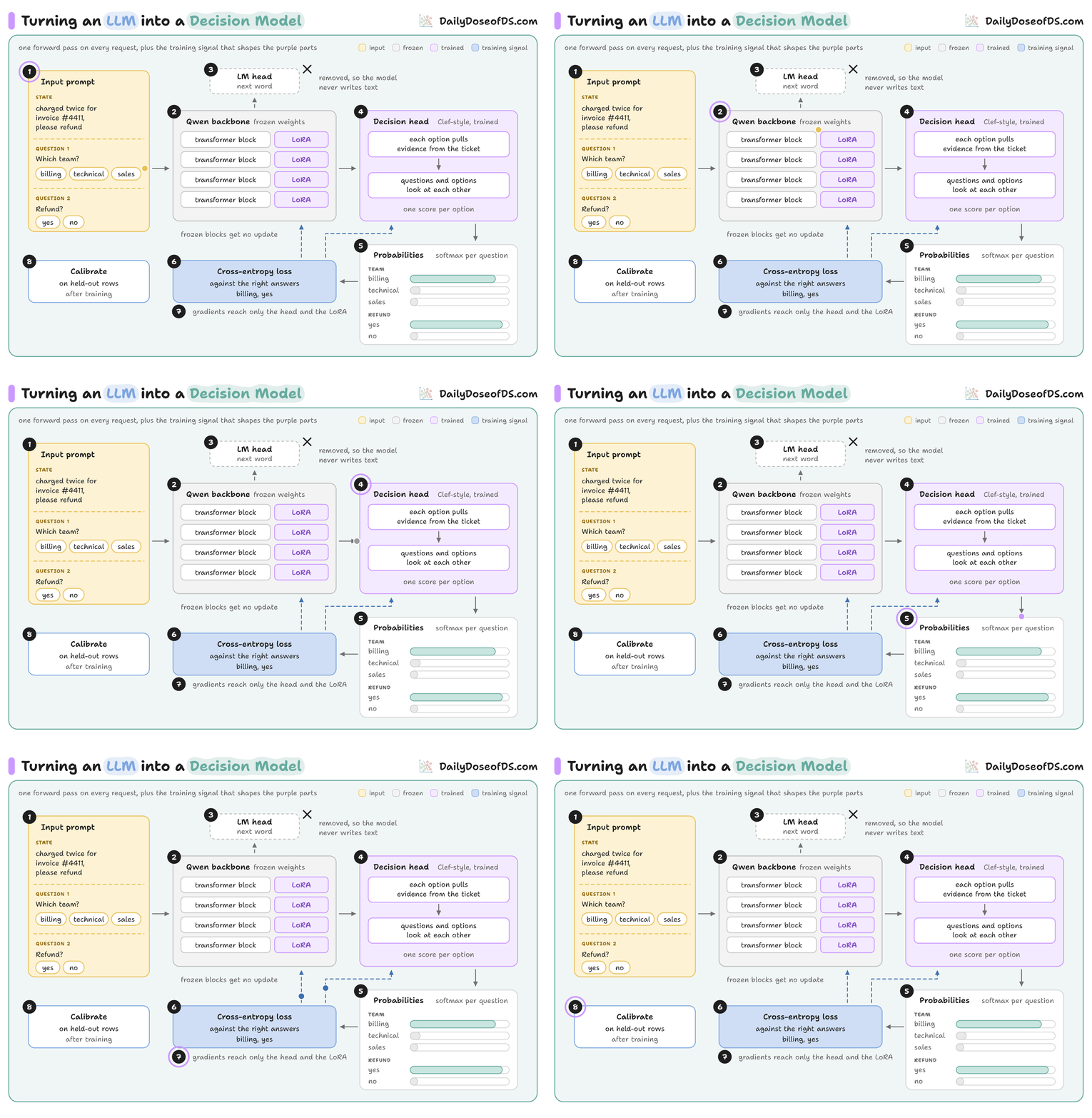
xAI released Grok Voice 3.0 on the 14th and opened it through the Grok Voice API at $0.08 per minute ($4.80 pe…
The author walked through /goal, output styles, /keybindings, debugging settings via /status, and commit attri…
In Skillselion's data as of 2026-10-16, the 4,902 price-labeled skills drew 84,668,769 installs, and 89.7% of…

