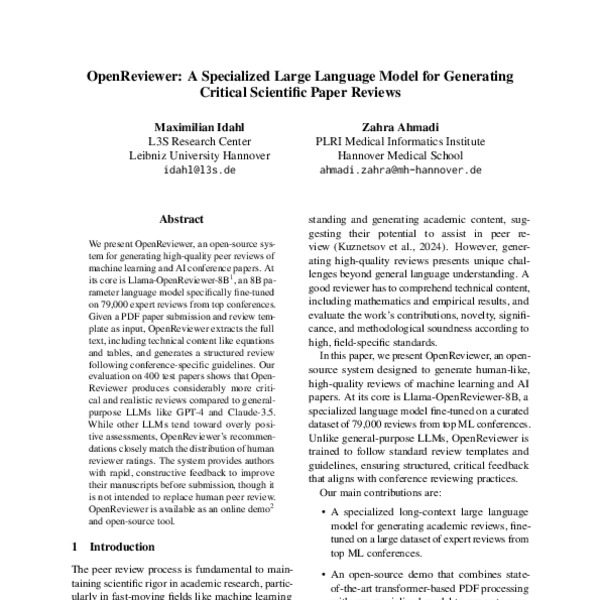
OpenReviewer is an open-source system that uses a specialized 8B-parameter language model trained on 79,000 expert reviews to generate critical peer reviews of AI and machine learning papers. Unlike general-purpose AI tools such as GPT-4 and Claude-3.5, which tend to be overly positive, OpenReviewer's assessments closely match real human reviewer distributions, making it useful for authors seeking constructive feedback before formal submission.
Summaries like this, in your inbox every morning.
Sign up free →What happened
Researchers released OpenReviewer, an open-source system that generates peer reviews for machine learning and AI conference papers. At its core is Llama-OpenReviewer-8B, an 8B parameter language model fine-tuned on 79,000 expert reviews from top conferences, which takes a PDF paper and review template as input and produces a structured review.
Why it matters
Testing on 400 papers showed that OpenReviewer produces considerably more critical and realistic reviews compared to general-purpose LLMs like GPT-4 and Claude-3.5, whose reviews tend to be overly positive. OpenReviewer's recommendations closely match the distribution of human reviewer ratings, meaning it can give authors rapid, constructive feedback before formal submission—though the creators stress it is not intended to replace human peer review.
What to watch
OpenReviewer is available as an online demo and open-source tool, giving researchers and authors a new way to stress-test manuscripts before formal conference submission.
OpenReviewer is an open-source system engineered to automate the generation of peer reviews for machine learning and AI conference papers. The system's foundation is Llama-OpenReviewer-8B, an 8-billion-parameter language model that was fine-tuned specifically on 79,000 expert reviews sourced from top conferences. This substantial corpus of real-world expert feedback serves as the training base for the model to learn the tone, depth, and critical standards of genuine academic peer review.
The system works by accepting two inputs: a PDF of a research paper and a review template conforming to conference-specific guidelines. OpenReviewer extracts the full text of the paper, including technical content such as equations and tables, and then generates a structured review that follows the template format and conference requirements. This end-to-end pipeline handles the complexity of parsing scientific papers and translating that understanding into the detailed, multi-section format that peer reviews typically demand.
The creators evaluated OpenReviewer against a test set of 400 papers and compared its output to both human peer reviewers and competing AI systems. The results showed that OpenReviewer produces considerably more critical and realistic reviews compared to general-purpose LLMs like GPT-4 and Claude-3.5. A key finding was that while other LLMs tend toward overly positive assessments, OpenReviewer's recommendations closely match the distribution of human reviewer ratings—meaning its severity, structure, and recommendation distribution align with real academic peer review standards.
The intended use case is pre-submission author feedback: researchers can submit a draft to OpenReviewer to receive rapid, constructive criticism before formally submitting to a conference. The creators explicitly note that the system is not intended to replace human peer review, which continues to serve essential gate-keeping and quality-assurance functions in academic publishing. OpenReviewer is available both as an online demo for immediate use and as open-source code for researchers who wish to integrate or extend it.
OpenReviewer addresses a gap in AI-assisted academic publishing by tailoring a language model specifically to the task of critical peer review. General-purpose LLMs, despite their broad capabilities, default to overly lenient evaluation when assessing research—a tendency that misaligns with the gatekeeping function of academic peer review. By fine-tuning on 79,000 real expert reviews from top-tier conferences, Llama-OpenReviewer-8B learns to calibrate its assessments to match the actual severity and distribution of human reviewer feedback, making it substantially more useful as a pre-submission diagnostic tool.
The distinction matters practically: an author using ChatGPT or Claude to self-review their work before submission would receive inflated encouragement, masking weaknesses that human reviewers will likely catch. OpenReviewer's alignment with realistic reviewer ratings means that a negative or mixed review from the system carries genuine predictive weight about conference reception. This makes it a genuine labor-saving aid for manuscript preparation, though the creators' disclaimer that it does not replace human review is both ethically sound and necessary—peer review serves a gate-keeping and quality-assurance function that no automated system should fully absorb.
AI-summarized, only the topics you pick — one digest a day via Email, Slack, or Discord.
Free · takes 30 seconds · unsubscribe anytime
No comments yet. Be the first to share your thoughts!
Log in to join the discussion



Get curated AI news from 200+ sources delivered daily to your inbox. Free to use.
Get Started FreeFree · takes 30 seconds · unsubscribe anytime
