Summaries like this, in your inbox every morning.
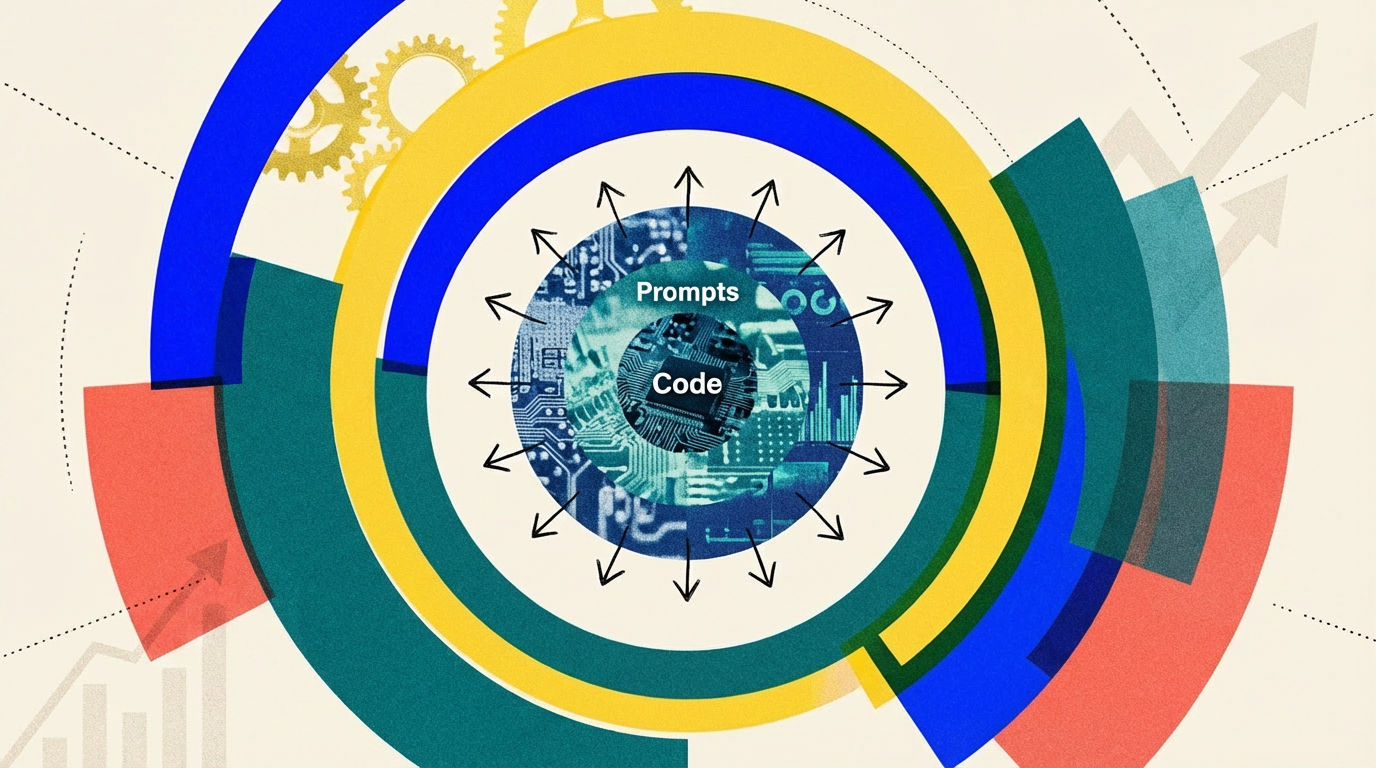
Sign up free →Chalmers University of Technology and Volvo Group researchers published a framework showing AI systems are creating six layers of engineering work, not replacing coding. Beyond traditional code, teams now manage prompts, AI workflows, safety guardrails, organizational decision routines, and regulatory compliance (like EU AI Act alignment)—all of which shape how systems behave but require human judgment to execute.
The gap is widest in the outer layers: while code engineering methods have existed for decades, there are almost no established practices for maintaining decision routines, preventing 'prompt drift' (when a tweaked prompt breaks behavior in unpredictable ways), or ensuring governance stays intact as teams scale AI deployments. Most research still focuses on code generation and bug-fixing instead.
For business teams and engineering managers, this means treating AI as a pure efficiency tool for code generation will deliver short-term wins but miss the larger organizational redesign required. The scarce skill is shifting from 'build faster' to 'decide what's worth building, validate it, govern it, and maintain it over time'—which means investing in engineering practices for decision-making and governance, not just faster code generation.
No comments yet. Be the first to share your thoughts!
Log in to join the discussion



Get curated AI news from 200+ sources delivered daily to your inbox. Free to use.
Get Started FreeFree · takes 30 seconds · unsubscribe anytime
1 minute a day. The AI essentials.
200+ sources · Email / LINE / Slack
