What happened
Black Forest Labs launched FLUX.3 Image Klein, shipping in Diffusers from day one. The distilled checkpoint makes a 1024 × 1024 image in about 2 seconds on an H100.
Why it matters
One model now covers text-to-image, multi-reference image-to-image, and bounding-box layout control, so developers may no longer need separate tools for placing and moving image regions.
What to watch
The open checkpoints are available now in the FLUX.3 Image Klein collection and can be tried in the Hugging Face space.
WHO IT HITSDevelopers and creative teams building image-generation features can now add precise layout control, moving or pinning parts of an image via bounding boxes, using a single Diffusers model with LoRA fine-tuning scripts included.
Summaries like this, in your inbox every morning.
FLUX.3 Image Klein arrives with an unusual combination: a single checkpoint that switches between generating an image from text, editing one or more reference images, and placing elements at specific coordinates. That last capability, called layout control, works by writing a JSON list of regions into the prompt, each with an id, a bbox, and a desc, on a normalized 0–1000 scale so the same box works at any image size. For edits, each region says where its content comes from in the reference and where it goes in the output, which is what lets a user move one object, such as a knitted knight, while pinning the rest of the scene.
The release also leans heavily on the tooling around it. The model ships as a Modular Diffusers pipeline, so developers can pop the text encoder out, encode a prompt once, free it, and generate many images from the cached embeddings, or insert their own step inside the denoising loop. Black Forest Labs provides the transformer as a single file in bf16 plus two quantized formats, fp8r and nvfp4, loadable with from_single_file for smaller GPUs, and Hugging Face supplies DreamBooth LoRA training scripts for both text-to-image and image-to-image tasks. Together these choices lower the barrier for teams that want to fine-tune on their own data or run on hardware that is not top of the line.
Pick your industry and the AI tools you use, and get news related to your work every day.
Free · 30 seconds with Google · unsubscribe anytimeWhat is AIToday? →
Ask AI anything about this article. The AI reads this article, earlier AIToday articles, and Wikipedia, and cites its sources. Q&As are published on this page for other readers too.
TOPPAN Holdings and Keio University ran a quantum-computer and generative-AI proof-of-concept from February 1…

NVIDIA released Nemotron 3.5 Super VL, an open-weight model with 120 billion parameters that handles text, ima…

NVIDIA released Nemotron 3.5 Bolt 74B-A9B 24GB, an AI model for local agents that hits over 80 tokens per seco…
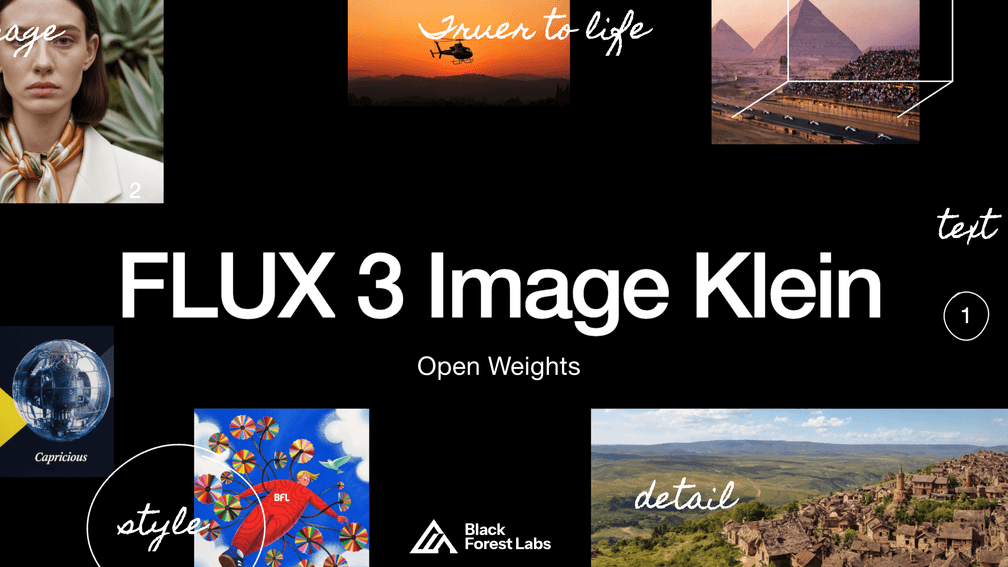
Black Forest Labs released FLUX 3 Image Klein as open weights on October 15, 2026 — a 5.6B-parameter model for…
Krea opened the beta for Krea 3, which does end-to-end 2K edits in under 8 seconds, accepts up to 8 reference…

PrismML released Ternary Bonsai 2 2B, 4B and 9B on October 15, 2026, remade from Qwen3.5 to process in three v…