What happened
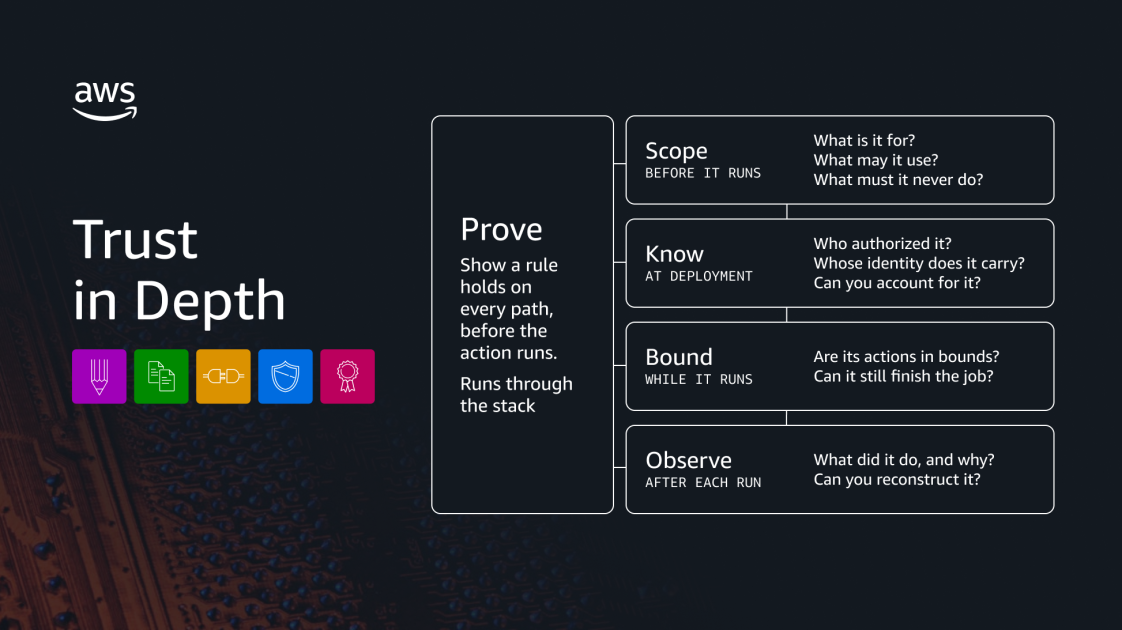
AWS introduced Trust in Depth, a four-layer approach — scope, know, bound, observe — that uses automated reasoning to prove an agent's rules hold wherever they can be stated precisely.
Why it matters
Enterprises that distrust agents' reliability can let them act autonomously on verifiable tasks, reserving human sign-off for judgment calls, according to AWS.
Summaries like this, in your inbox every morning.
AWS frames the problem plainly: the same autonomy that makes agents useful also makes them unpredictable, since an agent picks its own tools and steps and may take a different route each run. The standard fix — a person approving every action — breaks down as approvals pile up and reviewers stop catching what matters, leaving capable agents idle.
The company positions Trust in Depth as a shift in purpose from the industry's long-standing Defense in Depth discipline. Where that approach limited what could go wrong, this expands what can safely be allowed. AWS says it has run automated reasoning in production for more than a decade, including IAM at more than 2.1 billion requests per second, and is now bringing it to agents. It draws a line between rules that can be proven, such as who may approve access, and those that cannot, such as keeping a friendly tone, which stay with people.
A worked example describes a help desk agent offboarding an employee named Sam. The agent blocks his sign-in, converts his mailbox, places a legal hold, and changes his license, while Policy in AgentCore stops steps taken out of order. AWS says every step is recorded so the team can verify the outcome.
Pick your industry and the AI tools you use, and get news related to your work every day.
Free · 30 seconds with Google · unsubscribe anytimeWhat is AIToday? →
Ask AI anything about this article. The AI reads this article, earlier AIToday articles, and Wikipedia, and cites its sources. Q&As are published on this page for other readers too.
Cerebras chief strategy officer Andy Hock said that over the past two months, foundation labs and enterprises…
nFOX Lab launched the nFOX Platform for managing owned large language models and announced plans to open-sourc…

Oppenheimer said investors look forward to understanding the return on Meta's AI assistant Muse, which UBS ana…

Bank of America CEO Brian Moynihan said 1,000 outside contractors joined 3,000 internal employees fixing vulne…
On TheoPhysEval, GPT-6-Astra got 49 of 50 unpublished theoretical physics problems right — 98% — at under $3 e…
Microsoft and Nvidia held a launch party in San Francisco for the first RTX Spark laptops, which use Arm chips…