What happened
Deepmind Institute researchers proposed "Artificial Symbiotic Intelligence," calling for coordination of networks of agents, people, and connecting systems rather than one isolated superintelligent machine.
Why it matters
The authors argue intelligence is a social phenomenon, so the binding constraint shifts from model size to the rules and institutions governing how agents and humans work together.
What to watch
The view hinges on whether such governance is actually built, since the authors say orchestration harnesses — control layers coordinating several models — already beat individually "smarter" models.
WHO IT HITSEnterprise IT and platform teams running several models at once — and the policy and governance groups writing rules for them — would need to treat coordination layers, not just the largest models, as the thing to design and regulate.
Summaries like this, in your inbox every morning.
The essay extends an argument the authors' circle has been building. An earlier preprint, "Agentic AI and the next intelligence explosion" by James Evans, Benjamin Bratton, and Blaise Agüera y Arcas, laid out the social and institutional perspective behind the new essay. A second preprint, "Reasoning Models Generate Societies of Thought," supplied empirical support: when reinforcement learning rewards models only for reasoning accuracy, the models develop multi-perspective, conversational behavior on their own, without being explicitly programmed to do so. The Deepmind essay takes that finding from individual models to the possible design of societies made up of people and agents.
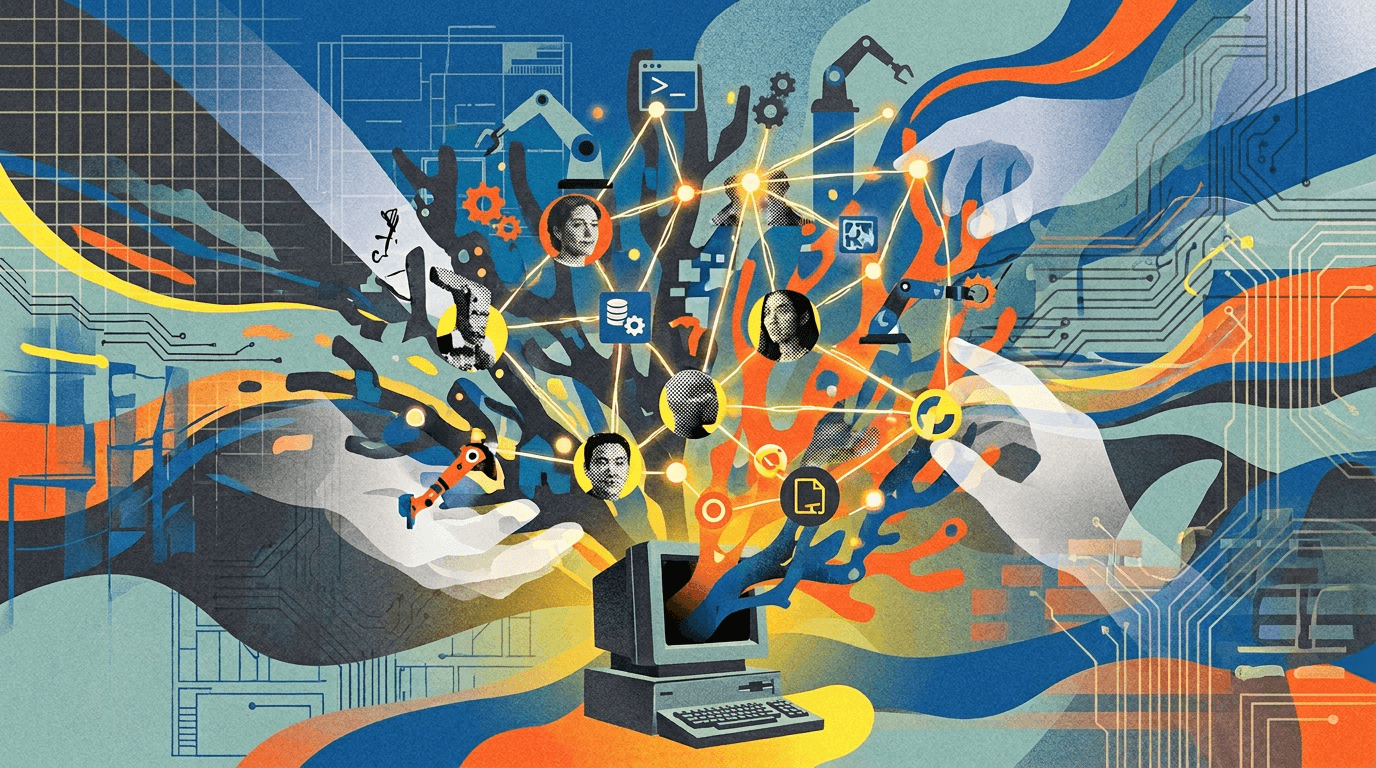
The authors also rethink what an agent is. In their usage it is a temporary bundle — of models, roles, memories, ethical orientations, tools, and skills — that users may experience as a coherent entity with a lasting personality, but that can be taken apart and recombined like a collage. People, by contrast, remain a continuous self across interactions because the brain forms a physically connected whole. In practical terms, the authors expect interfaces to shift away from one-on-one chatting toward visual network diagrams where agents appear as nodes and users direct them from a single overview.
Their alignment argument follows from the same premise: imposing a fixed set of values on models from above is a dead end, and values instead take shape through ongoing contact among people, agents, and institutions. What the outcome hinges on is whether a framework can be built to give that negotiation structure, and how quickly different fields adopt AI in different ways. If AGI is a social system rather than a single end product, the research and regulatory agenda would need to cover models, interfaces, institutions, and governance at the same time.
Pick your industry and the AI tools you use, and get news related to your work every day.
Free · 30 seconds with Google · unsubscribe anytimeWhat is AIToday? →
Ask AI anything about this article. The AI reads this article, earlier AIToday articles, and Wikipedia, and cites its sources. Q&As are published on this page for other readers too.
NVIDIA posted $89.02 billion in Data Center revenue for the second quarter of fiscal 2027, reported August 26…

A developer behind the Japan-equity platform ALPHA FORGE published a Three.js 3D simulation of its pipeline, w…

Moongazer RL, released as foxn2000/moongazer-rl, ran a fully asynchronous RL loop — rollout generation and mod…

Of 475 published Opus 5.5 videos, about 60% are motion graphics; Canvas was the most common rendering route at…
Developer ttokunaga reported September 2026 usage of about 41.574 billion Codex tokens and roughly 2.098 billi…
Anthropic launched the Claude Frontier Academy on October 2, committing $100 million to train 10,000 "Frontier…