What happened
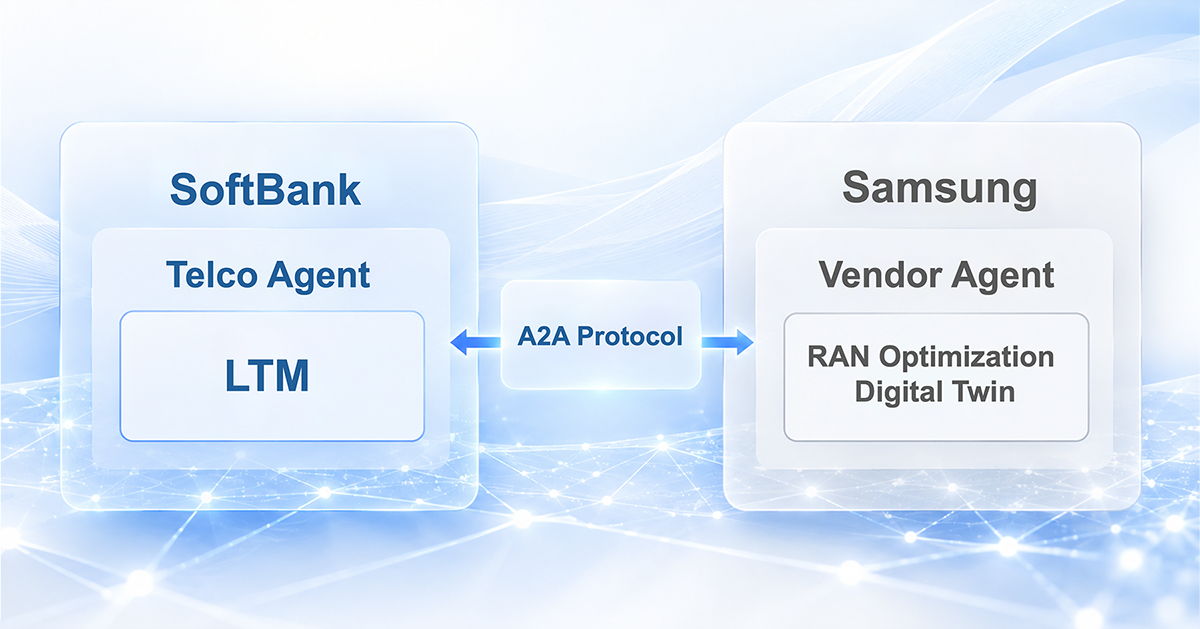
SoftBank and Samsung Electronics built a demo where SoftBank's Telco Agent asks Samsung's Vendor Agent to keep stadium cell A below 60% load and above 50Mbps; when cell A alone can't satisfy both, the agents expand to cell B.
Why it matters
The demo shows that two separately operated AI agents can jointly solve a network configuration task that neither could handle alone, while each side keeps its internal systems and intellectual property private.
What to watch
The demonstration is scheduled to be shown at the SVFW Summit 2026 in Mountain View, California, on October 14 and 15, 2026.
WHO IT HITSTelecom operators running multi-vendor networks and network vendors supplying them are the main audience; the research points to a way for each side's AI agents to coordinate without exposing vendor-specific optimization algorithms or internal implementations.
Summaries like this, in your inbox every morning.
SoftBank has been developing the Large Telecom Model (LTM), a generative AI foundation model for the telecom industry, as the core of its efforts to make network operations more autonomous. The collaboration with Samsung Electronics builds on an agreement the two companies reached in October 2025 to work together in the AI-RAN field, covering 6G, AI for RAN, AI and RAN, and Large Telecom Model.
The joint research addresses a practical problem: real networks are made up of base stations, network functions, and operating systems from multiple vendors. Rather than having a single operator-side AI agent handle every vendor-specific control method, the research places a Telco Agent on SoftBank's side and a Vendor Agent on Samsung's side, each retaining its own domain knowledge and tools. The demonstration starts from a predicted load spike on cell A covering a stadium, and when that cell alone cannot meet the requested conditions, the Telco Agent checks neighboring cells and extends control to cell B.
What the demonstration illustrates is not only a particular optimization method but the coordination loop itself: the Vendor Agent returns an evaluation result, the Telco Agent makes the next decision based on the wider network view, and the Vendor Agent optimizes again. As more AI agents are expected to be used within networks, SoftBank says it will continue developing both the LTM and the mechanisms that let different agents interoperate.
Pick your industry and the AI tools you use, and get news related to your work every day.
Free · 30 seconds with Google · unsubscribe anytimeWhat is AIToday? →
Ask AI anything about this article. The AI reads this article, earlier AIToday articles, and Wikipedia, and cites its sources. Q&As are published on this page for other readers too.
On October 12, CNBC's Jim Cramer said combining CrowdStrike, Palo Alto Networks and Okta makes an AI "kill swi…
Sam Jenkins of Punchcard Systems cites a 2025 Microsoft survey of 1,725 data security leaders finding nearly t…
American Express launched its Intent Intelligence framework, which captures and authenticates purchase instruc…

Forrester argues that MuleSoft's Agent Fabric, an agentic AI control plane for governing AI agents, is Salesfo…
Vertiv Holdings Co and the Deloitte Center for Integrated Research released an AI infrastructure deployment gu…
Arista's August 4 results showed second-quarter revenue of $3.036 billion, up 37.7%, and a 45.4% GAAP operatin…