What happened
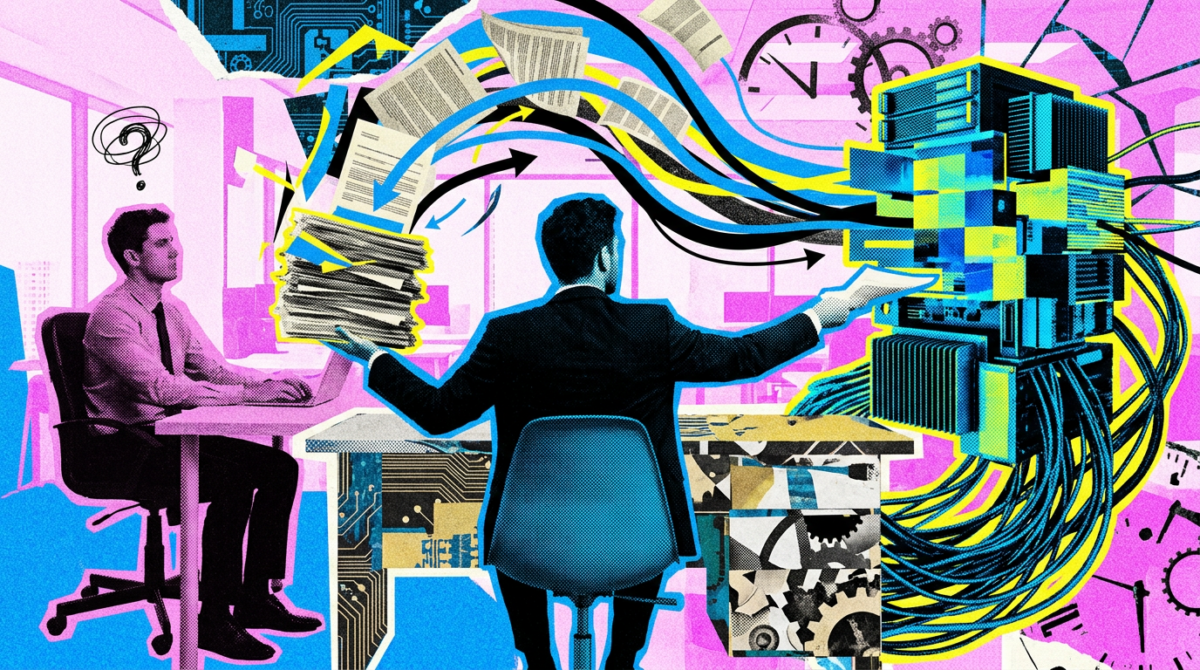
A survey by Epoch AI and Ipsos of 1,106 employed US adults (conducted July 10–19, 2026) found that 20 percent of working Americans hand off at least one task to AI that a human colleague or contractor used to do. AI use is highest in software development (57 percent of workers in that role) and data analysis (46 percent), lowest in record-keeping (25 percent). Two-thirds of AI output gets used unchanged or with only minor edits.
Why it matters
The data suggests AI is redistributing tasks between humans and machines rather than automating entire jobs. Only in software development does AI handle full or near-full task completion (10 percent); elsewhere it stays below 7 percent. Workers report time savings in 53 percent of cases when AI does most or all of a task, compared with 37 percent for partial support—though about one in six AI-assisted tasks now takes longer than before.
What to watch
The survey examined ten common knowledge-work tasks drawn from US Department of Labor data. Results are self-reported; neither actual time savings nor AI output quality were measured objectively. Prior surveys show 45 percent of US workers used AI on the job as of August 2025, though only 10 percent used it daily.
Summaries like this, in your inbox every morning.
The survey captures a significant inflection point in workplace AI adoption: not mass displacement, but task redistribution. The finding that 20 percent of US workers delegate at least one task to AI reflects widespread but selective use rather than wholesale automation. The variation in adoption rates—57 percent in software development versus 25 percent in record-keeping—suggests that AI's utility and workplace readiness remain task-dependent. The fact that workers accept AI output with minimal editing (66 percent unchanged or lightly tweaked) points to growing trust in AI competence for knowledge work, though the researchers caution this does not necessarily reflect objective output quality.
The timing savings data introduces a nuance: heavier AI use correlates with reported time savings (53 percent vs. 37 percent), but causality remains unclear—AI may genuinely speed work, or workers may use AI preferentially when seeking efficiency gains. The one-in-six tasks that take longer suggests friction: either the cost of prompting and review, or workers choosing to raise quality standards when AI saves time. Epoch AI's framing—AI as "versatile but usually not self-sufficient"—aligns with the evidence: full task automation remains rare, and human judgment remains the norm.
Pick your industry and the AI tools you use, and get news related to your work every day.
Free · 30 seconds with Google · unsubscribe anytimeWhat is AIToday? →
Ask AI anything about this article. The AI reads this article, earlier AIToday articles, and Wikipedia, and cites its sources. Q&As are published on this page for other readers too.
Vinci4D provides chip-design simulation software that trains on physics equations instead of customer data, an…

SEMI President and CEO Ajit Manocha told DIGITIMES that the semiconductor industry reached the US$1 trillion r…

CoreWeave fell more than 25% this week, its debt yield briefly rose above 16% on Thursday, and SK Hynix droppe…

Nvidia's AI Enterprise lists at $4,500 per GPU annually, and paid subscriptions add supported software, securi…
China's commerce and science ministries released a draft update adding 23 key AI technologies to its export co…

Anthropic told investors this week that it is making 85% gross margins, a figure the columnist calls a cash co…