
What happened
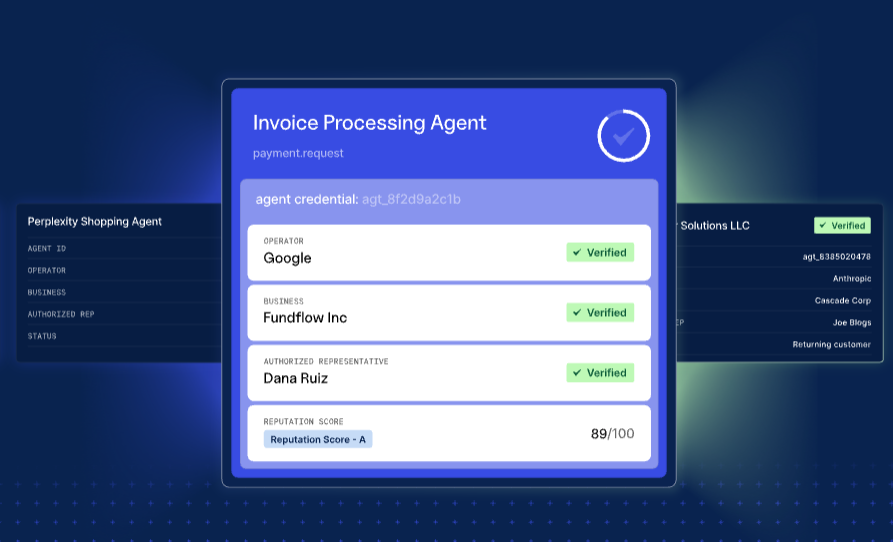
Baselayer raised a $35 million Series A led by M13, bringing total funding to about $40 million since its 2023 inception. It also launched its Agentic Identity Suite to verify AI agents acting on behalf of businesses.
Why it matters
Extending that network to AI agents could help merchants and banks decide whether to trust automated transactions.
What to watch
Baselayer must persuade agent developers, merchants and payment companies to recognize its credential, and no dominant standard exists yet. Financial institution relationships typically take 12 to 18 months to establish, while large merchant partnerships can take up to 24 months.
WHO IT HITSFinancial institutions, fintech companies and merchants that need to distinguish legitimate AI agents from bots or fraudsters will be affected, as will agent developers whose software may be blocked without recognized credentials.
Summaries like this, in your inbox every morning.
Baselayer started in February 2023 with a focus on Know Your Business, or KYB, identity verification — the process financial institutions use to verify businesses and assess risk. Co-founders Jonathan Awad and Timothy Hyde set out to modernize that lengthy and fragmented process. The company built what Awad describes as both an identity network and a fraud consortium, recognizing when the same person or business applies at multiple institutions. That data becomes more useful as more institutions and reseller partners join.
The challenge now is that AI agents present a different problem. Unlike a business with history, an agent may spin up for a single task and disappear, leaving little for a bank to evaluate. Baselayer's proposed answer is a credential that an authorized agent presents when it attempts a purchase or interacts with another business. The startup is working with agent developers, payment processors, merchants and fraud-detection providers — including FIS, Prove and Socure — to issue and recognize it. M13 managing partner Karl Alomar said his view of the company shifted as more companies began exploring payments made by AI agents.
Whether that credential becomes widely accepted is the open question. No dominant standard exists yet, and Baselayer must persuade a broad set of parties to recognize its system. The timeline is long: financial institution relationships typically take 12 to 18 months, and large merchant partnerships up to 24 months. Baselayer may reach some institutions faster through existing reseller relationships, but the outcome hinges on whether enough payment companies and merchants adopt its credential before competing approaches emerge. For financial institutions and merchants, the stakes are whether they can safely allow automated transactions without opening the door to faster, cheaper fraud.
For example, today's edition would include:
AI-summarized, only the topics you pick — one digest a day via Email, LINE, or Slack.
Free · 30 seconds with Google · unsubscribe anytimeWhat is AIToday? →
Ask AI anything about this article. Q&As are published on this page for other readers too.
Teradata is expanding its Tera AI assistant with a Context Engine, a Harness execution system and Agent Skills…

Baselayer raised $35 million in Series A funding led by M13, with Torch Capital, Picus Ventures and Afore Capi…
Heidi Health announced $340 million in new funding — a $100 million Series C led by Blackbird, with Phoenix Co…

Kantata Inc. unveiled Agent Studio, which sits inside its Expertise Engine

Meta's AI agent Muse has leapt to the top of app charts roughly two weeks after its release, helping push up c…
Meta's Muse agent, launched Sept