OpenAI published a proof of the Cycle Double Cover conjecture using its gpt-5.6 Sol model, marking the second major mathematical breakthrough by the company in less than two months. Although the proof has not yet been peer-reviewed, mathematicians are now weighing whether AI will eventually replace the discipline. The author, who trained AI models on math problems throughout 2024–25, reports that models improved dramatically—from being easily fooled by high-school problems in mid-2024 to solving graduate-level problems with correct reasoning 80% of the time by early 2025—though experts believe human creativity remains essential for the hardest open problems.
Summaries like this, in your inbox every morning.
Sign up free →What happened
OpenAI's gpt-5.6 Sol model generated a complete proof of the Cycle Double Cover conjecture—unsolved for over 50 years—published this past Friday. The proof has not yet been peer-reviewed, though experts have not flagged egregious errors. This comes less than two months after OpenAI's previous model made a breakthrough on another well-known mathematical conjecture in May.
Why it matters
Mathematicians are now facing an existential question about AI replacement, similar to concerns in software engineering, finance, law, and medicine. The ability to automate mathematical research could accelerate the pace of technological and scientific evolution, since much of the engineering behind modern innovations (secure banking, the Internet, GPS, LLMs themselves) relied on mathematical discoveries made decades earlier. However, the author—who trained AI models on math problems in 2024–25—notes that by early 2025, models were solving graduate-level problems with correct reasoning 80% of the time, a dramatic leap from mid-2024 when they could be tricked by high-school problems.
What to watch
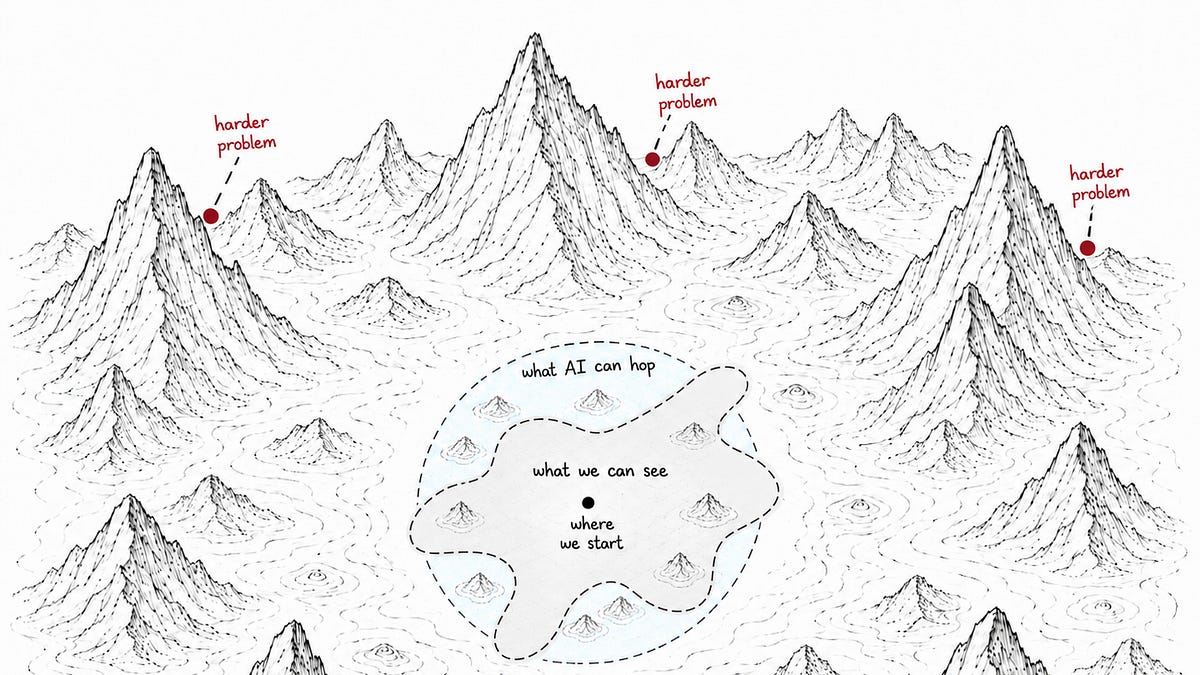
Fields Medallist Terence Tao describes AI as "jumping machines that can jump two meters in the air," able to solve smaller, more accessible problems that human mathematicians lack time to address, while the hardest conjectures remain out of reach. The article suggests AI and human mathematicians are complementary: Tao called 2026 AI a "trustworthy co-author, if used correctly." Emerging tools like Lean (a proof-formalisation language) and research into "world models" for geometric reasoning may further expand AI's mathematical reach.
On Friday of the week the article was published, OpenAI released a proof of the Cycle Double Cover conjecture generated entirely by its gpt-5.6 Sol model. The conjecture had remained unsolved for over 50 years. Although experts examining the proof have not identified egregious errors, it has not yet undergone peer review and formal confirmation. This achievement arrives less than two months after OpenAI's previous model made a breakthrough in another well-known mathematical conjecture in May.
The author is a mathematician who trained AI models to solve math problems throughout 2024–25, providing a firsthand perspective on the rate of improvement. The training process involved creating math problems in specific subdomains, presenting them to test models that would output step-by-step reasoning (called "chain of thought" or "CoT") along with a final answer, identifying cases where the model's reasoning was incorrect, correcting that reasoning, and feeding the corrected result back to the lab training the model. By mid-2024, it was straightforward to trick these state-of-the-art (though not yet fully trained) test models into producing incorrect answers to high-school-level problems. By early 2025, when the author was posing the most creative graduate-level problems they could devise, the models were answering correctly 80% of the time and, crucially, with correct reasoning. This represents a dramatic departure from 2023, when LLMs could not reliably multiply two 2-digit numbers.
The article argues that the significance of automating mathematical research extends far beyond replacing a professional class. Mathematical breakthroughs in the past have often seemed abstract or impractical at the time of discovery, yet decades later they enabled foundational technologies: secure banking and online shopping, the Internet, GPS, and LLMs themselves all depended on mathematical research conducted years or decades earlier. Mathematicians often work on problems simply because they notice something intuitively true and want to prove it—what Henri Poincaré called "the mathematician's free initiative." The author illustrates this with Goldbach's conjecture, posed in 1742: any even number can be written as the sum of two primes (or 1). Although we know it holds up to an 18-digit number and it seems intuitively true, it remains unproven for all even integers. Yet much of modern engineering owes its existence to the mathematical research process of proving or disproving such conjectures.
Fields Medallist Terence Tao (the mathematics equivalent of a Nobel laureate) offered a clarifying analogy in an interview with podcaster Dwarkesh Patel. He compared unsolved math problems to a mountain range shrouded in darkness, with walls of varying heights—some three feet high, some six, some fifteen, and some a mile high. Mathematicians try to identify and climb these walls, lighting candles and making maps as they work. AI tools, Tao said, are like jumping machines that can jump two meters high—higher than any human—sometimes jumping in the wrong direction or crashing, but sometimes reaching the tops of the lowest walls that humans could not reach before. In this metaphor, mathematicians and AI are complementary: humans tackle the far, hard-to-reach problems that AI cannot yet solve, while AI addresses a long tail of more accessible unsolved problems that simply do not receive enough human mathematician attention. Tao remarked later in the interview that by 2026, AI would be a "trustworthy co-author, if used correctly."
The Cycle Double Cover conjecture, which OpenAI just proved, is more heavily researched than earlier conjectures where AI made breakthroughs. The May breakthrough, for example, involved proving only one part of a conjecture formulated by Paul Erdős—and Erdős alone had formulated over 1,000 conjectures. This suggests the frontier of AI's mathematical capability is gradually expanding. Emerging technologies are poised to accelerate this expansion further: Lean, a programming language designed to formalize mathematical proofs, is gaining adoption among AI researchers and enables models to check their own work more efficiently. In parallel, billions of dollars are being poured into research on "world models"—systems that can reason in physical reality—which may enhance geometric intuition, a crucial capability for higher-order mathematics.
Yet the article concludes with a note of ambivalence. While the prospect of accelerating mathematical progress is genuinely exciting, mathematicians derive profound satisfaction from the "Eureka" moment of solving a problem—and the thought of losing that experience is painful. The saving grace may lie in what AI remains poor at: genuine creativity. Pure mathematics, the author suggests, is closer to art than to practical fields like law, medicine, or computer science. Despite 3–4 years of rapid AI progress in professional domains, models have not replaced artists or come close to producing prose people genuinely enjoy reading. The proof of Fermat's Last Theorem exemplifies the role of creativity in mathematics: Pierre de Fermat posed a conjecture so simple a 12-year-old could understand it, yet its proof eluded humanity for nearly 400 years until Andrew Wiles published a final version in 1995. That proof required creative leaps by Yutaka Taniyama, Goro Shimura, Frey, Serre, and Ribet, each making unexpected connections between seemingly unrelated mathematical objects. To this day, we do not know if Fermat's own claimed proof—scribbled in his notes as "truly marvelous" before his death—was real, potentially making him history's greatest troll.
The article frames AI's mathematical progress within a crucial historical context: mathematical breakthroughs, though often appearing abstract or useless in their time, have enabled the engineering innovations society relies on decades later. Secure banking, the Internet, GPS, and LLMs themselves would not exist without mathematical research conducted long beforehand. This framing elevates the stakes: automating mathematical research is not merely about replacing a professional skillset but about potentially accelerating the entire technological and scientific trajectory.
The author's firsthand experience training AI models in 2024–25 supplies a concrete measure of the rate of improvement. The jump from models being tricked by high-school problems in mid-2024 to solving graduate-level problems with correct reasoning 80% of the time by early 2025 is striking. Yet the article avoids hyperbole by citing Terence Tao's more nuanced framing: AI is a "jumping machine" that excels at smaller "walls" in a mountain range of open problems but remains far from the mile-high cliffs. The complementary nature of human and AI mathematicians—humans tackling the hardest problems while AI addresses a long tail of more accessible unsolved problems—emerges as a realistic near-term picture.
The article acknowledges that emerging research in formal proof languages (Lean) and "world models" for geometric reasoning may eventually expand AI's reach further. However, it concludes that the saving grace for mathematicians may lie in what AI remains "famously bad at: creativity," positioning pure mathematics closer to art than to applied fields like law or medicine, where AI has made greater inroads.
No comments yet. Be the first to share your thoughts!
Log in to join the discussionGet curated AI news from 200+ sources delivered daily to your inbox. Free to use.
Get Started FreeFree · takes 30 seconds · unsubscribe anytime
1 minute a day. The AI essentials.
200+ sources · Email / LINE / Slack