What happened
OpenAI is adding the textGrain watermark to text from ChatGPT and Codex, applying it to EU outputs over the coming weeks. From October 5, API users worldwide can switch it on for some models, off by default.
Why it matters
The move responds to the EU AI Act's requirement that providers make AI-generated text machine-detectable, so outputs may carry a signal firms and regulators can check — though OpenAI says detection has limits.
What to watch
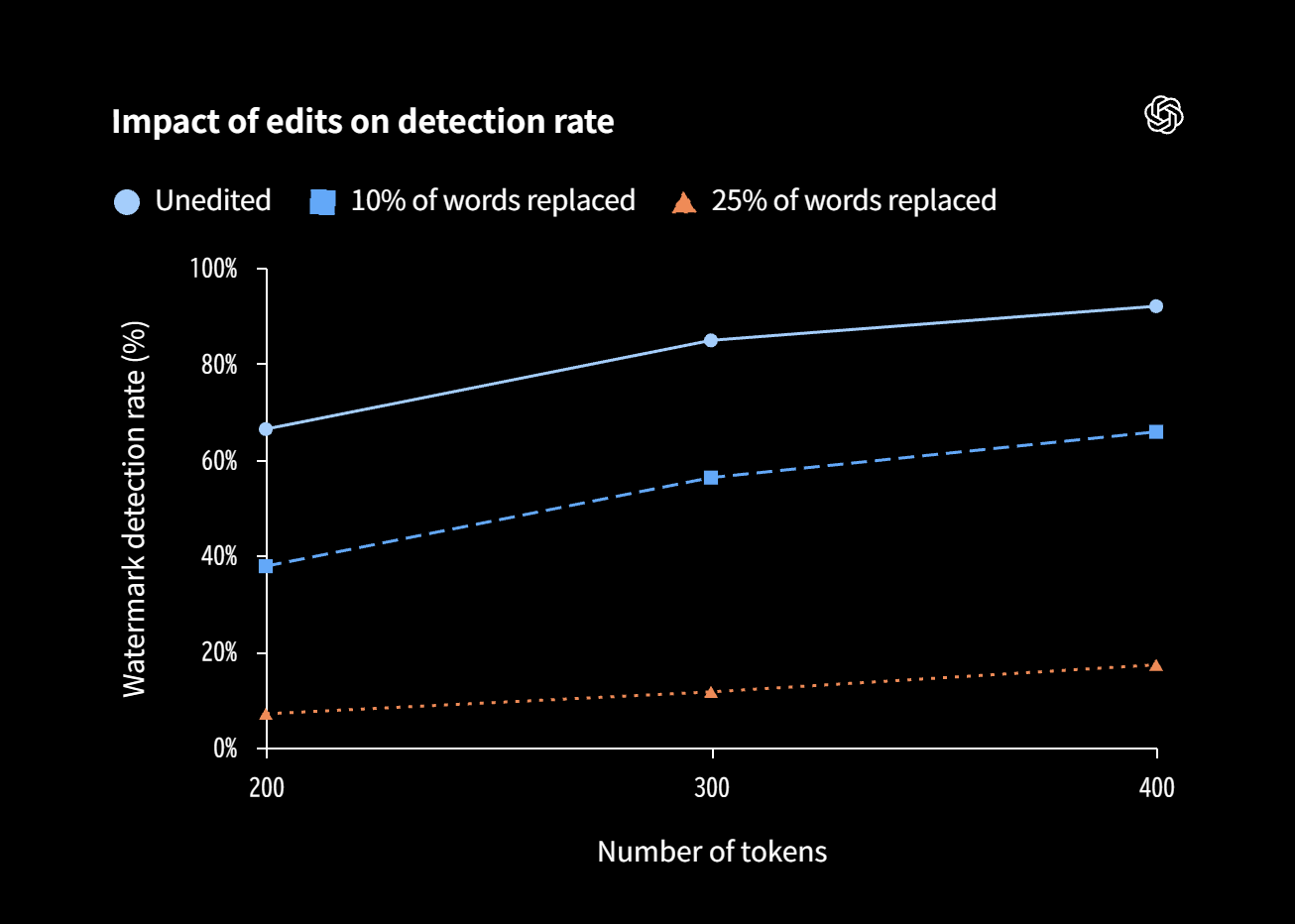
OpenAI will initially give the detector only to approved researchers and institutions, not the public, so real-world usefulness hinges on who gets access. Its own tests found detection drops to 66% when 10% of words are swapped.
WHO IT HITSCompliance, trust-and-safety, and platform teams at companies shipping generative AI products into the EU will need to account for a watermark that ships by default on EU outputs and is optional in the API. Editing tools and detection-reliant workflows may be affected, since OpenAI's tests show light rewording hurts detection.
Summaries like this, in your inbox every morning.
The rollout is tied directly to the EU AI Act, which requires generative AI providers to make AI-generated text machine-identifiable. OpenAI is answering that with textGrain, a technique that avoids stamping characters or metadata onto the text and instead bakes a statistical signal into how the model picks its words.
OpenAI's own numbers show where the approach holds and where it frays. Detection is strongest on prose with wide word choice, but weakens when the text is short, when the subject offers few alternatives, or when a person edits it — swapping 10% of words in a 400-token English passage cut detection from about 92% to 66%, and swapping 25% dropped it to 17%. The company also stresses that a detected watermark cannot establish human involvement, ownership, responsibility, or user identity, and that a missing watermark does not prove human authorship.
That is why the detector will go first to approved researchers and institutions rather than the general public. The practical stakes look likely to hinge on how much access those outsiders get, and whether detection holds up outside OpenAI's tests — especially on text that has passed through editing tools.
Pick your industry and the AI tools you use, and get news related to your work every day.
Free · 30 seconds with Google · unsubscribe anytimeWhat is AIToday? →
Ask AI anything about this article. The AI reads this article, earlier AIToday articles, and Wikipedia, and cites its sources. Q&As are published on this page for other readers too.
KDDI's ELYZA said on October 2 it set up "ELYZA RSI Research" to study recursive self-improvement, and CEO Yuy…
On a recent episode of The AI Investor Podcast, Eric Bleeker and Austin Smith broke down Google's release of G…
President Lee Jae Myung told a cabinet meeting that signs of AI use have emerged in some recent hacking incide…

Meta has begun offering parental controls in Meta AI, so parents can review the topics their teens asked about…

OpenAI is rolling out a new visual ad format shown while ChatGPT generates images, and will test it with selec…

DeepMind's 2022 study found that at equal compute, balancing model size and data beats pure bigness: a 70 bill…


