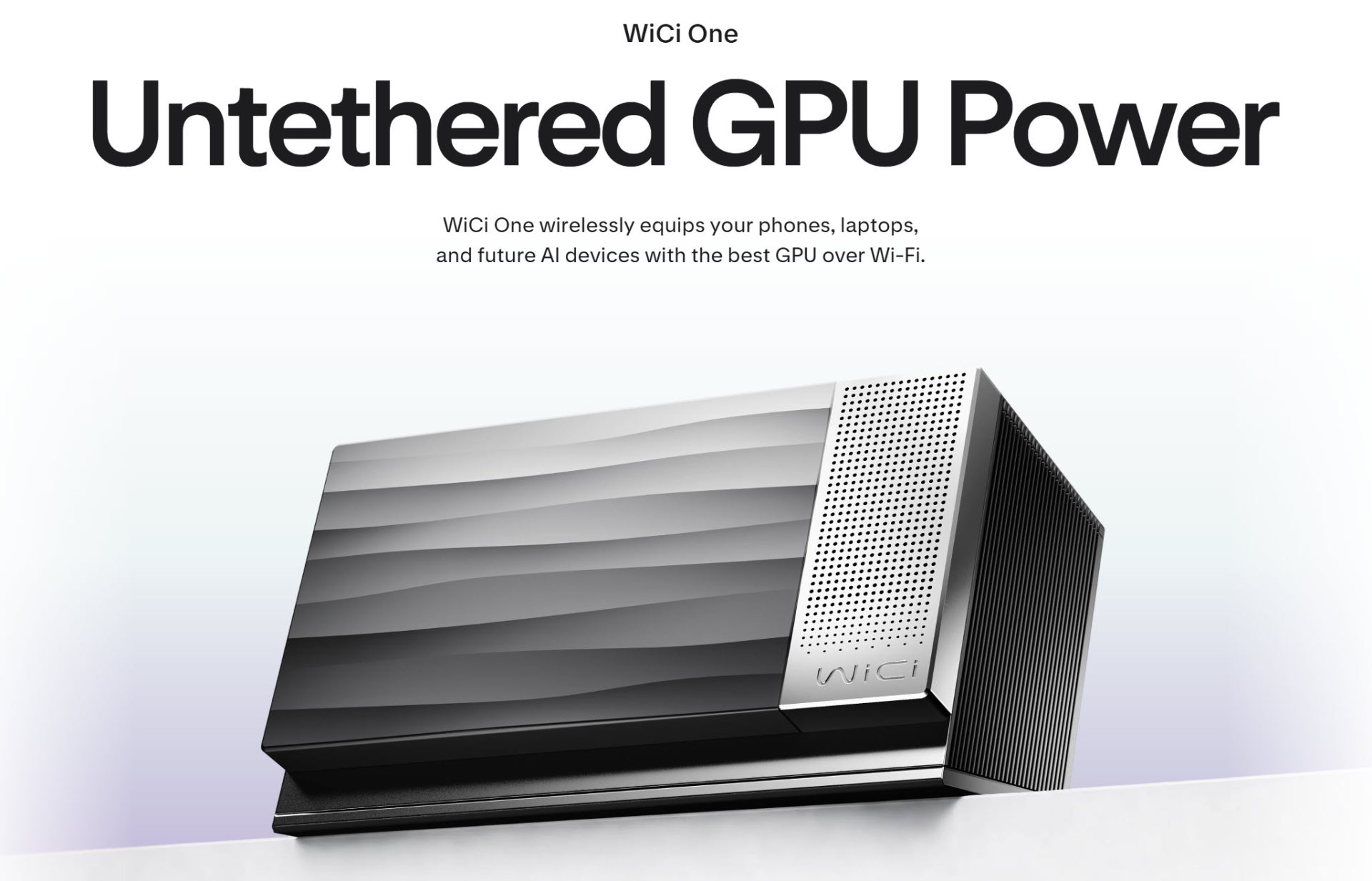
What happened
WiCi unveiled the WiCi One, a fully enclosed device that houses an RTX 5060 Ti 16 GB or RTX 5090 32 GB and shares it over Wi-Fi 7, starting at $2,599, with early signups at $1999.
Why it matters
It lets multiple devices use one GPU wirelessly, so users may avoid renting cloud AI or buying a second GPU; WiCi says the 5090 edition can run trillion-parameter models and accelerate heavy media on thin clients.
What to watch
WiCi's performance figures are its own demos, and the article notes the wireless link still needs independent, real-world testing. Watch whether verified testing backs up the claimed token rates.
WHO IT HITSThis lands on AI developers and gaming or media professionals who want a local GPU without a desktop tower, and on IT teams supporting shared compute in homes or small offices. It may help thin-client users run large models or demanding apps locally, though the wireless performance remains unverified.
Summaries like this, in your inbox every morning.
WiCi One comes from the minds behind the Vincross Hexa robot and the Sequoia-backed Vesta Sleep, and it arrives as centralized, shared computing solutions are gaining popularity. The device is a fully enclosed box that houses standard GPUs; the 5060 Ti edition pairs with an Intel Core 3 100U and 1 TB of storage, while the 5090 edition uses a Core Ultra 7 255H and 4 TB. WiCi says the 5090 model can turn that 4 TB of NVMe into working VRAM through TurboStream weight paging, part of a Unified Hierarchical Memory approach.
WiCi presents the WiCi One in three modes: Driver mode, where it appears as a standard local GPU to macOS, Windows or Linux; SDK mode with Python, JavaScript and Swift; and API mode as an OpenAI-compatible endpoint that existing clients can call with zero code changes. The company lists token rates for trillion-parameter models and gaming numbers, but the article notes these are demos measured on the 5090 edition.
The main caveat is the wireless interface itself. Unlike an eGPU over USB or OcuLink, WiCi One carries compute over Wi-Fi 7 at 4x4 MIMO and a 320 MHz band, using WiCi's own protocols to mitigate wireless drawbacks. Whether that holds up in real-world use is likely to hinge on independent testing, since the article says the solution remains to be tested in an actual test environment.
Pick your industry and the AI tools you use, and get news related to your work every day.
Free · 30 seconds with Google · unsubscribe anytimeWhat is AIToday? →
Ask AI anything about this article. The AI reads this article, earlier AIToday articles, and Wikipedia, and cites its sources. Q&As are published on this page for other readers too.
HBM is approaching half the cost of a GPU-HBM CoWoS package, prompting the question of whether memory remains…
DeepSeek is bringing more of the software it uses to develop its AI models to Huawei Technologies' Ascend 950…
Among respondents at companies with 1,001+ employees, 50.0% said AI is used company-wide, and 46.0% flagged AI…

Oracle invoked "force majeure" to delay payment on its Project Jupiter data center, and its 2056 bonds then tr…

Nvidia released the Open Agent Safety Platform on September 28, days after CEO Jensen Huang called warnings fr…
McDonald’s is increasingly using AI to guide menu prices in the U.S