What happened
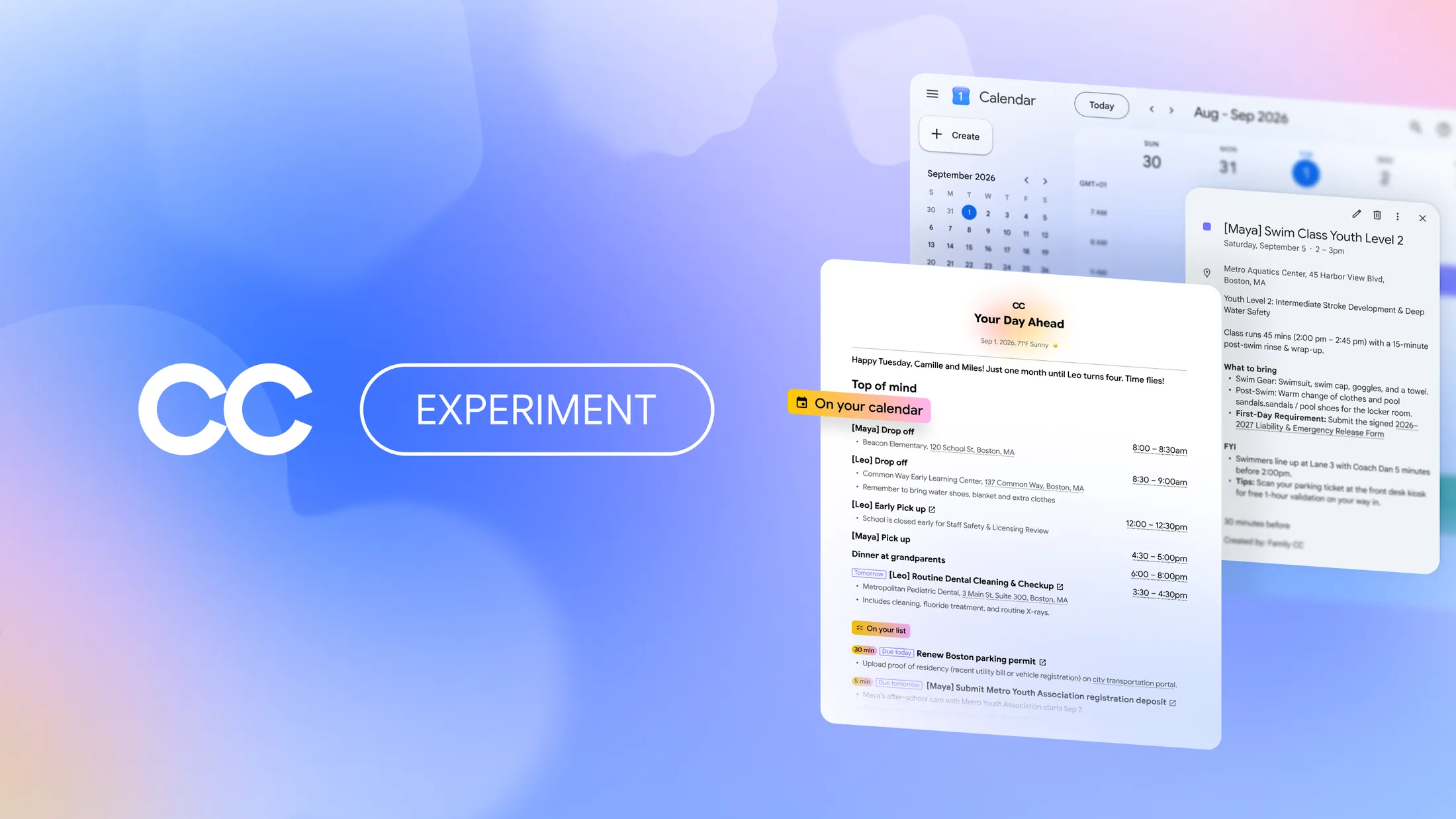
Google Labs opened its experimental AI agent CC to households of up to six people. Members choose what CC sees, and it builds "Your Day Ahead," calendar entries and task lists from Gmail, Calendar, Drive and Google Chat.
Why it matters
Pooling school notices, practice schedules and vet reminders that normally sit in one parent's inbox lets a household see who must be where, and what CC already handled.
What to watch
The household version is U.S.-only on web and mobile for users 18 and older with a personal Google account. Existing users get an upgrade email in coming days; everyone else joins a waitlist.
WHO IT HITSGoogle's move targets families coordinating school runs and shared calendars, putting a single AI agent in place of one parent's inbox for everyday logistics.
Summaries like this, in your inbox every morning.
CC began in December as a single-user product that emailed a daily briefing built from Gmail, Calendar and Drive, and Google moved it into the Gemini app in May under the name Daily Brief. The household version extends that same agent to as many as six people, with a verified Google account of its own so it has a distinct identity when it appears in an inbox or chat thread. Each CC runs on its own isolated cloud computer, built on Antigravity, Google's agentic harness for developers, and on the company's latest Gemini models, which lets it open a registration form, pull live drive times from Google Maps between back-to-back activities, or create a shared Doc or Sheet.
Tom Shane, senior product manager at Google Labs, wrote in a blog post that "one of our top user requests was for CC to do more to help run a busy home," and said coordination gets harder when information is spread across separate accounts. Google says CC responds only to group members and will not act outside the group or pass anything beyond it without permission. Senders can be put on an auto-share list that routes everything from a school or an airline to CC, and each member gets a private weekly rundown of new senders to approve or ignore.
The rollout's reach looks likely to hinge on how the permission and auto-share controls hold up in real households, where one member's inbox choices affect what everyone else sees. For families already juggling separate Google accounts, the question is whether a shared brief reduces that coordination load or simply adds another place to check.
For example, today's edition would include:
AI-summarized, only the topics you pick — one digest a day via Email, Slack, or Discord.
Free · 30 seconds with Google · unsubscribe anytimeWhat is AIToday? →
Ask AI anything about this article. Q&As are published on this page for other readers too.
OpenAI launched Astra for Law, wrapping GPT-6 Astra in a legal search index covering US case law, statutes, re…

Anthropic detailed three metrics — AI-led R&D, oversight of autonomous AI agents, and compute allocation — dis…

Shiseido Japan's AI agent for ingredient discovery cut search time by 95% and increased proposed ingredient ca…

Anthropic published a blog post on September 8, 2026 (US time), outlining six common prompting anti-patterns t…
Microsoft is phasing in a consolidation of its Microsoft 365 Copilot app and experience into Microsoft Copilot…

Nvidia CEO Jensen Huang rejected the notion that the industry must choose between safety and speed, saying "yo…