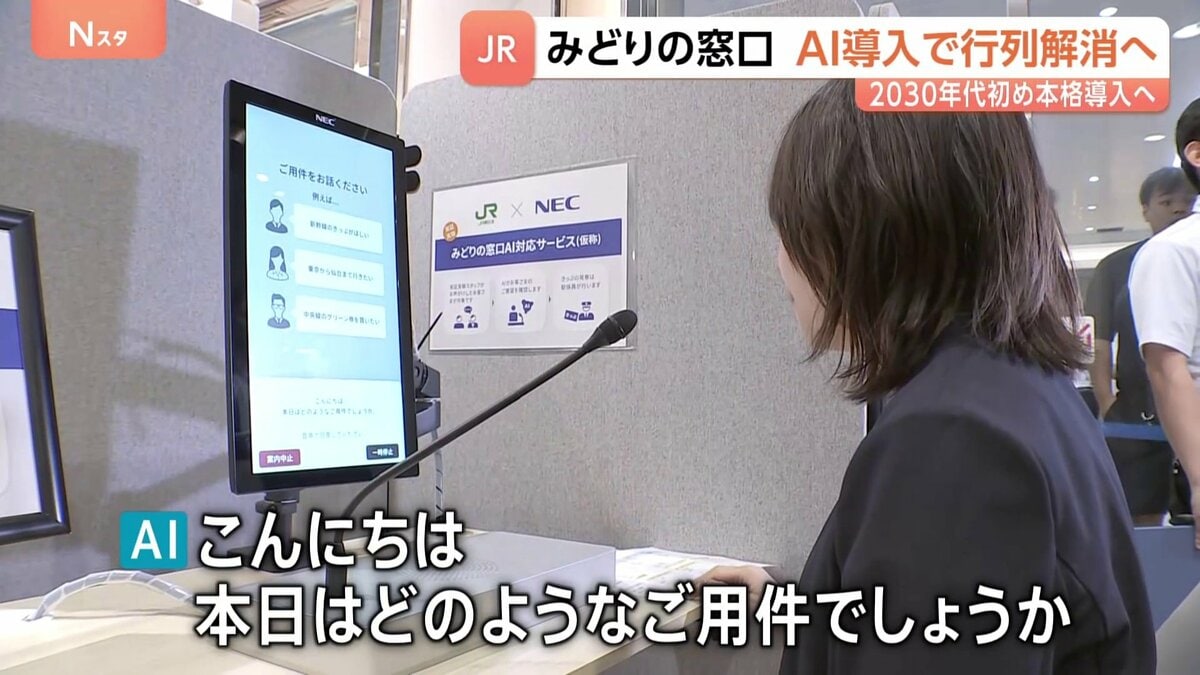
JR East, Japan's largest railway operator, is running a demonstration experiment to reduce wait times at Midori Windows—its ticket sales counters—by deploying AI to gather customer requests before they reach the counter. The system aims to eliminate congestion at these high-traffic service points by allowing staff to prepare in advance for each customer's specific ticketing needs.
Summaries like this, in your inbox every morning.
Sign up free →What happened
JR East (East Japan Railway Company) is conducting a demonstration experiment where artificial intelligence gathers customer requests in advance at Midori Windows (ticket counters), aiming to reduce wait times and resolve congestion.
Why it matters
Midori Windows handle complex ticketing requests that often create long queues. By using AI to pre-screen customer needs before they reach the counter, JR East aims to streamline operations and improve service experience during peak travel periods.
What to watch
The results of this demonstration experiment will determine whether AI-assisted pre-screening becomes a standard feature at JR East's ticket counters, potentially spreading to other railway operators managing similar congestion challenges.
JR East, Japan's largest railway company, is running a demonstration experiment at its Midori Windows—the ticket sales counters that serve customers with complex ticketing needs beyond what automated machines can handle. The experiment deploys artificial intelligence to gather customer requests and preferences in advance, before customers reach the physical counter. The goal is straightforward: reduce wait times and eliminate the congestion that regularly builds up at these service points. Currently, Midori Windows handle a wide range of transactions—from international rail tickets and group bookings to special fare passes and rail-pass exchanges—and each customer's needs must be discovered and processed at the counter itself, creating bottlenecks especially during busy travel periods. By having AI conduct this initial intake, JR East aims to allow counter staff to prepare documentation, verify eligibility, and organize information in parallel, so that when the customer arrives, the transaction can proceed much faster. The company has not announced a specific timeline for broader rollout or the locations where the trial is taking place, but the demonstration is intended to validate whether this approach can meaningfully improve service efficiency and passenger satisfaction at one of Japan's most critical transportation hubs.
JR East's demonstration experiment reflects a growing effort to apply AI technology to everyday customer service bottlenecks in Japan's transportation sector. Midori Windows have long been a pain point for travelers, particularly during peak seasons, because ticket agents must handle diverse and often complex requests—international tickets, group bookings, special passes, and rail-pass exchanges—that cannot be quickly processed through automated machines. By deploying AI to understand customer needs before they reach the counter, JR East seeks to shift the cognitive work upstream, allowing agents to prepare documentation and information in real time rather than discovering requirements only when the customer is at the window. This approach treats the queue problem not as a staffing issue alone but as an information-flow problem, where advance knowledge enables parallel preparation. The experiment's outcome will likely influence whether similar pre-screening AI systems become standard across JR East's network and potentially inspire adoption by other Japanese railway operators facing similar congestion.
AI-summarized, only the topics you pick — one digest a day via Email, Slack, or Discord.
Free · takes 30 seconds · unsubscribe anytime
No comments yet. Be the first to share your thoughts!
Log in to join the discussion


Get curated AI news from 200+ sources delivered daily to your inbox. Free to use.
Get Started FreeFree · takes 30 seconds · unsubscribe anytime
1 minute a day. The AI essentials.
200+ sources · Email / LINE / Slack