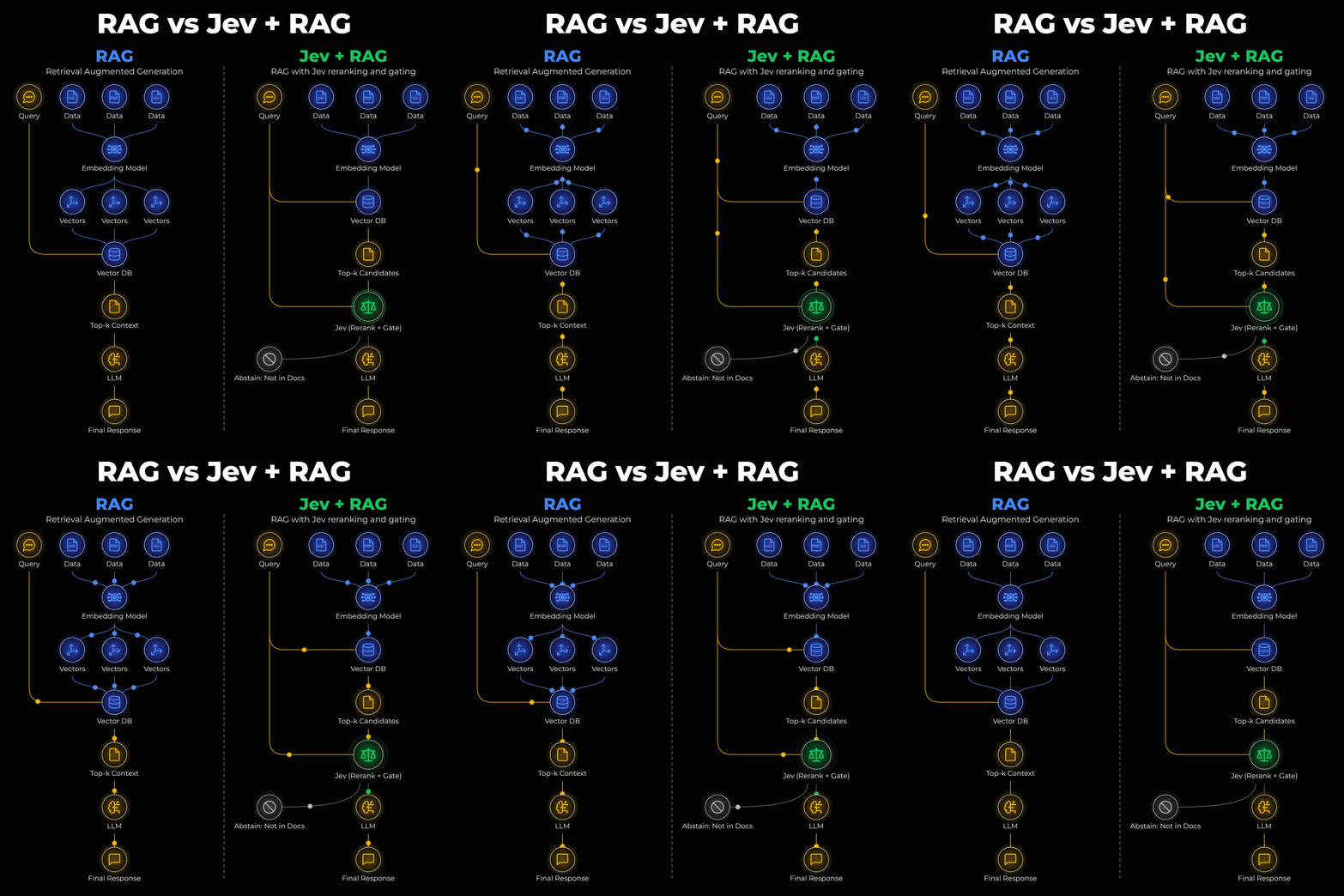
What happened
Jev + RAG keeps retrieval as is, but replaces a conventional reranker with a typed decision—"Does this passage help answer the query?"—returning a probability per candidate that application code thresholds.
Why it matters
Ranking and answerability are different questions, so a passage can be more relevant than its rivals while still holding weak or merely adjacent evidence that the LLM would otherwise turn into a plausible answer.
What to watch
Jev cannot recover a passage that never entered the candidate set, so the ceiling is set by the existing embedding model, vector database, and retriever.
WHO IT HITSTeams building production RAG pipelines — retrieval and platform engineers who currently bolt a reranker onto a vector search stack — would need to add a thresholding step and decide where answerability gates the LLM call.
Summaries like this, in your inbox every morning.
The article frames Jev + RAG as a change to one stage of a well-known pipeline rather than a new architecture. In a standard setup, documents are chunked, embedded, and stored in a vector DB; a query is embedded and the top-k closest chunks are pulled, often followed by a reranker that reorders those passages before they go into the context window. The newsletter's point is that this ordering step answers a different question from whether the evidence actually supports an answer.
The proposed alternative keeps retrieval exactly as it is and turns the query into shared state while the retrieved passages become candidates judged together. Each candidate gets a probability, application code applies a threshold, and passages above it continue while those below are dropped. The same request can also assess whether what remains is enough to answer at all.
The ceiling, as the article stresses, belongs to retrieval: Jev cannot recover a passage that never entered the candidate set. The practical stakes therefore hinge on where the threshold is set and on how much the existing embedding model and vector database are already surfacing — the pieces Jev explicitly does not replace.
Pick your industry and the AI tools you use, and get news related to your work every day.
Free · 30 seconds with Google · unsubscribe anytimeWhat is AIToday? →
Ask AI anything about this article. The AI reads this article, earlier AIToday articles, and Wikipedia, and cites its sources. Q&As are published on this page for other readers too.
Anthropic released Claude Haiku 5.5, a small model for repetitive work, with list prices of 10 cents per milli…

TIMEWELL said on October 1, 2026 it was chosen as a Shinshu AI GEARS subsidy recipient, working with Orion Kik…

Preferred Networks began offering a major update to its Japan-focused AI translation service PLaMo翻訳, claiming…

Analysts estimate China's best models are now just four months behind OpenAI and Anthropic, versus seven month…

At Sequoia AI Ascent, DeepMind CEO Demis Hassabis said AGI arrives in 2030 and described a two-step mission: b…

The developer behind typingtube says 200 planning documents exist, yet searches of the 102-line instruction fi…

