What happened
A new analysis argues that embodied AI systems face a systemic bottleneck called the 'edge AI wall,' where onboard compute limits and exponential search space growth make traditional scaling ineffective.
Why it matters
Physical robots have strict energy and latency constraints, unlike cloud AI. Even with faster chips, combinatorial explosion makes planning intractable, so a new mathematical approach is needed.
What to watch
A proposed 'combinatorial compression engine' reduced search space by 8–11× in simulations. Real-world validation and adoption remain open questions.
Summaries like this, in your inbox every morning.
The article extends a previous discussion on computational instability in autonomous mobile robots to the broader field of embodied AI. It argues that scaling laws from cloud AI do not translate to physical systems due to energy and latency constraints. The proposed solution, based on Duality-Nonequilibrium theory, aims to compress the search space rather than just optimize models. This represents a shift from hardware scaling to algorithmic innovation. The implications are significant for robotics and autonomous vehicles, as current approaches may hit a ceiling. Future work will likely focus on testing this method in real-world scenarios.
Pick your industry and the AI tools you use, and get news related to your work every day.
Free · 30 seconds with Google · unsubscribe anytimeWhat is AIToday? →
Ask AI anything about this article. The AI reads this article, earlier AIToday articles, and Wikipedia, and cites its sources. Q&As are published on this page for other readers too.
A Zenn contributor sorted AI use into three modes — AI as an assistant, AI running alongside people, and AI th…

A developer released agent-guardrails, a one-script Python standard-library plugin that guards Bash, Write, Ed…
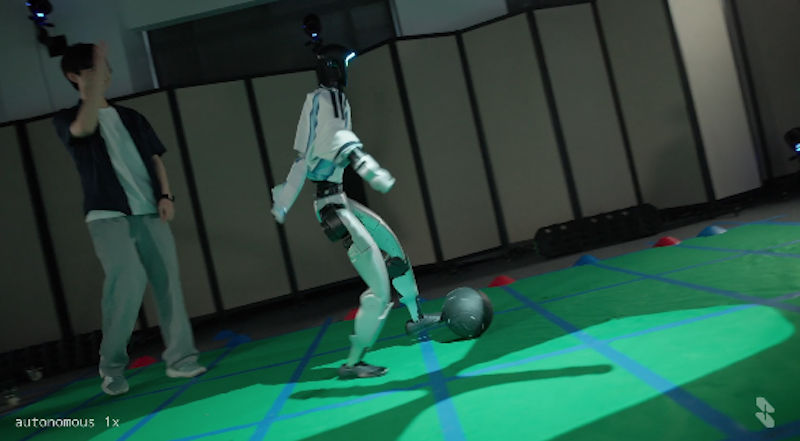
Skild AI used Nvidia Isaac Sim to give its S1 model one objective — score a goal — and let it compete against…
A Qiita article compared automated red-teaming methods for LLM apps — GCG, PAIR, and TAP — using mock implemen…

In a webinar hosted by French Mathematical Society president Isabelle Gallagher, Fields Medal winner Hugo Dumi…
Yamazaki Mazak and ABEJA said on the 16th they will start joint development of physical AI, using ABEJA's ABEJ…