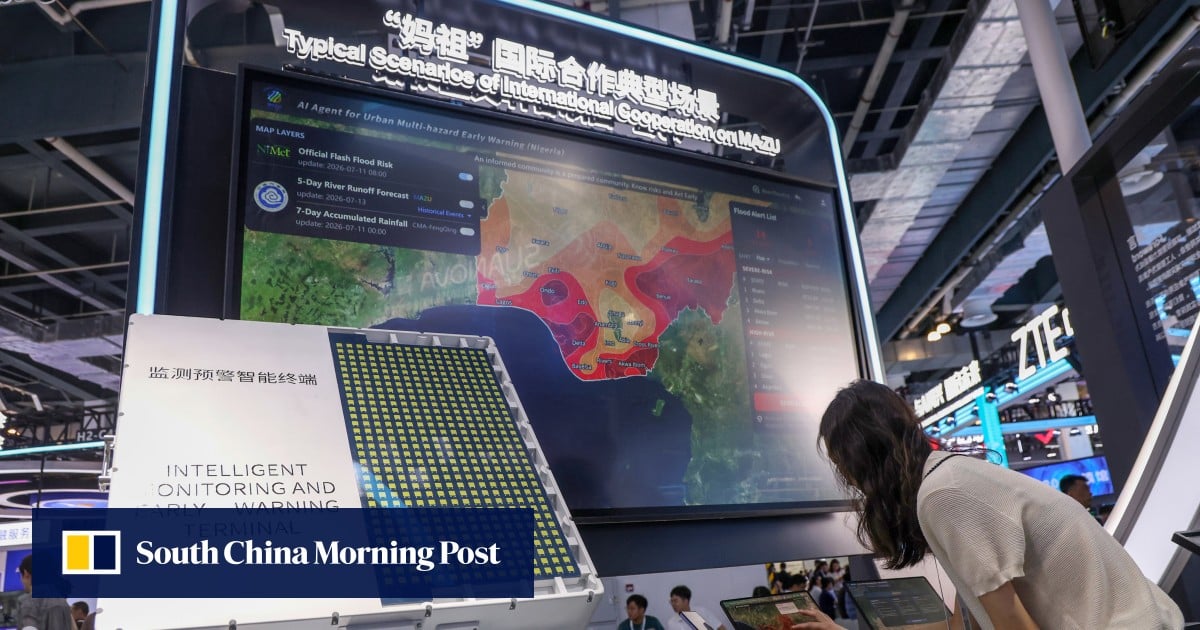
China has expanded its Mazu AI weather warning system to seven developing countries in Asia, Africa, and the Pacific — Pakistan, Djibouti, Ethiopia, Jordan, Mongolia, the Solomon Islands, and Sri Lanka — as part of the UN Early Warnings for All initiative to protect vulnerable regions from extreme weather. A public cloud version has been tested by 40 Global South countries, positioning the system as an international public good for disaster preparedness in regions with limited forecasting infrastructure.
Summaries like this, in your inbox every morning.
Sign up free →What happened
China's Mazu, an AI-powered weather warning system, has been deployed on the ground in seven countries — Pakistan, Djibouti, Ethiopia, Jordan, Mongolia, the Solomon Islands, and Sri Lanka — to help them prepare for natural disasters like typhoons and rainstorms. A public cloud version has been tested by 40 Global South countries.
Why it matters
Pan Jinjun, chief engineer at the China Meteorological Administration, framed Mazu as the first national project responding to the UN Early Warnings for All initiative, which aims to ensure everywhere on Earth is protected from extreme weather. The system is designed to provide tailored early warning services for developing nations that often lack resources for advanced weather forecasting.
What to watch
The system was first unveiled at last year's World AI Conference in Shanghai and was intentionally designed from the outset for global use. Pan announced the expansion ahead of the World Artificial Intelligence Conference in Shanghai.
China's Mazu weather warning system, an AI-powered platform designed to help developing nations prepare for natural disasters, is now operational in seven countries across three continents. Deployed on the ground in Pakistan, Djibouti, Ethiopia, Jordan, Mongolia, the Solomon Islands, and Sri Lanka, the system has been physically integrated into daily operations in each nation, moving beyond pilot testing to active use in disaster preparedness.
Mazu—an acronym for Multi-hazard Alert, Zero-gap and Universal—takes its name from a sea goddess venerated in coastal East Asia, a choice that reflects its intended global scope from inception. Pan Jinjun, chief engineer at the China Meteorological Administration, described the system to several media outlets as an "international public good" offering "tailored early warning services for developing nations." The system's development responds directly to the UN Early Warnings for All initiative, which aims to ensure comprehensive protection from extreme weather across the entire globe. Pan emphasized that Mazu is the first national project aligned with this UN mandate.
The system exists in two operational forms. The public cloud version, which provides quicker access to meteorological data, has undergone testing in 40 Global South countries, according to People's Daily. This broader testing phase enabled developers to refine the system for diverse climates and institutional contexts before full deployment. The complete system, with its full functionality, is now running operationally in the seven countries mentioned, where it supports early warning operations for typhoons, rainstorms, and other hazardous weather events. The system was first unveiled at the previous year's World AI Conference in Shanghai, and Pan's recent announcement of its expanded deployment came ahead of the current World Artificial Intelligence Conference in Shanghai.
Mazu represents a deliberate Chinese strategy to position advanced AI technology as a development tool for the Global South. Named after a sea goddess and intentionally designed for international deployment from inception, the system addresses a critical gap: many developing countries lack the resources and infrastructure for sophisticated weather forecasting despite facing disproportionate risk from extreme weather events. By framing Mazu as an "international public good," Pan Jinjun and the China Meteorological Administration align the system with the UN's Early Warnings for All mandate, which targets universal extreme-weather protection—a goal many poorer nations struggle to meet alone.
The phased expansion—from testing in 40 countries to operational deployment in seven—suggests a measured rollout that embeds the system into existing institutional structures rather than simply offering software. This ground-level integration in Pakistan, Djibouti, Ethiopia, Jordan, Mongolia, the Solomon Islands, and Sri Lanka positions Mazu as critical infrastructure for disaster response, not merely a technology product. The timing of the announcement ahead of Shanghai's World AI Conference underscores China's broader effort to lead in AI development for humanitarian use cases, contrasting with Western narratives that often frame AI through a security or corporate lens.
AI-summarized, only the topics you pick — one digest a day via Email, Slack, or Discord.
Free · takes 30 seconds · unsubscribe anytime
No comments yet. Be the first to share your thoughts!
Log in to join the discussion





Get curated AI news from 200+ sources delivered daily to your inbox. Free to use.
Get Started FreeFree · takes 30 seconds · unsubscribe anytime
