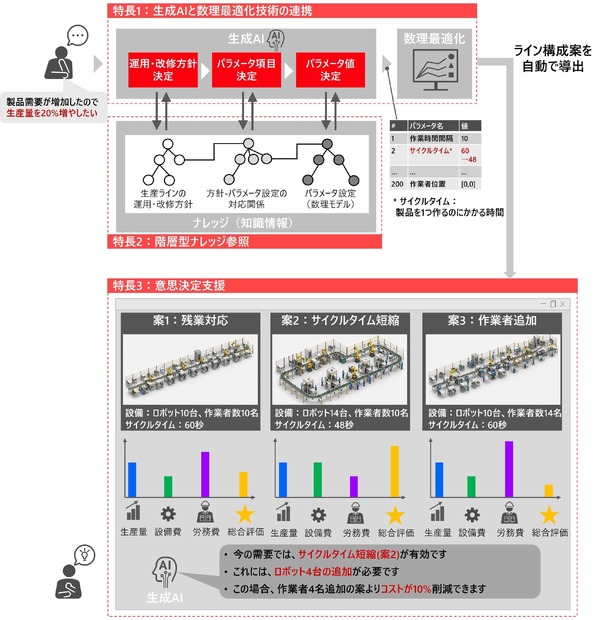
Hitachi and SZTAKI have developed a technology combining generative AI with mathematical optimization to automatically design and operate production lines.
The system handles both day-to-day line operations and the design of new line configurations, potentially reducing the manual expertise and planning effort currently required in manufacturing.
What happened
Hitachi and SZTAKI have developed a technology that links generative AI with mathematical optimization to automatically plan both the operation of production lines and the derivation of line configuration proposals.
Why it matters
Manufacturing facilities currently rely on manual expertise to design and run production lines; automating this process could reduce planning time and improve consistency across operations, though the article does not specify deployment timelines or business impact.
What to watch
The article does not disclose pricing, availability dates, or which manufacturers will pilot or adopt this technology first.
Hitachi and SZTAKI have jointly developed a new technology that automates the planning and operation of manufacturing production lines by combining generative AI with mathematical optimization techniques. The system is designed to handle two levels of decision-making: the day-to-day operational management of existing production lines and the strategic derivation of new line configuration proposals. By integrating AI-driven reasoning with constraint-based optimization, the technology aims to reduce the reliance on manual planning and improve the speed and quality of decisions in complex manufacturing environments. The article does not provide specific use cases, pilot results, or a timeline for commercial availability.
The collaboration between Hitachi, a major Japanese industrial conglomerate, and SZTAKI (a research institution) reflects a trend in manufacturing automation toward integrating AI decision-making with mathematical optimization. Generative AI can help synthesize complex requirements and scenarios, while optimization algorithms ensure that proposed solutions meet constraints (cost, throughput, resource limits). By linking these two capabilities, the technology aims to bridge the gap between high-level operational decisions and detailed technical execution—automating tasks that have traditionally required deep domain knowledge from production engineers.
AI-summarized, only the topics you pick — one digest a day via Email, Slack, or Discord.
Free · takes 30 seconds · unsubscribe anytime
Ask AI anything about this article. Q&As are published on this page for other readers too.
Marvell Technology's stock rose around 5 percent, driven by social media discussion of its optical networking…

Three semiconductor equipment suppliers—Onto Innovation (US$1.1b revenue, US$15.7b market value), KLA (US$13.6…
IBM and OpenAI announced a strategic partnership on August 13, 2026, embedding OpenAI frontier models like GPT…
Micron's third-quarter fiscal 2026 revenues jumped 346% year over year to $41.46 billion, driven by strong dat…
GE Vernova (NYSE:GEV), a power infrastructure company spun off from General Electric, is being highlighted as…

Wells Fargo identified commercial real estate (CRE) as a beneficiary of what it calls "unrelenting demand for…

The AI news that matters, in one minute each morning.
Sign up free