What happened
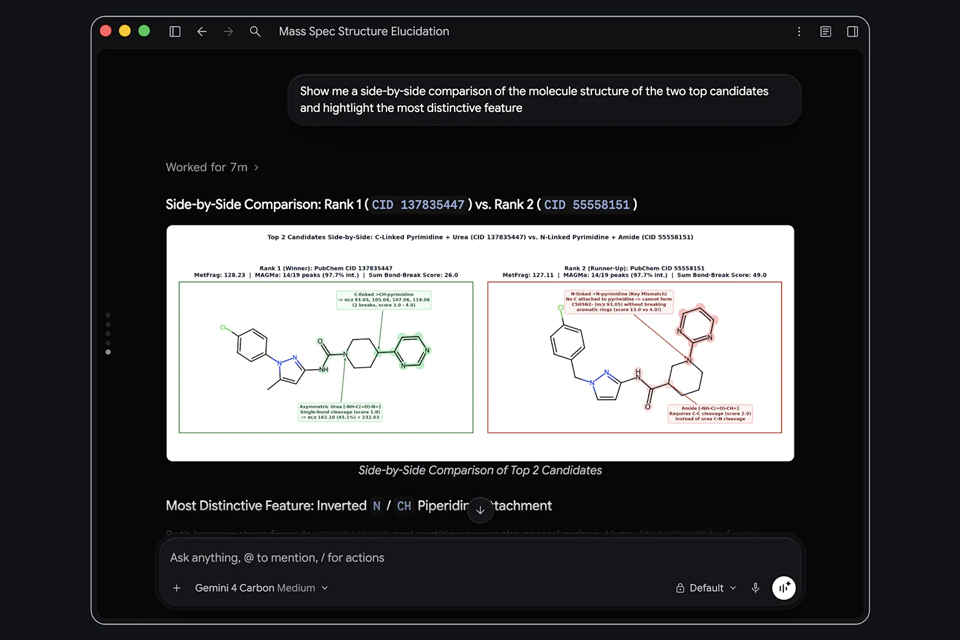
Google DeepMind released Mass Spec Skills as a Google Antigravity plugin that automates molecule identification from tandem mass spectra; on 100 MoNA-sampled compounds it achieved about 97% exact-match accuracy.
Why it matters
The tool lets researchers identify molecules that conventional reference-library matching leaves unannotated, a gap that previously required slow manual work by experts.
WHO IT HITSResearchers in analytical chemistry and metabolomics who currently spend hours manually interpreting unannotated mass spectra could automate that step, while the free top-tier program targets up to 10,000 of them.
Summaries like this, every morning.
Mass Spec Skills combines Gemini's chemical reasoning with the ability to run established mass spectrometry tools and query public chemical databases. This addresses a longstanding bottleneck: conventional reference-spectrum matching annotates only about 5% of measured spectra on average, or about 10% for human samples, leaving the rest as unresolved "dark matter." When a molecule is registered in a public database but its spectrum is not recorded, researchers must infer structure directly from observed fragment ions—a task that previously took experts considerable time by hand.
The Antigravity plugin streamlines this by letting researchers describe tasks and instrument-specific tolerances in plain language in a single prompt. The agent then selects and combines relevant skills to process unannotated tandem mass spectra, outputting proposed chemical structures and an auditable report in one workflow. It checks spectrum reference libraries, looks up molecular formulas, retrieves candidate structures from chemical databases, and validates each candidate against observed fragment peaks, diagnostic neutral losses, and bond cleavages. Beyond the benchmark, the tool cannot resolve some isomers such as enantiomers or closely related structures from LC-MS/MS spectra alone—those require orthogonal methods like chromatographic retention time, ion mobility, or NMR. For novel molecules absent from existing databases, it cannot search or confirm structures, but it does provide starting-point information such as predicted chemical formulas, peak assignments, and detailed annotation tables.
Pick your industry and the AI tools you use, and get news related to your work every day.
Free · 30 seconds with Google · unsubscribe anytimeWhat is AIToday? →
Ask AI anything about this article. The AI reads this article, earlier AIToday articles, and Wikipedia, and cites its sources. Q&As are published on this page for other readers too.
Aevius, spun out of Mass General Brigham and led by CEO Rowland Pettit, launched on the 17th with $22 million…
OpenAI said GPT-6.2, working with partner Onava, designed 322 protein candidates, of which 35 bound the target…
The American Journal of Managed Care published a piece featuring Mahadi Baig, MD, on community oncology's gaps…
Waystar integrated into Google Cloud's Gemini for healthcare, and Oracle debuted AI agents for clinical trials

Shanghai AI Lab's Sage-Med-Preview, a 35B-parameter medical multimodal model with 3B activated parameters, ave…

Nihin Media, which makes the MedGen Japan AI assistant, raised new funding via a third-party allotment with De…