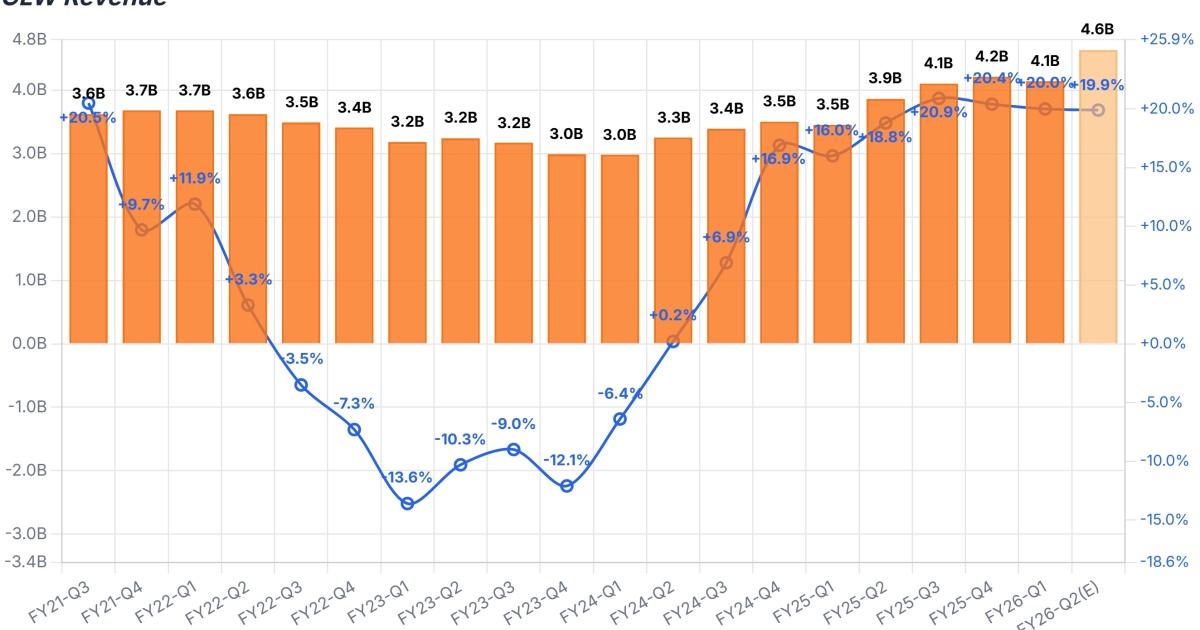
Corning will report second-quarter earnings on July 28 backed by major multi-billion-dollar supply deals with Nvidia and Amazon to support AI infrastructure buildout. The company is investing in three new U.S. factories to expand optical connectivity tenfold and fiber capacity by 50%, with its optical communications segment—which grew 36.2% last quarter—positioned to drive near-term gains as hyperscalers ramp AI compute spending.
Summaries like this, in your inbox every morning.
Sign up free →What happened
Corning will report Q2 earnings on July 28. In the quarter, the company secured major partnerships: Nvidia invested $500 million(約800億円) in Corning warrants on May 6 to secure production capacity; Amazon announced a multibillion-dollar multi-year procurement contract on June 8. Corning will build three new U.S. factories, expanding optical connectivity capacity tenfold and fiber optic capacity by 50%, and create 1,000 manufacturing jobs in North Carolina.
Why it matters
Optical communications—Corning's fastest-growing segment, which accounted for 44.6% of prior-quarter revenue and grew at 36.2% in FY26 Q1—stands to benefit most from AI infrastructure buildout. The company's profit margins have been climbing since 2022; with gross margins at 36.9% and net margins around 10%, continued demand for high-value optical and fiber products could expand margins further. For Corning shareholders and suppliers to hyperscalers (large cloud providers), this signals sustained AI capex momentum.
What to watch
moomoo data projects Q2 revenue of $4.63 billion(約7400億円) and net income of $612 million(約980億円) (a 30.51% increase). Corning's put/call ratio stands at 1.00, reflecting bearish sentiment, while implied volatility is at 90.27%, indicating investors expect significant stock movement after earnings. Historically, the stock has risen the day after earnings in 6 of the past 12 reports.
Corning will report second-quarter earnings on July 28 before market open, coming off a transformative quarter in which the company secured two landmark deals tied to AI infrastructure.
On May 6, Nvidia invested $500 million(約800億円) in Corning warrants to secure production capacity for critical optical interconnect products. The investment covers high-speed optical fiber and MPO optical interconnect components designed for Nvidia's AI supercomputer clusters and tailored for CPO (co-packaged optics) architecture. This partnership underscores Nvidia's dependence on Corning's technology to link its chips efficiently within large-scale AI systems.
Amazon followed on June 8 with a multibillion-dollar multi-year procurement contract to supply optical fiber, optical cables, and high-density optical interconnect components to Amazon's U.S. data centers on a continuous basis. To support Amazon Web Services' large-scale AI computing campus expansion, Corning will expand its North Carolina facility and create 1,000 manufacturing jobs.
Corning's capacity response has been bold. The company will build three new factories in the United States, expanding optical connectivity capacity tenfold and fiber optic capacity by 50%. These investments reflect confidence in sustained hyperscaler demand for optical infrastructure to support AI workloads.
For the second quarter, moomoo data forecasts revenue of $4.63 billion(約7400億円) and net income of $612 million(約980億円), implying a 30.51% increase in profit. Optical communications is driving the momentum—the segment represented 44.6% of prior-quarter revenue and grew at 36.2% in FY26 Q1. Market expectations are for a new record in optical communications revenue this quarter, boosted by AI demand.
Profitability trends are improving. Corning's gross margin stood at 36.9% in the prior quarter, while net margins have hovered around 10%. Since 2022, profit margins have been climbing steadily. With high-value optical and fiber products gaining share and the optical sector booming, there remains room for further margin expansion.
Market sentiment ahead of earnings is mixed. The put/call ratio sits at 1.00, a relatively elevated level reflecting bearish positioning. Implied volatility is at 90.27%, suggesting investors anticipate significant price movement after the report. Historically, Corning stock has risen the day after earnings in 6 of the past 12 reports. The company's P/E ratio of 70.50 places it at the 68th percentile of its five-year range, indicating valuation is not at extremes but elevated relative to history.
Corning has transformed from a legacy glass manufacturer into a critical infrastructure supplier for the AI era. The May Nvidia investment and June Amazon procurement deal signal that hyperscalers view the company's optical and fiber products as essential to scaling AI clusters efficiently. Optical communications, which accounted for 44.6% of Corning's prior-quarter revenue and grew 36.2% in the most recent fiscal quarter, has become the company's primary growth driver—a stark shift from its traditional diversified portfolio.
The capital intensity of Corning's response—three new factories, 1,000 new jobs, and a tenfold expansion of optical connectivity capacity—underscores how critical these partnerships are to the company's strategy. The company's profit margins have been rising steadily since 2022, with gross margins at 36.9% in the prior quarter and net margins hovering around 10%. This combination of operating leverage (fixed costs spreading across higher revenue from AI-driven orders) and higher-margin optical products suggests room for further margin expansion. Market sentiment appears cautious heading into earnings, reflected in a put/call ratio of 1.00 and elevated implied volatility at 90.27%, though the stock has historically risen the day after earnings in 6 of the past 12 reports.
AI-summarized, only the topics you pick — one digest a day via Email, Slack, or Discord.
Free · takes 30 seconds · unsubscribe anytime
No comments yet. Be the first to share your thoughts!
Log in to join the discussion

Get curated AI news from 200+ sources delivered daily to your inbox. Free to use.
Get Started FreeFree · takes 30 seconds · unsubscribe anytime
