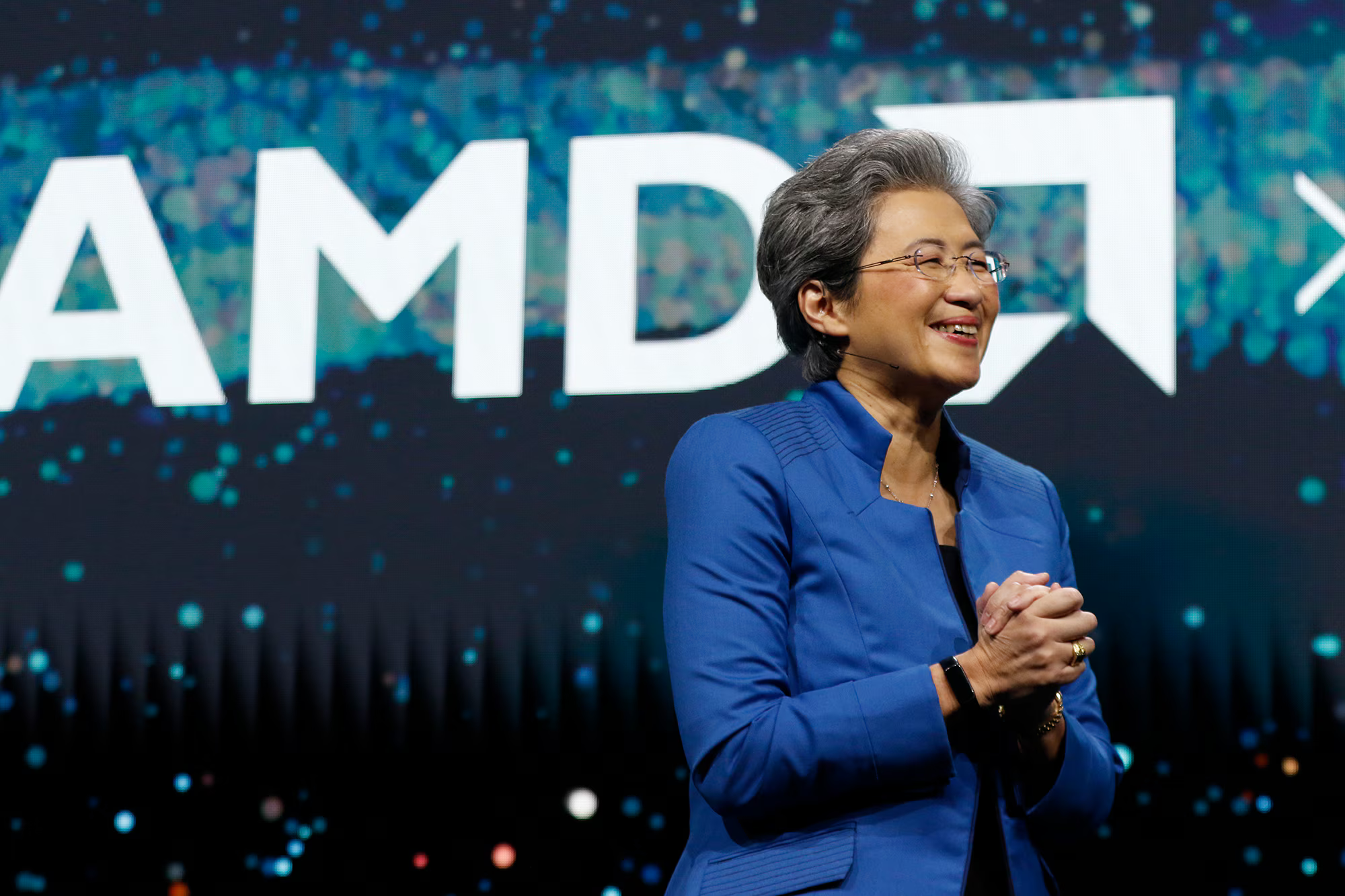
AMD is on track to reach CEO Lisa Su's $100 billion(約16兆円) revenue target two years ahead of schedule, driven by hyperscale cloud providers' massive spending on AI infrastructure and a shift away from single-supplier dominance. The semiconductor market is becoming more competitive as customers increasingly seek a second supplier, particularly for inference workloads that are expanding alongside AI training.
Summaries like this, in your inbox every morning.
Sign up free →What happened
AMD appears positioned to reach the $100 billion(約16兆円) revenue target that CEO Lisa Su had forecast, potentially achieving it two years sooner than originally predicted, as hyperscale cloud providers commit hundreds of billions of dollars to AI infrastructure.
Why it matters
The semiconductor market is shifting from a winner-take-all dynamic to one where customers seek multiple suppliers, particularly as inference workloads (the phase where an AI produces answers) expand alongside AI training. This opens space for AMD to capture more AI-related spending beyond its traditional rivals.
What to watch
The trajectory depends on whether hyperscale cloud providers continue diversifying their supplier relationships and expand inference spending at the pace the market currently suggests.
AMD's $100 billion(約16兆円) revenue target is coming into focus two years sooner than CEO Lisa Su originally projected, according to recent market signals. The shift reflects a fundamental reshaping of the semiconductor industry by artificial intelligence spending. Hyperscale cloud providers—the massive data center operators that train and run large AI systems—are committing hundreds of billions of dollars to AI infrastructure, creating a market large enough to support multiple suppliers rather than enriching a single competitor. Two years ago, many investors believed the AI chip race would follow a winner-take-all pattern, with one company dominating. That assumption is proving wrong. As inference workloads expand alongside AI training, customers are increasingly insisting on a second supplier option. Inference is the computationally intensive phase where a trained AI model produces answers; as this workload grows, it multiplies the total chip demand across the industry. AMD is positioned to capture more of this growing demand because cloud providers are diversifying their supply chains. This competitive opening—away from the single-supplier dominance many predicted—is allowing AMD to approach Lisa Su's ambitious $100 billion(約16兆円) revenue milestone much faster than the original timeline suggested.
The semiconductor industry is undergoing a structural shift driven by the scale of AI spending. Hyperscale cloud providers are deploying hundreds of billions of dollars into AI infrastructure, creating demand large enough that no single chip supplier can meet it alone. This contrasts with expectations from two years ago, when many investors viewed the AI semiconductor race as a winner-take-all competition. AMD's accelerated path to $100 billion(約16兆円) in revenue reflects this change: as inference workloads expand—the computational step where trained AI models actually produce answers for users—customers are increasingly unwilling to depend on a single supplier and are actively seeking alternatives. This diversification dynamic works in AMD's favor, allowing it to capture a larger share of AI-related semiconductor spending than a pure winner-take-all model would have permitted. Lisa Su's original $100 billion(約16兆円) revenue forecast, now appearing achievable two years early, implicitly assumes this competitive landscape will sustain.
AI-summarized, only the topics you pick — one digest a day via Email, Slack, or Discord.
Free · takes 30 seconds · unsubscribe anytime
No comments yet. Be the first to share your thoughts!
Log in to join the discussion




Get curated AI news from 200+ sources delivered daily to your inbox. Free to use.
Get Started FreeFree · takes 30 seconds · unsubscribe anytime
