What happened
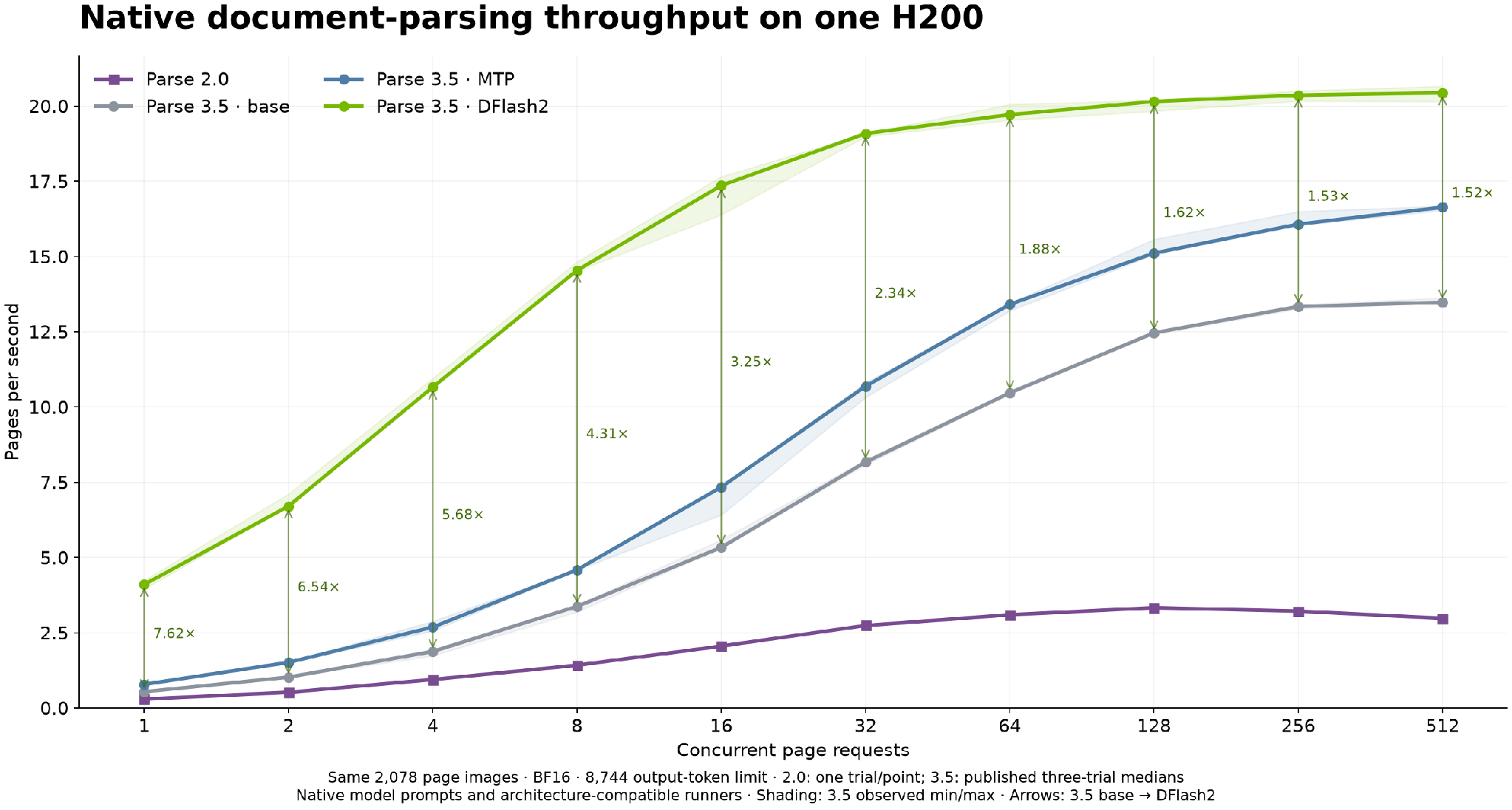
NVIDIA released three open datasets for Nemotron 3.5 Parse, including Synthetic Charts V1 with 9.98M examples, plus a fine-tuning recipe and the DFlash2 speculator, which lifted single-pass throughput 7.62× at concurrency 1.
Why it matters
Teams building document-processing pipelines can now fine-tune Parse on their own page types and get faster parsing, which the body says leaves room to re-parse difficult regions for better accuracy.
WHO IT HITSDevelopers and data teams that extract structured data from scanned documents (forms, charts, tables) for retrieval-augmented generation and agents can fine-tune Parse on their own image/label pairs and trade throughput for accuracy on hard pages.
Summaries like this, every morning.
NVIDIA's Nemotron 3.5 Parse is a compact document model that turns page images into structured data for retrieval-augmented generation (RAG) and agents. The release adds open training data and a fine-tuning recipe on top of that model, plus a DFlash2 speculator for faster inference. The body describes the training as two phases: supervised fine-tuning (SFT) to teach document understanding, then reinforcement learning with verifiable rewards (RLVR) using Group Relative Policy Optimization (GRPO) to improve accuracy, consistency, and reliable completion.
The datasets are aimed at the hardest parts of document parsing: charts without marked numeric values and tables where a shifted row or column changes meaning. NVIDIA says these advances were largely powered by synthetic data generation, rendering variations with known ground truth and training the model to reverse the process. The fine-tuning recipe walks developers through paired data generation, NeMo Automodel SFT, and NeMo RL GRPO, using vLLM to generate candidate answers.
The inference work combines architecture changes with DFlash2. DFlash2 has a small draft model propose up to 32 tokens ahead, which Parse verifies together; in the measured 32-token configuration it averages about 14 accepted draft tokens, or roughly 15 output tokens of progress per verification step. NVIDIA says the faster parsing gives room to revisit difficult regions, with double and triple pass adding 2.18 and 2.46 ParseBench points over single pass in the published reference evaluation.
Pick your industry and the AI tools you use, and get news related to your work every day.
Free · 30 seconds with Google · unsubscribe anytimeWhat is AIToday? →
Ask AI anything about this article. The AI reads this article, earlier AIToday articles, and Wikipedia, and cites its sources. Q&As are published on this page for other readers too.
Cloudera unveiled a Digital Sovereignty solution combining Cloudera Anywhere Cloud, Open Data Lakehouse, Unifi…

With d0590ece6, Shelly exposed run_command and write_file under a new mcpExecEnabled setting, each call waitin…

Muse, an AI agent, had three local LLMs and Claude Haiku read Chapter 1 of "I Am a Cat" (11,612 characters) an…

On Artificial Analysis' v5.0.1 index, Gemini 4 Neon scored 61, ahead of Claude Opus 5.5 (59), GPT-6 Astra (57)…
The Digital Agency said a public call for Japanese-made large language models for ガバメントAI 源内 in 令和9年度(2027年度)…

NVIDIA said on November 27 that its RTX Spark compact desktop is on sale from ASUS, Dell and MSI, with a 20-co…